


New Zealand and Fiji have signed a defense agreement to enhance military training and maritime security, that comes amid rising tensions over security in the region.
The agreement, signed yesterday in Suva by New Zealand Minister of Defence Andrew Little and Fijian Minister for Home Affairs and Immigration Pio Tikoduadua, sets a legal framework for military cooperation between the countries in each other’s territories. The agreement would also address disaster and humanitarian response coordination, and the challenges of climate change.
Little said that the deal “reflects the value New Zealand places on our relationship with Fiji,” adding that it was important for the two militaries to work together more effectively.
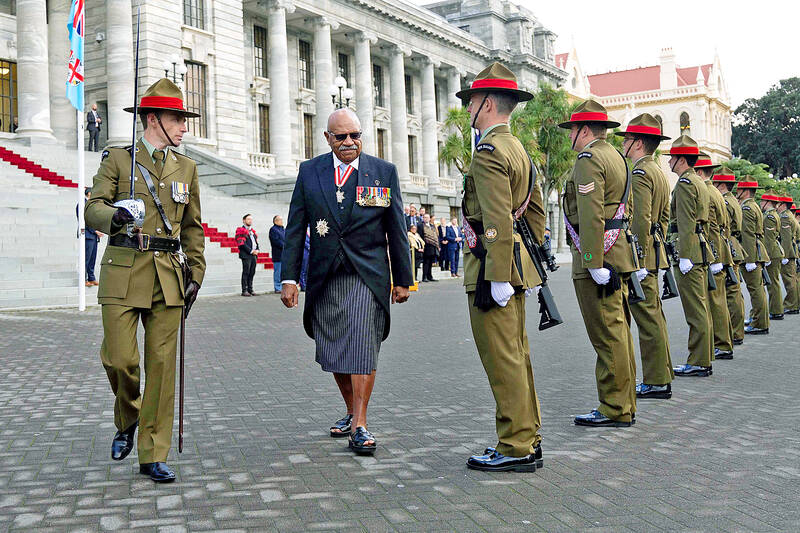
Photo: AFP
It comes as the US, New Zealand and Australia push to build stronger security ties with Pacific nations, as they attempt to offer an alternative to China’s growing influence in the region. Last month the US and Papua New Guinea signed a defense and maritime cooperation agreement.
Last year, the Solomon Islands signed a security pact with China, but Beijing failed to secure a broader regional security deal.
“Beijing’s success in signing the China-Solomon Islands security deal last year has kind of put a chill on other Pacific Island nations doing the same, especially if not balanced by deals with Australia, New Zealand or the United States,” said Derek Grossman, a senior defense analyst at the US think tank RAND Corporation.
Last week, Fijian Prime Minister Sitiveni Rabuka signaled the country’s intention to shift away from a policing agreement reached with China more than a decade ago, that had been suspended since he came into office in January.
During a visit to Wellington, Rabuka said the 2011 agreement was under review.
“If our systems and our values differ, what cooperation can we get from them? We need to look at that again before we decide whether we go back to it, or if we continue the way that we have in the past by cooperating with those who have similar democratic values and systems,” Rabuka reportedly said in Wellington last week.
Under the policing agreement, China provided training as well as supplies to support Fijian police forces.
Donations from China to Fiji included anti-riot gear, traffic command vehicles, office equipment, radio communication equipment, fiberglass, rubber boats for rescue operations and other materials.
Police officers from China were deployed to Fiji on attachment programs for periods of three to six months, the Fijian police force said in 2021, although it was not immediately clear where they were stationed.
In 2018, a small group of Fijian police officers were also trained in China on drug-trafficking cases, Chinese state media reported.
Fiji’s move toward canceling its policing agreement with China was in part due to a desire to “prioritize working with like-minded democratic nations like New Zealand and Australia,” Grossman said.
He added that the Fiji-New Zealand defense deal “will allow Kiwi forces to add capacity to Fiji and expose Suva to new technologies and enhance interoperability.”
Samantha Custer, director of policy at the University of William and Mary’s AidData China Research program, said that Fiji’s moves to distance itself from Beijing might have wider repercussions in the region.
“The buyer’s remorse we see playing out in Fiji right now may spread to other parts of the region in future as countries rethink the trade-offs of their security cooperation agreements and training with the PRC [People’s Republic of China],” she said.


Through the noise of rushing papers and whirring belts at a print factory in Kyoto, two creators watch their photo essay come to life in broadsheet form — part of an effort to win new audiences in the age of artificial intelligence (AI). Despite the decline of the publishing industry, self-publication and handmade “zine” magazines are growing in popularity in Japan, reflecting the nation’s enduring love of paper in the digital era. While speaking to Agence France-Presse at the plant, his hands black with ink, one of the creators, Kazuma Obara, said: “I think [paper] is a medium that engages all five
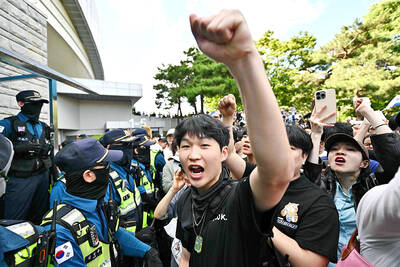
‘ABSURD MISTAKE’: The election commission said that there had been a failure to anticipate turnout after 14 polling stations ran short of ballot papers South Korean riot police yesterday cleared protesters from a Seoul polling station after a 35-hour blockade sparked by a shortage of ballot papers during local elections earlier this week. Wednesday’s election was the first nationwide vote since South Korean President Lee Jae-myung took office following the ouster of Yoon Suk-yeol over his short-lived martial law declaration. Lee’s ruling Democratic Party swept most races, but failed to flip the crucial Seoul mayoral seat. The South Korean National Election Commission apologized, blaming a failure to anticipate turnout after 14 polling stations in Seoul ran short of ballot papers. Some polling stations stayed open until 10pm to

France experienced its hottest spring on record, the French weather service said on Tuesday, after an exceptional early heat wave that also broke highs for the season in England and Wales. Meteo-France said the average nationwide temperature over March to May was 13.8°C — about 1.7°C above the norm, and surpassing records set in 2011 and 2020. “The warmest spring since records began in 1900,” it said in a bulletin. All three months were warmer than average, but the onset of an “unprecedented heatwave” late last month pushed the mercury to highs typically seen at the height of the summer. “Our country had never
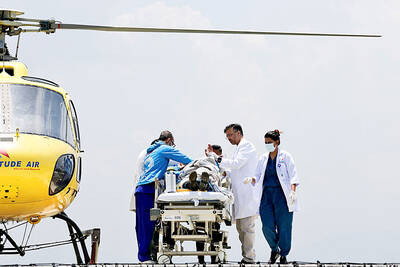
A Sherpa guide was found crawling to base camp on Mount Everest a week after he went missing and was reunited with his family, who had given up hope he would return. Dawa Sherpa was last seen on Friday last week descending the mountain, but he did not reach base camp even though his client did. The pair were among the last climbers on the mountain as the climbing season came to an end and the route was dismantled. Dawa was located by a cleaning crew on Thursday morning as he was crawling down the snowy slopes around the Khumbu Icefall, just above


 RSS
RSS