


Scaling Mount Everest is always dangerous, but expedition organizers have said that a combination of extreme weather, corner-cutting on safety, and inexperienced and “impatient” foreign climbers has resulted in one of the peak’s deadliest mountaineering seasons.
As the last search-and-rescue teams hang up their boots, and the tent city at base camp packs up for the year, expert climbers said several of the 17 people killed or missing and presumed dead this season could have avoided disaster.
“This season was very bad overall,” said Imagine Nepal Trek and Expedition organizer Mingma Gyalje Sherpa, whose team was responsible for opening the route to the summit.
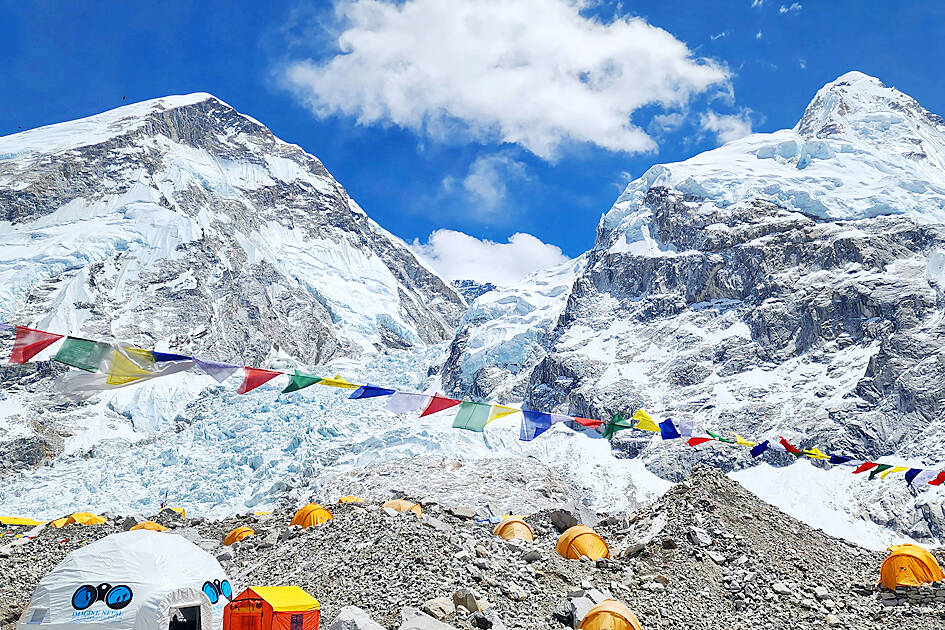
Photo: AFP
“The main reason is that the weather was extremely cold ... but there was also carelessness,” he said.
Higher death numbers were recorded in past seasons, but those tolls included several killed in single large-scale disasters.
In 2014, 16 Nepalese guides were killed by an avalanche, with climbing closed for the rest of the season.
The deadliest season was in 2015, when at least 18 people died in an earthquake that also killed about 9,000 people across Nepal.
This season, 12 people died and five others went missing.
Ten of them were foreigners, the highest such toll on record, as well as seven Nepalese: guides, mountain workers and a climber.
About five climbers die each year on the oxygen-starved paths to the 8,849m icy peak.
Some have said too many foreign mountaineers are ill-prepared for what remains a major test of body and soul.
Nepal issued a record 478 permits for foreign clients this season, with about 600 climbers and guides reaching the top, prompting some to suggest there is a need to cut numbers.
The guides said the mountain was the coldest they have ever experienced, with freezing temperatures far lower than usual adding to the danger.
“It should already have been warm, around minus-28°C,” Mingma Gyalje Sherpa said. “This year it was even down to minus-40°C.”
Climate change is dramatically altering weather patterns and causing extreme fluctuations in temperature, but scientists caution against linking individual events directly to global heating without evidence.
Three of Mingma Gyalje Sherpa’s route-opening team — Dawa Tseri, Pemba Tenzing and Lakpa Rita Sherpa — died after falling off ropes at Camp 2 when a serac ice block fell and buried them in the Khumbu icefall.
As the season progressed, more climbers died or were reported missing in the icy heights.
Several others suffered frostbite and infections related to high-altitude pulmonary edema, when liquid accumulates in air spaces of the lungs.
The freezing weather and high winds meant many Nepalese guides and porters suffered frostbite early in the season, Mingma Gyalje Sherpa said.
That had a knock-on effect, especially for equipping higher-altitude camps.
“It meant that Camp 4 was not prepared enough and not all supplies reached there ... but clients were impatient and climbing began,” he said.
“I think some of the casualties could have been prevented if all the supplies were there,” he added.
The rapid growth of the climbing industry has created fierce competition among companies for business, raising fears that some are cutting corners on safety.
Austria-based Furtenbach Adventures founder Lukas Furtenbach said that a majority of the deaths could have been avoided “with mandatory safety standards.”
“These accidents do all have a similar pattern,” Furtenbach said.
ROCKY RELATIONS: The figures on residents come as Chinese tourist numbers drop following Beijing’s warnings to avoid traveling to Japan The number of Chinese residents in Japan has continued to rise, even as ties between the two countries have become increasingly fractious, data released on Friday showed. As of the end of December last year, the number of Chinese residents had increased by 6.5 percent from the previous year to 930,428. Chinese people accounted for 22.6 percent of all foreign residents in Japan, making them by far the largest group, Japanese Ministry of Justice data showed. Beijing has criticized Tokyo in increasingly strident terms since Japanese Prime Minister Sanae Takaichi last year suggested that a military conflict around Taiwan could
A pro-Iran hacking group claimed to breach FBI Director Kash Patel’s personal e-mail inbox and posted some of the contents online. The e-mails provided by the hacking group include travel details, correspondence with leasing agents in Washington and global entry, and loyalty account numbers. The e-mail address the hackers claim to have compromised has been previously tied to Patel’s personal details, and the leaked e-mails contain photos of Patel and others, in addition to correspondence with family members and colleagues. “The FBI is aware of malicious actors targeting Director Patel’s personal email information,” the agency said in a statement on

RIVALRY: ‘We know that these are merely symbolic investigations initiated by China, which is in fact the world’s most profligate disrupter of supply chains,’ a US official said China has started a pair of investigations into US trade practices, retaliating against similar probes by US President Donald Trump’s administration as the superpowers stake out positions before an expected presidential summit in May. The move, announced by the Chinese Ministry of Commerce on Friday, is a direct mirror of steps Trump took to revive his tariff agenda after the US Supreme Court last month struck down some of his duties. “China expresses its strong dissatisfaction and firm opposition to these actions,” a ministry spokesperson said in a statement, referring to the so-called Section 301 investigations initiated on March 11.
When a hiker fell from a 55m waterfall in wild New Zealand bush, rescuers were forced to evacuate the badly hurt woman without her dog, which could not be found. After strangers raised thousands of dollars for a search, border collie Molly was flown to safety by a helicopter pilot who was determined to reunite the pet and the owner. A week earlier, an emergency rescue helicopter found the woman with bruises and lacerations after a fall at a rocky spot at the waterfall on the South Island’s West Coast. She was airlifted on March 24, but they were forced to


 RSS
RSS