


On a boat off the coast of an island near Abu Dhabi, marine scientist Hamad al-Jailani feels the corals, picked from the reef nursery and packed in a box of seawater, and studies them carefully, making sure they have not lost their color.
The corals were once bleached. Now they are big, healthy and ready to be moved back to their original reefs in the hope that they will thrive once more.
“We try to grow them from very small fragments up to — now some of them have reached — the size of my fist,” said al-Jailani, who is a member of Environment Agency Abu Dhabi’s (EAD) coral restoration program.

Photo: AP
The nursery gives corals the ideal conditions to recover: clear waters with strong currents and the right amount of sunlight.
Al-Jailani periodically checks the corals’ growth, removes any potentially harmful seaweed and seagrass, and even lets the fish feed off the corals to clean them, until they are healthy enough to be relocated.
The EAD has been rehabilitating and restoring corals since 2021, when reefs off the United Arab Emirates’ (UAE) coast faced their second bleaching event in just five years.
EAD’s project is one of many initiatives — public and private — across the country to protect the reefs and marine life that depend on them, in a nation that has come under fire for its large-scale developments and polluting industries that cause harm to underwater ecosystems.
There has been some progress, but experts remain concerned for the future of the reefs in a warming world.
Coral bleaching occurs when sea temperatures rise and sun glares flush out algae that give the corals their color, turning them white. Corals can survive bleaching events, but cannot effectively support marine life, threatening the populations that depend on them.
The UAE lost up to 70 percent of its corals, especially around Abu Dhabi, in 2017 when water temperatures reached 37°C, the EAD said.
However, al-Jailani said that 40 to 50 percent of corals survived the second bleaching event in 2021.
Although the bleaching events “did wipe out a good portion of our corals,” he said, “it did also prove that the corals that we have are actually resilient [and] can actually withstand these kind of conditions.”
Bleaching events are happening more frequently around the world as waters warm due to human-induced climate change, caused by the burning of oil, coal and gas that emit heat-trapping gases into the atmosphere.
Other coral reef systems around the world have suffered mass bleaching events, most notably Australia’s Great Barrier Reef.
How to limit global warming and its effects is to be discussed at length at the UN climate conference, which would be held in Dubai this year.
The UAE is one of the world’s largest oil producers and has some of the highest per capita carbon dioxide emissions globally.
The country has pledged to have net zero carbon emissions by 2050, which means all carbon dioxide emissions are either slashed or canceled out, but the goal has been met with skepticism from analysts.
However, bleaching due to warming weather is not the only threat to coral reefs around the gulf. High oil tanker traffic, fossil-fuel related activities, offshore installations and the exploitation of marine resources are putting marine life under intense stress, causing them to degrade, the UN Environment Programme said.
Environmentalists have long criticized the UAE, and Dubai in particular, for its large-scale buildings and huge coastal developments.
The building of the Palm Jebel Ali, which began more than a decade ago and has been on hold since 2008, caused an outcry among conservationists after it reportedly destroyed about 8 square kilometers of reef.

Crowds in Bangladesh are flocking to snap photographs with an unlikely social media star — an albino buffalo with flowing blond hair nicknamed “Donald Trump” that is due to be sacrificed within days. Owner Zia Uddin Mridha, 38, said his brother named the 700kg bull over its flowing helmet of hair resembling the signature look of the US president. “My younger brother picked this name because of the buffalo’s extraordinary hair,” he said at his farm in Narayanganj, just outside the capital, Dhaka. Mridha said that a constant stream of curious visitors — social media fans, onlookers and children — have come throughout

It began as a satirical online project. Now millions of young people in India are flocking to it as an outlet for their frustration. A parody political party called the Cockroach Janta Party, with the insect as its symbol, has exploded across India’s social media by turning absurdist humor into protest. Memes and short videos mocking corruption, joblessness and political dysfunction have flooded social media sites, where millions of users are embracing the cockroach — known for its ability to survive harsh conditions — as a tongue-in-cheek symbol of endurance. The online movement’s rise has been unusually rapid. The Cockroach Janta Party (CJP)

BIGGER ROLE: Beijing has said it maintains an impartial stance on the war in Ukraine, but by training Russian troops, China is far more involved than previously known China’s armed forces secretly trained about 200 Russian military personnel in China late last year, and some have since returned to fight in Ukraine, according to three European intelligence agencies and documents seen by Reuters. While China and Russia have held a number of joint military exercises since Moscow’s full-scale invasion of Ukraine in 2022, Beijing has repeatedly said that it is neutral in the conflict and presents itself as a peace mediator. The covert training sessions, which predominantly focused on the use of drones, were outlined in a dual-language Russian-Chinese agreement signed by senior Russian and Chinese officers in Beijing on
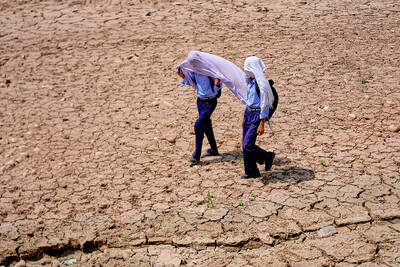
HOTTER: While Indians are accustomed to summer heat, climate change has caused northwestern India to warm faster than other parts of the country, an academic said Roads and markets have emptied during afternoons and some farmers have switched to nighttime work to avoid scorching temperatures as a heat wave grips large parts of India. The India Meteorological Department forecast maximum temperatures for yesterday of about 45°C in the capital, New Delhi, where authorities have opened temporary “cooling zones” to help people cope. The weather department warned that conditions would likely persist across several northern regions in the coming days, with temperatures staying well above seasonal averages. Authorities urged people to stay indoors during the hottest hours and take precautions against heat-related illnesses. India declares a heat wave whenever maximum temperatures


 RSS
RSS