


Francoise Gilot, a prolific and acclaimed painter who produced art for more than half a century, but was nonetheless more famous for her turbulent relationship with Pablo Picasso — and for leaving him — died on Tuesday in New York City, where she had lived for decades.
She was 101.
Gilot’s daughter Aurelia Engel told reporters that her mother had died at Mount Sinai West hospital after lung and heart problems.

Photo: AFP
“She was an extremely talented artist, and we will be working on her legacy and the incredible paintings and works she is leaving us with,” Engel said.
The French-born Gilot had long made her frustration clear that despite acclaim for her art, which she produced from her teenage years until five years ago, she would still be best known for her relationship with the older and more famous Picasso, whom she met in 1943 at age 21, his junior by four decades.
The union produced two children — Claude and Paloma Picasso.
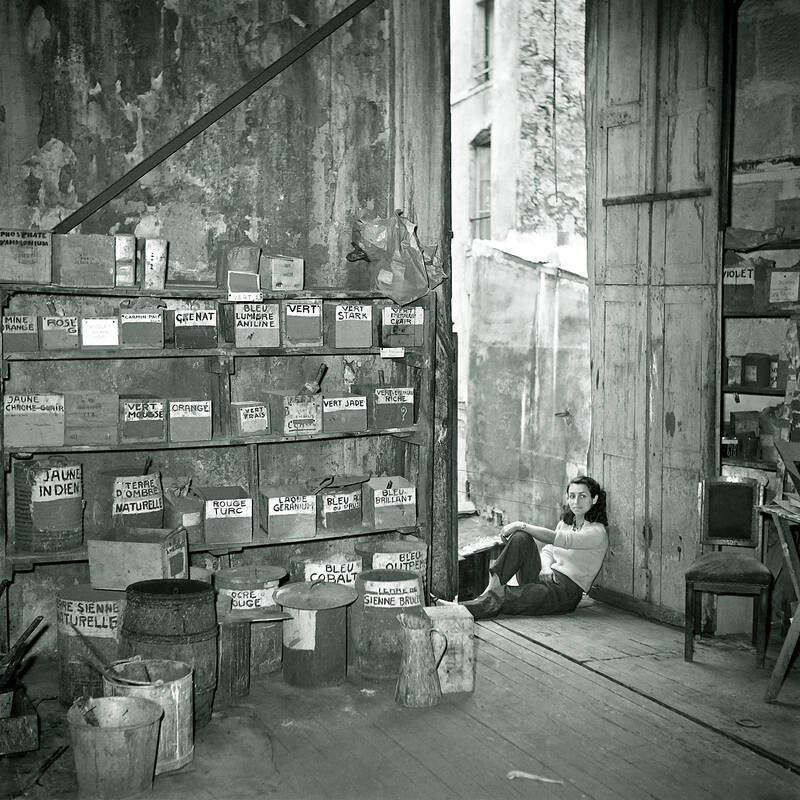
Photo: AFP
However, unlike the other key women in Picasso’s life — wives or paramours — Gilot eventually walked out.
“He never saw it coming,” Engel said of her mother’s departure. “She was there because she loved him and because she really believed in that incredible passion of art which they both shared, [but] she came as a free, though very, very young, but very independent person.”
Gilot herself told the Guardian in 2016 that “I was not a prisoner” in the relationship.
“I’d been there of my own will and I left of my own will,” she said, then 94. “That’s what I told him once, before I left. I said: ‘Watch out, because I came when I wanted to, but I will leave when I want.’ He said: ‘Nobody leaves a man like me.’ I said: ‘We’ll see.’”
Born on Nov. 26, 1921, in leafy Neuilly-sur-Seine in suburban Paris, Gilot was an only child.
“She knew at the age of five that she wanted to be a painter,” Engel said.
In accordance with her parents’ wishes, she studied law while maintaining art as her true passion. She first exhibited her paintings in 1943.
That was the year she met Picasso when she and a friend visited a restaurant on the Left Bank, amid a gathering that included his then-companion, Dora Maar.
“I was 21 and I felt that painting was already my whole life,” she wrote in Life With Picasso.
When Picasso asked Gilot and her friend what they did, the friend responded that they were painters, to which Picasso responded, Gilot wrote: “That’s the funniest thing I’ve heard all day. Girls who look like that can’t be painters.”
The two were invited to visit Picasso in his studio and the relationship soon began.
Not long after leaving Picasso in 1953, Gilot reunited with a former friend, artist Luc Simon, and married him in 1955. They had a daughter — Engel — and divorced in 1962. In 1970, Gilot married Jonas Salk, an American virologist and researcher famed for his work with the polio vaccine, and began living between California and Paris, and later New York.
When he died in 1995, Gilot moved full-time to New York.
In 2021 her Paloma a la Guitare (1965) sold for US$1.3 million at a Sotheby’s auction.
Engel said that although the relationship with Picasso was clearly a difficult one, it gave her mother a certain freedom from her parents and the constraints of a bourgeois life — and perhaps enabled her to pursue her true dream of being a professional painter, a passion she shared with Picasso above all else.
“They both believed that art was the only thing in life worth doing,” she said. “And she was able to be her true self, even though it was not an easy life with him, but still she was able to be her true self.”
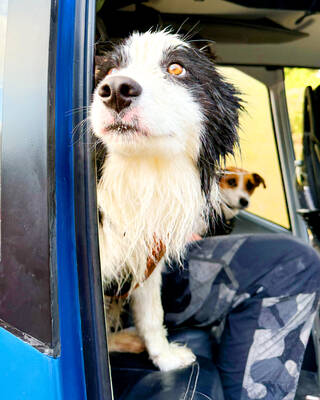
When a hiker fell from a 55m waterfall in wild New Zealand bush, rescuers were forced to evacuate the badly hurt woman without her dog, which could not be found. After strangers raised thousands of dollars for a search, border collie Molly was flown to safety by a helicopter pilot who was determined to reunite the pet and the owner. A week earlier, an emergency rescue helicopter found the woman with bruises and lacerations after a fall at a rocky spot at the waterfall on the South Island’s West Coast. She was airlifted on March 24, but they were forced to
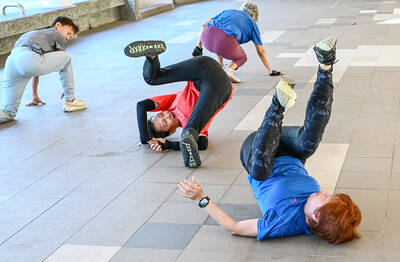
CONFIDENCE BOOSTER: ’After parkour ... you dare to do a lot of things that you think only young people can do,’ a 67-year-old parkour enthusiast said In a corner of suburban Singapore, Betty Boon vaults a guardrail, crawls underneath a slide, executes forward shoulder rolls and scales a steep slope, finishing the course to applause. “Good job,” the 69-year-old’s coach cheers. This is “geriatric parkour,” where about 20 retirees learned to tackle a series of relatively demanding exercises, building their agility and enjoying a sense of camaraderie. Boon, an upbeat grandmother, said learning parkour has aided her confidence and independence as she ages. “When you’re weak, you will be dependent on someone,” she said after sweating it out with her parkour classmates in suburban Toa Payoh,

Chinese dissident artist Gao Zhen (高兟), famous for making provocative satirical sculptures of former Chinese leader Mao Zedong (毛澤東), was tried on Monday over accusations of “defaming national heroes and martyrs,” his wife and a rights group said. Gao, 69, who was detained in 2024 during a visit from the US, faces a maximum three-year prison sentence, said his wife, Zhao Yaliang (趙雅良), and Shane Yi, a researcher at the Chinese Human Rights Defenders group which operates outside the nation. The closed-door, one-day trial took place at Sanhe City People’s Court in Hebei Province neighboring the capital, Beijing, and ended without a

‘TOXIC CLIMATE’: ‘I don’t really recognize Labour anymore... The idea that you can implement far-right ideas in order to stop the far right is nonsense,’ a protester said Tens of thousands of people on Saturday marched through central London to protest against the far right, weeks ahead of local elections and six months after Britain saw one of its largest far-right demonstrations. Organized by hundreds of civic groups, including trade unions, anti-racism campaigners and Muslim representative bodies, Saturday’s Together Alliance event was billed as the biggest in UK history to counter right-wing extremism. A separate pro-Palestinian march had also converged with the main rally. While organizers claimed 500,000 had turned out in total, the police gave a figure of about 50,000. Protesters carrying placards with slogans such as


 RSS
RSS