


US President Joe Biden and congressional leaders confronted each other on the debt limit impasse on Tuesday, ending their meeting with no breakthrough, but agreeing to meet again this week to try to avert the looming risk of an unprecedented government default.
Speaking at the White House, Biden described the talks as “productive,” even though House of Representatives Speaker Kevin McCarthy said after the high-stakes Oval Office meeting that he “didn’t see any new movement” toward resolving the stalemate.
Lawmakers and their staffs were to continue discussions on the annual federal budget at Biden’s encouragement. Biden and the congressional leaders are to meet again tomorrow.
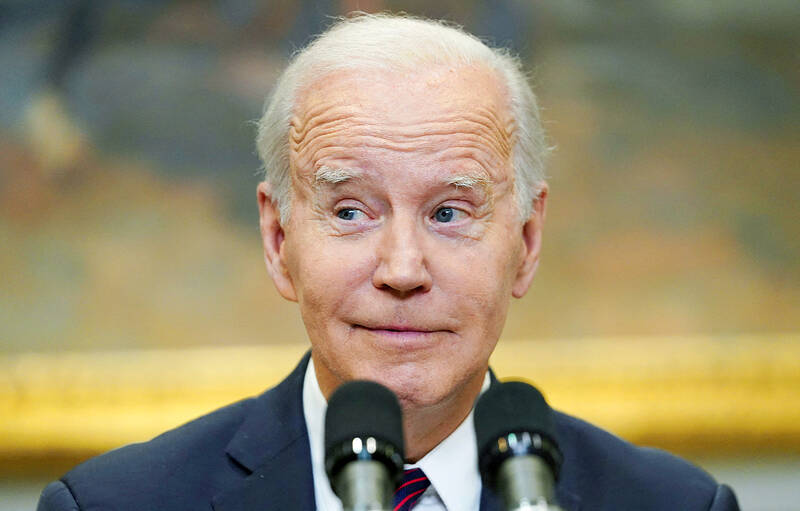
Photo: Reuters
After the hour-long discussion in the Oval Office, Biden said he was “absolutely certain” that the country could avert a default, declaring that failure to meet the US’ obligations “is not an option.”
Still, time is short. The government is bumping up against its legal limit for borrowing and would not be able to pay all of its bills as soon as June 1 if the US Congress does not agree to raise the debt ceiling. That failure would send the country into default with wide-reaching economic impact at home and around the world.
Republicans came to the White House hoping to negotiate sweeping cuts to federal spending in exchange for allowing new borrowing to avoid default. Biden, on the other hand, reinforced his opposition to allowing the country’s full faith and credit to be held “hostage” to negotiations — while affirming his willingness to hold talks on the budget only after default is no longer a threat.
“I told congressional leaders that I’m prepared to begin a separate discussion about my budget, spending priorities, but not under the threat of default,” Biden said.
Outside the White House, McCarthy said: “I asked the president this simple question: Does he not believe there’s any place we could find savings?”
As the president welcomed McCarthy, House Minority Leader Hakeem Jeffries, Senate Majority Leader Chuck Schumer and Senate Minority Leader Mitch McConnell, he quipped to reporters: “We’re going to get started, solve all the world’s problems.”
Biden later described the meeting’s tone as “very measured and low-key,” adding: “Occasionally there would be a little bit of an assertion that maybe was a little over the top from the speaker.”
He especially took issue with McCarthy’s branding as a lie the Democrats’ assertion that the Republicans’ budget restraints would hurt veterans.
Still, Biden added: “I trust Kevin will try to do what he says.”
There seemed to be at least a bit of daylight between McConnell, who has let his House counterpart take the lead in negotiations and backed him up ahead of the White House meeting, and McCarthy.
The Senate leader said: “The United States is not going to default. It never has and it never will.”
The speaker, though, simply said: “I’ve done everything in my power to make sure we will not default.”
Democrats said there is room to “come together” on spending cuts as part of the budget process, but quickly jumped on McCarthy’s refusal to rule out the possibility of default, with Schumer saying the Republican is “greatly endangering America.”
“To use the risk of default, with all the dangers that has for the American people, as a hostage and say it’s my way or no way, are mostly my way or no way, is dangerous,” Schumer said.

An American scientist convicted of lying to US authorities about payments from China while he was at Harvard University has rebuilt his research lab in Shenzhen, China, to pursue technology the Chinese government has identified as a national priority: embedding electronics into the human brain. Charles Lieber, 67, is among the world’s leading researchers in brain-computer interfaces. The technology has shown promise in treating conditions such as amyotrophic lateral sclerosis and restoring movement in paralyzed people. It also has potential military applications: Scientists at the Chinese People’s Liberation Army have investigated brain interfaces as a way to engineer super soldiers by boosting

Indonesian police have arrested 13 people after shocking images of alleged abuse against small children at a daycare center went viral, sparking outrage across the nation, officials said on Monday. Police on Friday last week raided Little Aresha, a daycare center in Yogyakarta on Java island, following a report from a former employee. CCTV footage circulating on social media showed children, most younger than two, lying on the floor wearing only diapers, their hands and feet bound with rags. The police have confirmed that the footage is authentic. Police said they also found 20 children crammed into a room just 3m by 3m. “So

A grieving mother has ended her life at a clinic in Switzerland four years after the death of her only child. Wendy Duffy, 56, a physically healthy woman, died at the Pegasos clinic in Basel after struggling to cope with the death of her 23-year-old son, Marcus. The former care worker, from the West Midlands, England, had previously attempted to take her own life. The case comes as assisted dying would not become law in England and Wales after proposed legislation, branded “hopelessly flawed” by opponents, ran out of time. Ruedi Habegger, the founder of Pegasos, described Duffy’s death as

From post offices and parks to stations and even the summit of Mount Fuji, Japan’s vending machines are ubiquitous, but with the rapid pace of inflation cooling demand for their drinks, operators are being forced to rethink the business. Last month beverage giant DyDo Group Holdings announced it would remove about 20,000 vending machines — about 7 percent of their stock nationwide — by January next year, to “reconstruct a profitable network.” Pokka Sapporo Food & Beverage, based in Nagoya, also said last month it would sell its 40,000-machine operation to Osaka-based Lifedrink Co. “The strength of the vending machine


 RSS
RSS