


Singapore’s top diplomat yesterday expressed “grave concern” over altercations in the South China Sea following a near collision between Chinese and Philippine vessels in the highly contested region.
Singaporean Minister for Foreign Affairs Vivian Balakrishnan said his government wants all nations, including superpowers, to work together to ensure “free access and opportunities” in Southeast Asia and its sea lanes.
“So obviously we do view any altercations, conditions for incidents at sea, with grave concern,” he told reporters in Canberra.
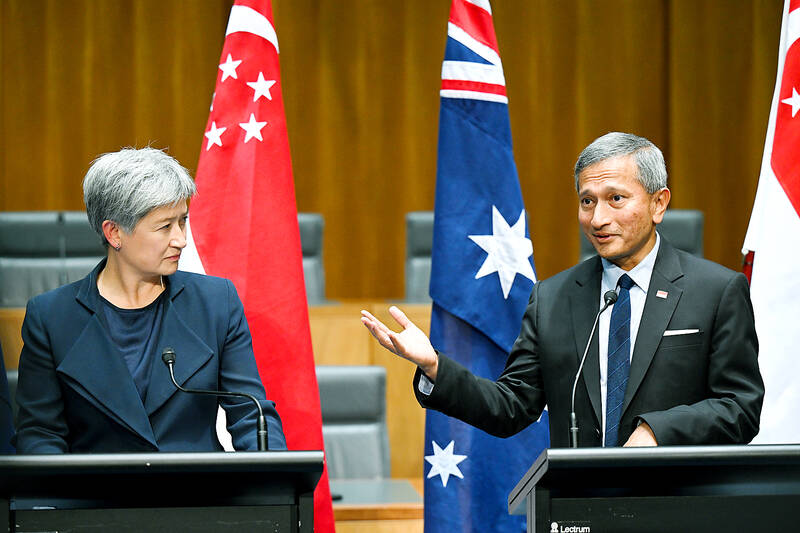
Photo: EPA-EFE
Tensions have escalated in recent months between China and the Philippines over the South China Sea. Two China Coast Guard vessels blocked Philippine patrol boats near the Second Thomas Shoal (Renai Shoal, 仁愛暗沙) on April 23. Beijing and Manila both defended the actions of their vessels.
Balakrishnan said that it was important to “head off these situations” and emphasized the importance of ASEAN’s ongoing negotiations for a code of conduct in the South China Sea.
“It will not resolve the disputes over sovereignty, but it can help build confidence,” he said.
Balakrishnan was speaking at a news conference with Australian Minister for Foreign Affairs Penny Wong (黃英賢) following an annual meeting of the Singapore-Australia Joint Ministerial Committee.
He gave some of his strongest comments yet in support of the AUKUS agreement, a security partnership between Australia, the US and the UK, which could see Canberra operating a fleet of nuclear submarines as early as the 2030s.
As long as the AUKUS agreement contributed “constructively” to regional security, Singapore would support it, Balakrishnan said.
He said he hoped the US and China could stabilize their relationship to “maximize the options for all of us.”
“That would give all of us much relief and a sense of stability,” he said.

Philippine President Ferdinand Marcos Jr has fired his national police chief, who gained attention for leading the separate arrests of former Philippine president Rodrigo Duterte on orders of the International Criminal Court and televangelist Apollo Carreon Quiboloy, who is on the FBI’s most-wanted list for alleged child sex trafficking. Philippine Executive Secretary Lucas Bersamin did not cite a reason for the removal of General Nicolas Torre as head of the 232,000-member national police force, a position he was appointed to by Marcos in May and which he would have held until 2027. He was replaced by another senior police general, Jose
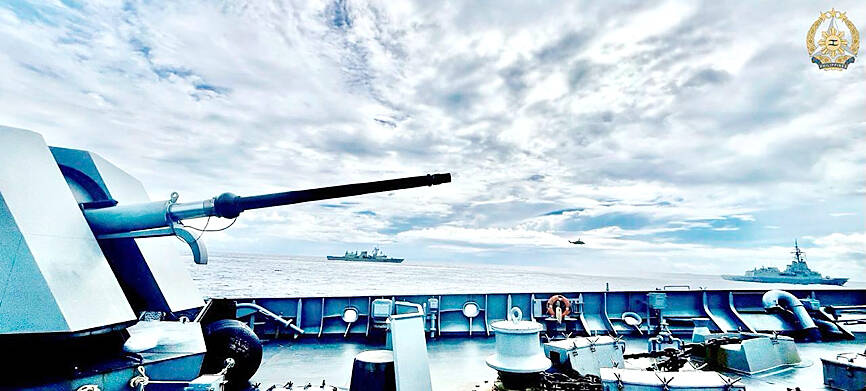
STILL AFLOAT: Satellite images show that a Chinese ship damaged in a collision earlier this month was under repair on Hainan, but Beijing has not commented on the incident Australia, Canada and the Philippines on Wednesday deployed three warships and aircraft for drills against simulated aerial threats off a disputed South China Sea shoal where Chinese forces have used risky maneuvers to try to drive away Manila’s aircraft and ships. The Philippine military said the naval drills east of Scarborough Shoal (Huangyan Island, 黃岩島) were concluded safely, and it did not mention any encounter with China’s coast guard, navy or suspected militia ships, which have been closely guarding the uninhabited fishing atoll off northwestern Philippines for years. Chinese officials did not immediately issue any comment on the naval drills, but they

POWER CONFLICT: The US president threatened to deploy National Guards in Baltimore. US media reports said he is also planning to station troops in Chicago US President Donald Trump on Sunday threatened to deploy National Guard troops to yet another Democratic stronghold, the Maryland city of Baltimore, as he seeks to expand his crackdown on crime and immigration. The Republican’s latest online rant about an “out of control, crime-ridden” city comes as Democratic state leaders — including Maryland Governor Wes Moore — line up to berate Trump on a high-profile political stage. Trump this month deployed the National Guard to the streets of Washington, in a widely criticized show of force the president said amounts to a federal takeover of US capital policing. The Guard began carrying

Ukrainian drone attacks overnight on several Russian power and energy facilities forced capacity reduction at the Kursk Nuclear Power Plant and set a fuel export terminal in Ust-Luga on fire, Russian officials said yesterday. A drone attack on the Kursk nuclear plant, not far from the border with Ukraine, damaged an auxiliary transformer and led to 50 percent reduction in the operating capacity at unit three of the plant, the plant’s press service said. There were no injuries and a fire sparked by the attack was promptly extinguished, the plant said. Radiation levels at the site and in the surrounding


 RSS
RSS