


Simon Abney-Hastings, the son of a farmhand from the Australian outback, might be an unlikely choice to receive an invitation to King Charles III’s coronation at Westminster Abbey next week, but he is the one person other than those in the line of succession who could actually have a claim on the throne.
Unlikely though it might seem, the scenario is based on research by British medieval historian Michael Jones.
Two decades ago he uncovered a document in Rouen Cathedral in France which he says is proof that King Edward IV was illegitimate.
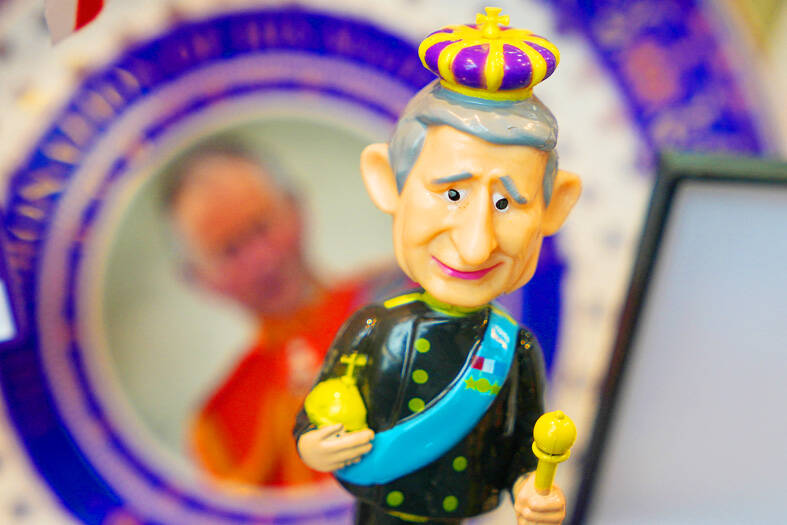
Photo: Reuters
During the five weeks when Edward might have been conceived, his father, Richard of York, was 160km from his wife, Cecily Neville, the Duchess of York, Jones says.
As a result, Jones says that Edward was not the rightful heir to the throne, and the line of succession should instead have gone through Edward’s younger brother, George, the Duke of Clarence, who is a direct ancestor of Abney-Hastings.
Although the family do not possess any lands or stately homes in the UK, by virtue of their lineage they inherited the ancient Scottish title of Earl of Loudoun.
Abney-Hastings’ father, Michael Abney-Hastings, emigrated from the UK to Australia in 1960.
Michael inherited the title from his mother, the 13th Countess of Loudoun, in 2002 and it passed on his death in 2012 to his son, who is the 15th earl.
In recognition of the family’s heritage, Simon Abney-Hastings, 48, is one of just 13 individuals carrying out ceremonial roles largely because they successfully proved that their forebears played a particular role at previous coronations.
The earls of Loudon have traditionally been the bearers of the golden spurs as far back as the 12th century.
In earlier centuries the spurs — signifying the monarch’s role as head of the armed forces — were attached to the new sovereign’s feet. In more recent times they have just ceremonially touched the heels of the monarch before being placed on the altar.
The surprising implications of the Rouen Cathedral discovery came as a shock to the Abney-Hastings family nearly 20 years ago.
A British documentary team visited an unsuspecting Michael Abney-Hastings at his home in Australia for the 2004 program Britain’s Real Monarch.
To the amusement of his family, they were told that new research pointed to Edward IV being illegitimate, which “means that you are the rightful king of England.”
Michael Abney-Hastings responded that he had been aware of a “distant” link to the Plantagenet royal dynasty, but said that the news that he might have been King Michael I was “a bit of a shock.”
An Australian, Simon Abney-Hastings lives in Wangaratta in the southeastern state of Victoria, and appears to have no plans to press any claim.
His lawyer and private secretary Terence Guthridge said that although historians might believe he has the right to inherit the throne, the 15th earl “has never held this view.”
He has always been a “loyal and staunch supporter” of both Queen Elizabeth II and her son, Guthridge said.
“Indeed, they exchange birthday or Christmas cards every year,” he added.

When a hiker fell from a 55m waterfall in wild New Zealand bush, rescuers were forced to evacuate the badly hurt woman without her dog, which could not be found. After strangers raised thousands of dollars for a search, border collie Molly was flown to safety by a helicopter pilot who was determined to reunite the pet and the owner. A week earlier, an emergency rescue helicopter found the woman with bruises and lacerations after a fall at a rocky spot at the waterfall on the South Island’s West Coast. She was airlifted on March 24, but they were forced to
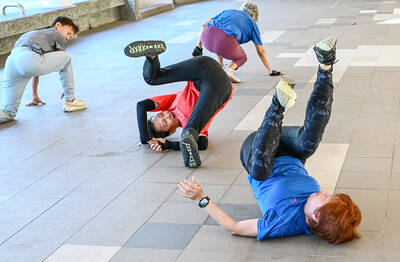
CONFIDENCE BOOSTER: ’After parkour ... you dare to do a lot of things that you think only young people can do,’ a 67-year-old parkour enthusiast said In a corner of suburban Singapore, Betty Boon vaults a guardrail, crawls underneath a slide, executes forward shoulder rolls and scales a steep slope, finishing the course to applause. “Good job,” the 69-year-old’s coach cheers. This is “geriatric parkour,” where about 20 retirees learned to tackle a series of relatively demanding exercises, building their agility and enjoying a sense of camaraderie. Boon, an upbeat grandmother, said learning parkour has aided her confidence and independence as she ages. “When you’re weak, you will be dependent on someone,” she said after sweating it out with her parkour classmates in suburban Toa Payoh,

HIGH HOPES: The power source is expected to have a future, as it is not dependent on the weather or light, and could be useful for places with large desalination facilities A Japanese water plant is harnessing the natural process of osmosis to generate renewable energy that could one day become a common power source. The possibility of generating power from osmosis — when water molecules pass from a less salty solution to a more salty one — has long been known. However, actually generating energy from that has proved more complicated, in part due the difficulty of designing the membrane through which the molecules pass. Engineers in Fukuoka, Japan, and their private partners think they might have cracked it, and have opened what is only the world’s second osmotic power plant. It generates

Chinese dissident artist Gao Zhen (高兟), famous for making provocative satirical sculptures of former Chinese leader Mao Zedong (毛澤東), was tried on Monday over accusations of “defaming national heroes and martyrs,” his wife and a rights group said. Gao, 69, who was detained in 2024 during a visit from the US, faces a maximum three-year prison sentence, said his wife, Zhao Yaliang (趙雅良), and Shane Yi, a researcher at the Chinese Human Rights Defenders group which operates outside the nation. The closed-door, one-day trial took place at Sanhe City People’s Court in Hebei Province neighboring the capital, Beijing, and ended without a


 RSS
RSS