


As the sun sets on another scorching Yangon day, the hot and bothered descend on the Myanmar city’s parks, the coolest place to spend an evening during yet another power blackout.
A wave of exceptionally hot weather has blasted Southeast Asia this week, sending the mercury to 45°C and prompting thousands of schools to suspend in-person classes.
Even before the chaos and conflict unleashed by the military’s 2021 coup, Myanmar’s creaky and outdated electricity grid struggled to keep fans whirling and air conditioners humming during the hot season.
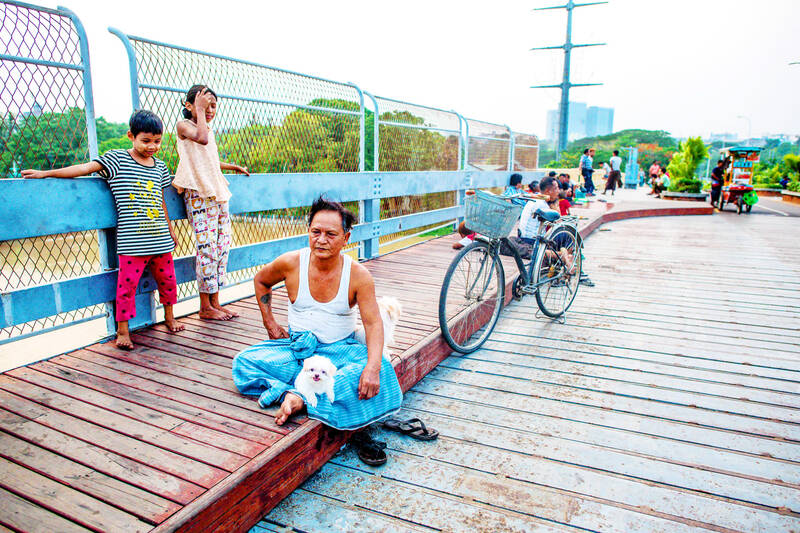
Photo: AFP
Now, infrastructure attacks and dwindling offshore gas reserves mean those who cannot afford expensive diesel generators must face at least eight hours daily at the mercy of the scorching heat.
For many in the city of about 8 million, relief comes only at night and outdoors with the metropolis’ parks offering natural shade and blissful breezes.
“My parents can’t stay inside their house in the afternoon. They have to go outside and sit under the shade of trees,” one Yangon resident said as she visited Inya Lake late on Friday.
She said her parents warn her about going outside, urging her to cover up.
“I feel this year is far hotter than last year,” she added.
Mya Aye, 62, said she comes to the park every day when the power goes off at 5pm.
“The weather at home is so hot that neither the children nor the elderly can stay,” she said.
Across swathes of Myanmar’s arid heartland day temperatures on Thursday were 3°C to 4°C higher than the April average, according to the Burmese Department of Meteorology and Hydrology.
In Chauk in Magway region, the temperature reached a blazing 45.9°C on Wednesday, the department said.
Back at Inya Lake, one man said that he and his family had traveled from the northern part of Yangon as they could not remain at home because of the heat.
“Even if we sit outside, the sun’s rays are very hot and we can’t sit anywhere,” he said.
“After 10am in the morning, it’s getting hotter and we can’t stand it,” he said, adding that older people were particularly affected.
“Elderly people are not going outside because of the heat and they just stay inside. After the sun is gone, they come out,” he said.
The frequent power outages only made the situation worse, he said, with homes emptying each evening.
“When there is a power blackout everyone sits out on the street until 9pm or 10pm,” he said.
Global temperatures hit record highs last year and the UN’s World Meteorological Organization said Asia was warming at a particularly rapid pace, with the effect of heatwaves in the region becoming more severe.

Kouri Richins, a Utah mother who published a children’s book about grief after the death of her husband is to serve a life sentence for his murder without the possibility of parole, a judge ruled on Wednesday. Richins was convicted in March of aggravated murder for lacing a cocktail given to her husband, Eric Richins, with five times the lethal dose of fentanyl at their home near Park City in 2022. A jury also found her guilty of four other felonies, including insurance fraud, forgery and attempted murder for trying to poison her husband weeks earlier on Feb. 14, 2022, with a

DELA ROSA CASE: The whereabouts of the senator, who is wanted by the ICC, was unclear, while President Marcos faces a political test over the senate situation Philippine authorities yesterday were seeking confirmation of reports that a top politician wanted by the International Criminal Court (ICC) had fled, a day after gunfire rang out at the Philippine Senate where he had taken refuge fearing his arrest. Senator Ronald “Bato” dela Rosa, the former national police chief and top enforcer of former Philippine president Rodrigo Duterte’s “war on drugs,” has been under Senate protection and is wanted for crimes against humanity, the same charges Duterte is accused of. “Several sources confirmed that the senator, Senator Bato, is no longer in the Senate premises, but we are still getting confirmation,” Presidential

HELP DENIED? The US Department of State said that the Cuban leadership refuses to allow the US to provide aid to Cubans, ‘who are in desperate need of assistance’ US Secretary of State Marco Rubio on Wednesday said that Cuba’s leadership must change, as Washington renewed an offer of US$100 million in aid if the communist nation agrees to cooperate. Cuba has been suffering severe economic tumult led by an energy shortage that plunged 65 percent of the country into darkness on Tuesday. Cuba’s leaders have blamed US sanctions, but Rubio, a Cuban American and critic of the government established by Fidel Castro, said the system was to blame, including corruption by the military. “It’s a broken, nonfunctional economy, and it’s impossible to change it. I wish it were different,” he told

Myanmar yesterday published a parliamentary bill proposing the death sentence for those who detain or violently coerce people into working in online scam centers. Internet fraud factories have flourished in Myanmar, part of Southeast Asia’s scam economy, targeting Internet users worldwide with romance and cryptocurrency investment cons. The multibillion-dollar black market attracts many willing employees, but repatriated foreigners have also reported being trafficked to sites in Myanmar and tortured by scam center operators. The draft legislation would allow capital punishment for “violence, torture, unlawful arrest and detention, or cruel treatment against another person for the purpose of forcing them to commit online scams.” The


 RSS
RSS