


Water could be more widespread and recent on Mars than previously thought, based on observations of Martian sand dunes by China’s rover.
The finding highlights new, potentially fertile areas in the warmer regions of Mars where conditions might be suitable for life to exist, although more study is needed.
Friday’s news comes days after mission leaders said that the Zhurong rover has yet to wake up since going into hibernation for the Martian winter nearly a year ago.

Photo: Reuters
Its solar panels are likely covered with dust, choking off its power source and possibly preventing it from operating again, said Zhang Rongqiao (張榮橋), the mission’s chief designer.
Before Zhurong fell silent, it observed salt-rich dunes with cracks and crusts, which researchers said were likely mixed with melting morning frost or snow as recently as a few hundred thousand years ago.
Their estimated date range for when the cracks and other dune features formed in Mars’ Utopia Planitia, a vast plain in the northern hemisphere: some time after 1.4 million to 400,000 years ago or even younger.
Conditions during that period were similar to now on Mars, with rivers and lakes dried up and no longer flowing as they did billions of years earlier.
Studying the structure and chemical makeup of these dunes can provide insights into “the possibility of water activity” during this period, the Beijing-based team wrote in a study published in Science Advances.
“We think it could be a small amount ... no more than a film of water on the surface,” coauthor Qin Xiaoguang (秦小光), of the Chinese Academy of Sciences’ Institute of Geology and Geophysics, said in an e-mail.
The rover did not detect any water in the form of frost or ice, but Qin said that computer simulations and observations by other spacecraft on Mars indicate that even now at certain times of year, conditions could be suitable for water to appear.
What is notable about the study is how young the dunes are, said Frederic Schmidt, a planetary geologist at the University of Paris-Saclay, who was not part of the study.
“This is clearly a new piece of science for this region,” he said.
Small pockets of water from thawing frost or snow, mixed with salt, likely resulted in the small cracks, hard crusty surfaces, loose particles and other dune features such as depressions and ridges, the Chinese scientists said.
They ruled out wind as a cause, as well as frost made of carbon dioxide, which makes up the bulk of Mars’ atmosphere.
Martian frost has been observed since NASA’s 1970s Viking missions, but these light dustings of morning frost were thought to occur in certain locations under specific conditions.
The rover has now provided “evidence that there may be a wider distribution of this process on Mars than previously identified,” said Mary Bourke, an expert in Mars geology at Trinity College Dublin.
However small this watery niche, it could be important for identifying habitable environments, she said.

An American scientist convicted of lying to US authorities about payments from China while he was at Harvard University has rebuilt his research lab in Shenzhen, China, to pursue technology the Chinese government has identified as a national priority: embedding electronics into the human brain. Charles Lieber, 67, is among the world’s leading researchers in brain-computer interfaces. The technology has shown promise in treating conditions such as amyotrophic lateral sclerosis and restoring movement in paralyzed people. It also has potential military applications: Scientists at the Chinese People’s Liberation Army have investigated brain interfaces as a way to engineer super soldiers by boosting

Indonesian police have arrested 13 people after shocking images of alleged abuse against small children at a daycare center went viral, sparking outrage across the nation, officials said on Monday. Police on Friday last week raided Little Aresha, a daycare center in Yogyakarta on Java island, following a report from a former employee. CCTV footage circulating on social media showed children, most younger than two, lying on the floor wearing only diapers, their hands and feet bound with rags. The police have confirmed that the footage is authentic. Police said they also found 20 children crammed into a room just 3m by 3m. “So

A highway bomb attack in a restive region of southwestern Colombia on Saturday killed 14 people and injured at least 38, the latest spate of violence ahead of next month’s presidential election. Authorities blamed the attack in the Cauca department — a conflict-ridden, coca-growing region — on dissidents of the now-disbanded FARC guerrilla army, who have been sowing violence across the country. “Those who carried out this attack ... are terrorists, fascists and drug traffickers,” Colombian President Gustavo Petro said on social media. “I want our very best soldiers to confront them,” he added. The leftist leader blamed the bombing
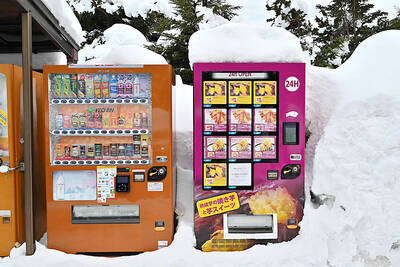
From post offices and parks to stations and even the summit of Mount Fuji, Japan’s vending machines are ubiquitous, but with the rapid pace of inflation cooling demand for their drinks, operators are being forced to rethink the business. Last month beverage giant DyDo Group Holdings announced it would remove about 20,000 vending machines — about 7 percent of their stock nationwide — by January next year, to “reconstruct a profitable network.” Pokka Sapporo Food & Beverage, based in Nagoya, also said last month it would sell its 40,000-machine operation to Osaka-based Lifedrink Co. “The strength of the vending machine


 RSS
RSS