


In a forest in southern Chile, a giant tree has survived for thousands of years and is in the process of being recognized as the oldest in the world.
Known as the “Great Grandfather,” the trunk of this tree measuring 4m in diameter and 28m tall is also believed to contain scientific information that could shed light on how the planet has adapted to climatic change.
Believed to be more than 5,000 years old, it is on the brink of replacing Methuselah, a 4,850-year-old Great Basin bristlecone pine found in California, as the oldest tree on the planet.
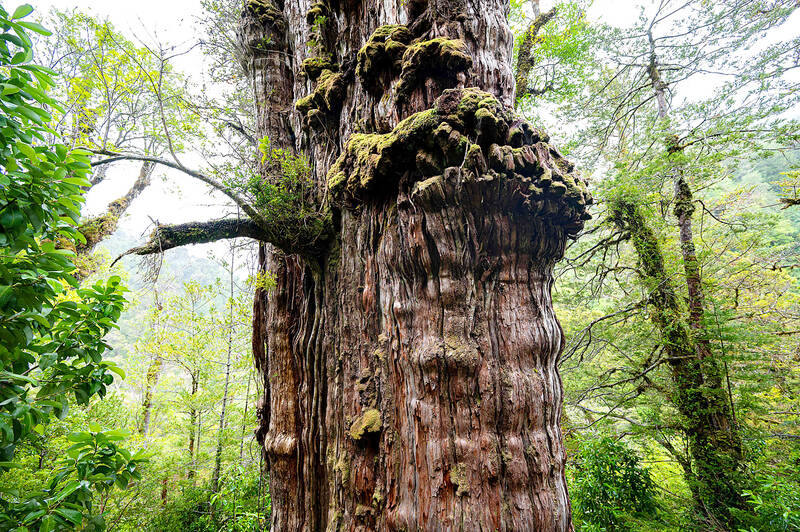
Photo: AFP
“It’s a survivor, there are no others that have had the opportunity to live so long,” said Antonio Lara, a researcher at Austral University of Chile’s Center for Climate and Resilience Research, who is part of the team measuring the tree’s age.
The Great Grandfather lies on the edge of a ravine in a forest in the southern Los Rios Region, 800km to the south of the capital, Santiago.
It is a Fitzroya cupressoides, a type of cypress tree that is endemic to the south of the continent.
In recent years, tourists have been walking one hour through the forest to the spot to be photographed beside the new “oldest tree in the world.”
Due to its growing fame, the national forestry body has had to increase the number of park rangers and restrict access to protect the Great Grandfather.
By contrast, the exact location of Methuselah is kept a secret.
Also known as the Patagonian cypress, it is the largest tree species in South America.
It lives alongside other tree species, such as coigue, plum pine and tepa, Darwin’s frogs, lizards, and birds such as the chucao tapaculo and Chilean hawk.
For centuries its thick trunk has been chopped down to build houses and ships, and it was heavily logged during the 19th and 20th centuries.
Park warden Anibal Henriquez discovered the tree while patrolling the forest in 1972. He died of a heart attack 16 years later while patrolling the same forest on horseback.
“He didn’t want people and tourists to know [where it was] because he knew it was very valuable,” his daughter Nancy Henriquez said.
Anibal Henrique’s nephew, Jonathan Barichivich, grew up playing among the Fitzroya and is one of the scientists studying the species.
In 2020, Barichivich and Lara extracted a sample from the Great Grandfather using the longest manual drill that exists, but they did not reach the center.
They estimated that their sample was 2,400 years old, and used a predictive model to calculate the full age of the tree.
“Eighty percent of the possible trajectories show the tree would be 5,000 years old,” Barichivich said.
He hopes to soon publish the results.
The study has created excitement within the scientific community given that dendrochronology — the method of dating tree rings to when they were formed — is less accurate when it comes to older trees, as many have a rotten core.
However, this is about more than just a competition to enter the record books, as the Great Grandfather is a font of valuable information.
“There are many other reasons that give value and sense to this tree and the need to protect it,” Lara said.
There are very few thousand-year-old trees on the planet.
“The ancient trees have genes and a very special history because they are symbols of resistance and adaptation. They are nature’s best athletes,” Barichivich said.
“They are like an open book and we are like the readers who read every one of their rings,” Austral University assistant researcher of dendrochronology Carmen Gloria Rodriguez said.
Those pages show dry and rainy years, depending on the width of the rings, she said.
Fires and earthquakes are also recorded in those rings, such as the most powerful tremor in history that hit the area in 1960.
The Great Grandfather is also considered a time capsule that can offer a window into the past.
“If these trees disappear, so too will disappear an important key about how life adapts to changes on the planet,” Barichivich said.
‘GROSS NEGLIGENCE?’ Despite a spleen typically being significantly smaller than a liver, the surgeon said he believed Bryan’s spleen was ‘double the size of what is normal’ A Florida surgeon who is facing criminal charges after allegedly removing a patient’s liver instead of his spleen has said he is “forever traumatized” by that person’s death. In a deposition from November last year that was recently obtained by NBC, 44-year-old Thomas Shaknovsky described the death of 70-year-old William Bryan as an “incredibly unfortunate event that I regret deeply.” Bryan died after the botched surgery; and last month, a grand jury in Tallahassee indicted Shaknovsky on a charge of manslaughter. “I’m forever traumatized by it and hurt by it,” Shaknovsky added, also saying that wrong-site surgeries can happen “during

Kouri Richins, a Utah mother who published a children’s book about grief after the death of her husband is to serve a life sentence for his murder without the possibility of parole, a judge ruled on Wednesday. Richins was convicted in March of aggravated murder for lacing a cocktail given to her husband, Eric Richins, with five times the lethal dose of fentanyl at their home near Park City in 2022. A jury also found her guilty of four other felonies, including insurance fraud, forgery and attempted murder for trying to poison her husband weeks earlier on Feb. 14, 2022, with a

‘PERSONAL MISTAKES’: Eileen Wang has agreed to plead guilty to the felony, which comes with a maximum sentence of 10 years in federal prison A southern California mayor has agreed to plead guilty to acting as an illegal agent for the Chinese government and has resigned from her city position, officials said on Monday. Eileen Wang (王愛琳), mayor of Arcadia, was charged last month with one count of acting in the US as an illegal agent of a foreign government. She was accused of doing the bidding of Chinese officials, such as sharing articles favorable to Beijing, without prior notification to the US government as required by law. The 58-year-old was elected in November 2022 to a five-person city council, from which the mayor is selected

IN PROTECTION: Video released by the Senate showed Ronald dela Rosa being chased through the halls of the upper chamber, pursued by National Bureau of Investigation officers Philippine authorities on Monday said that they would not arrest for now a lawmaker wanted by the International Criminal Court (ICC) for his alleged role in former Philippine president Rodrigo Duterte’s drug war, capping a lengthy Senate standoff. Philippine Senator Ronald dela Rosa, who served as police chief and Duterte’s top enforcer during the bloody drug crackdown, would be treated as if in the custody of the Senate, National Bureau of Investigation (NBI) Director Melvin Matibag told reporters after the politician had taken refuge in the legislative building. “We respect that they are a co-equal branch,” Matibag said after the Senate refused


 RSS
RSS