


Auckland, New Zealand’s largest city, has been hit by a tornado, two months after the wider region was devastated by Cyclone Gabrielle, and three months after the city was struck by deadly flooding.
Auckland Emergency Management said it began receiving reports of “localized havoc” around 9pm on Sunday, the NZ Herald reported.
Authorities received more than 30 calls, with roofs lifted off homes and trees toppled.
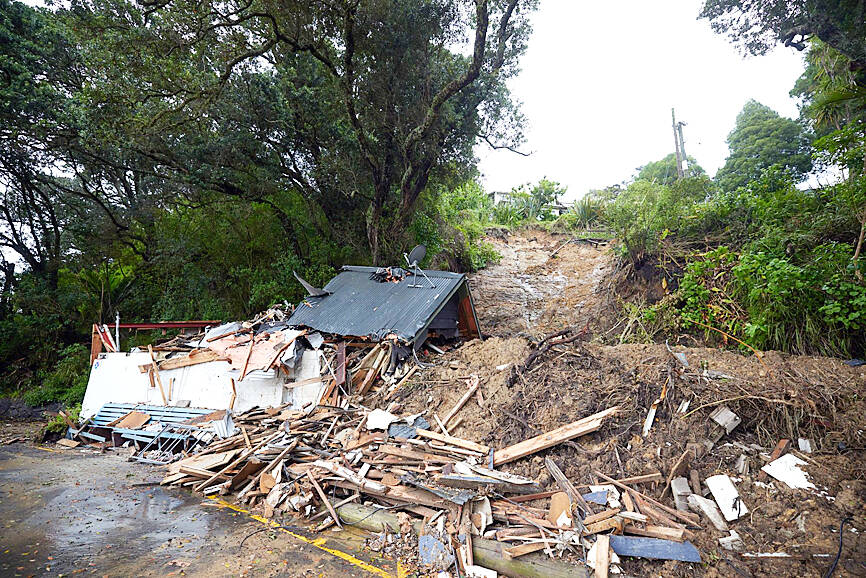
Photo: Bloomberg
“It’s a scary scene here in the neighborhood,” East Tmaki resident Manpreet Braar told the paper.
“People are heartbroken seeing the condition of their houses and roofs. You can sense the fear factor upon having a look at the damage,” Braar said.
Another resident told Stuff news Web site that the tornado had smashed his dining room window and sent glass shards flying across the room “like bullets.”
Priyank Aro said his family “feared for our life,” and fled outside to find that the “scene was really bad,” with trees and fences knocked down.
No injuries were reported, and firefighters helped residents put tarpaulins over their roofs overnight.
Most of the damage reports were from homes about 11 streets from Golflands to East Tmaki suburbs, Fire and Emergency New Zealand incident controller David McKeown said.
New Zealand was also hit by more than 14,000 lighting strikes in the 12 hours to 6am yesterday, the Meteorological Service of New Zealand said.
More heavy rain and thunderstorms are forecast for the South Island, it said.
Police in the South Island city of Nelson said another tornado struck the Upper Moutere area yesterday, with 12 houses either losing roofs or having them lifted, while residents in the surrounding area reported power outages.
Four people were killed in January when Auckland, a city of 1.6 million people on New Zealand’s North Island, was hit by what insurers said was the “biggest climate event” in the country’s history.
Flood waters swept through streets and down highways, causing landslides and sink holes, and temporarily shuttering Auckland Airport.
That disaster was followed weeks later by Cyclone Gabrielle, which killed 11 people and left thousands displaced, as flood waters and landslides destroyed homes.
New Zealand Prime Minister Chris Hipkins called a national state of emergency and said it was “the most significant weather event New Zealand has seen in this century.”
Episodes of heavy rainfall are becoming more common and more intense in New Zealand due to climate change, but the impact varies by region.

An American scientist convicted of lying to US authorities about payments from China while he was at Harvard University has rebuilt his research lab in Shenzhen, China, to pursue technology the Chinese government has identified as a national priority: embedding electronics into the human brain. Charles Lieber, 67, is among the world’s leading researchers in brain-computer interfaces. The technology has shown promise in treating conditions such as amyotrophic lateral sclerosis and restoring movement in paralyzed people. It also has potential military applications: Scientists at the Chinese People’s Liberation Army have investigated brain interfaces as a way to engineer super soldiers by boosting
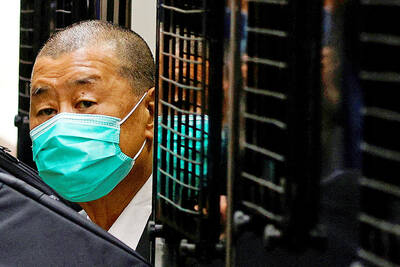
Jailed media entrepreneur Jimmy Lai (黎智英) has been awarded Deutsche Welle’s (DW) freedom of speech award for his contribution to Hong Kong’s pro-democracy movement. The German public broadcaster on Thursday said Lai would be presented in absentia with the 12th iteration of the award on June 23 at the DW Global Media Forum in Bonn. Deutsche Welle director-general Barbara Massing praised the 78-year-old founder of the now-shuttered news outlet Apple Daily for standing “unwaveringly for press freedom in Hong Kong at great personal risk.” “With Apple Daily, he gave journalists a platform for free reporting and a voice to the democracy movement in
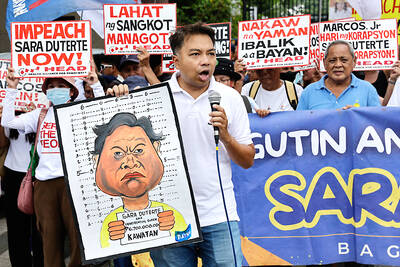
PHILIPPINE COMMITTEE: The head of the committee that made the decision said: ‘If there is nothing to hide, there is no reason to hide, there is no reason to obstruct’ A Philippine congressional committee on Wednesday ruled that there was “probable cause” to impeach Philippine Vice President Sara Duterte after hearing allegations of unexplained wealth, misuse of state funds and threats to have the president assassinated. The unanimous decision of the 53-member committee in the Philippine House of Representatives sends the two impeachment complaints to deliberations and voting by the entire lower chamber, which has more than 300 lawmakers. The complaints centered on Duterte’s alleged illegal use and mishandling of intelligence funds from the vice president’s office, and from her time as education secretary under Philippine President Ferdinand Marcos Jr. Duterte and the
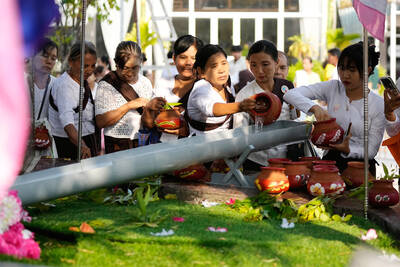
Burmese President Min Aung Hlaing yesterday cut all prisoners’ sentences by one-sixth, a blanket measure that a source close to deposed leader Aung San Suu Kyi said would further shorten her detention. Aung San Suu Kyi has been sequestered since a 2021 military coup, but the senior member of her dissolved National League for Democracy (NLD) party said that while her term had been reduced, her remaining sentence is still unclear. “We also don’t know exactly how many years she has left,” the source told reporters, speaking on condition of anonymity for security reasons. The military toppled Aung San Suu Kyi’s elected government


 RSS
RSS