


Rights group Amnesty International yesterday urged Cambodia to immediately stop the ongoing “mass forced evictions” of 10,000 families from the Angkor Wat temple complex.
The Cambodian government late last year ramped up the relocation of families living within the sprawling UNESCO world heritage site to a new community being built on former rice paddies 25km away.
Authorities say they are acting to protect the ruins by moving squatters whose informal settlements are damaging the local environment by producing rubbish and overusing water resources.
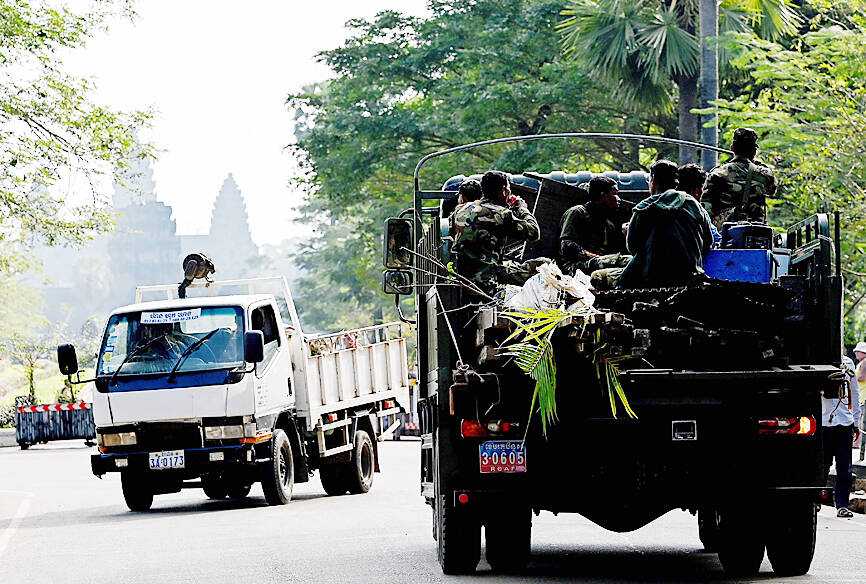
Photo: AFP
The government says that people are moving voluntarily, but Amnesty said its research found that villagers faced “implicit threats if they did not move.”
Those affected were not properly consulted or given enough notice, it said.
“These are forced evictions in disguise and on a mass scale. People were pressured to volunteer and made to feel fearful of reprisals if they refused to leave or challenged the evictions,” Ming Yu Hah, Amnesty’s deputy regional director for campaigns, said in a statement.
“The Cambodian authorities should immediately halt this harmful eviction drive that seriously risks impoverishing thousands of families,” Ming Yu Hah said.
The ruined Angkor Wat temples, half-swallowed by the jungle, are the country’s top tourist attraction.
Families being moved are given a 20m-by-30m plot of land, US$350 cash, 30 pieces of tin roofing material and access to a welfare card, but they have to build their own homes.
Long Kosal, a spokesman for the Apsara National Authority, which manages the archeological park, refused to comment on Amnesty’s statement.
Cambodian Prime Minister Hun Sen has warned that Angkor Wat would be withdrawn from the world heritage list if villagers were not relocated away.
UNESCO guidelines say that relocations should be carried out with the consent of the population concerned and that local communities should be the primary beneficiaries of tourism from heritage sites.

‘CROSSING THE LINE’: China’s embassy in Seoul criticized US Forces Korea Commander General Xavier Brunson, asking if his ‘hostile’ remarks were authorized by Washington South Korea and the US are in talks over recent public remarks by the commander of US Forces Korea, Seoul’s presidential office said yesterday, after the comments drew sharp criticism from China. In a recent podcast interview, US Forces Korea Commander General Xavier Brunson described South Korea as “the dagger in the heart of Asia” from China’s east coast, prompting the Chinese embassy in Seoul to say that he had “truly crossed the line.” The interview came amid growing speculation that Washington might seek to expand the role of US Forces Korea in countering the growing regional influence of China, a key

Through the noise of rushing papers and whirring belts at a print factory in Kyoto, two creators watch their photo essay come to life in broadsheet form — part of an effort to win new audiences in the age of artificial intelligence (AI). Despite the decline of the publishing industry, self-publication and handmade “zine” magazines are growing in popularity in Japan, reflecting the nation’s enduring love of paper in the digital era. While speaking to Agence France-Presse at the plant, his hands black with ink, one of the creators, Kazuma Obara, said: “I think [paper] is a medium that engages all five

Australian researchers have trained lab-grown brain cells on a silicon computer chip to play the 1990s shooter game Doom and said they are just scratching the surface of what the neurons could be capable of doing. It is the science-fiction work of biotech boffins at Cortical Labs, who researched and developed the technology that harnesses the workings of the brain’s networking system. Each so-called “biological computer” contains about 200,000 living human brain cells, grown from stem cells that were harvested from blood donations. Having mastered the simple computer game Pong, where a paddle is moved up and down to send a ball

France experienced its hottest spring on record, the French weather service said on Tuesday, after an exceptional early heat wave that also broke highs for the season in England and Wales. Meteo-France said the average nationwide temperature over March to May was 13.8°C — about 1.7°C above the norm, and surpassing records set in 2011 and 2020. “The warmest spring since records began in 1900,” it said in a bulletin. All three months were warmer than average, but the onset of an “unprecedented heatwave” late last month pushed the mercury to highs typically seen at the height of the summer. “Our country had never


 RSS
RSS