


Every Sunday, Chinese tutor Kirill Burobin begins work in the early morning and is kept busy until midnight.
As Russia seeks to tighten ties with China amid Moscow’s invasion of Ukraine, the number of Burobin’s students has tripled over the past year.
“Sunday is the busiest,” said 20-year-old Burobin, who makes a good living with his online lessons.
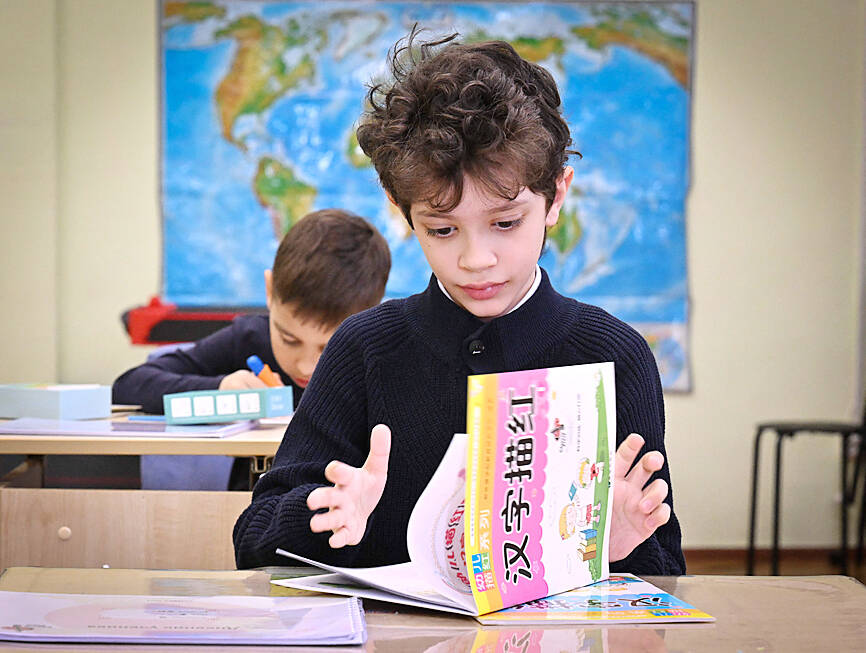
Photo: AFP
“I have 16 hours of classes virtually without a break,” he said.
The boom in demand for Chinese lessons in Russia illustrates the country’s pivot toward Asia as tensions build between Moscow and the West.
Chinese President Xi Jinping’s (習近平) three-day visit to Russia beginning today aims to deepen what the two countries have called a “no-limits” relationship, which is increasingly important for Russia as its international isolation deepens.
Pummeled by multiple rounds of Western sanctions, Russia’s economic and technological development is becoming more dependent on China.
Last year there were nearly 11,000 vacancies requiring knowledge of the Chinese language, a 44 percent increase from 2021, Natalia Danina, a manager at HeadHunter, the country’s top online recruitment company.
Over the same period, the number of jobs for Chinese speakers in Russia has doubled in sales, transport and logistics, said Danina, pointing to an “accelerated transition” to Chinese-made equipment and spare parts.
Demand for Chinese speakers in energy jobs has tripled, she added.
Burobin, who also studies Eastern civilizations at a top Moscow university, said that he is happy to help his students learn more about “a whole new world.”
“Russians are taking up Chinese because Beijing has become our main partner for decades to come, and this is just the beginning,” he said.
In August last year, Avito, Russia’s leading online classified advertising platform, reported a 138 percent increase in requests for Chinese lessons in Moscow in one year. The same figure stood at 350 percent for the far eastern city of Vladivostok.
The popularity of Chinese classes might be starting to catch up with demand for English lessons in the country. Alina Khamlova, 26, who teaches both languages, said she had only three English language students this year, compared with 12 who are learning Chinese.
One of her students is Maria, a 22-year-old designer who dreams of traveling to China to make her clothes there, because it is “cheaper than in Russia.”
Another student is a 25-year-old gym coach, Ivan, who wants to work in China because Europeans “are paid very well” there.
Khamlova also said that many young people in Russia hope to study in Chinese universities now that many European establishments had become “inaccessible to them.”
While English still retains a dominant position, the number of high-school students who chose Chinese as a foreign language during their final school exams has doubled in one year to 17,000, state education watchdog Rosobrnadzor said.
Russia’s growing isolation from the West has prompted many language schools to revise their curricula and acquire Chinese teachers.
Founded in 2017, the ChineseFirst language center has seen twice as many registrations this year, said its cofounders, Wang Yinyu (王銀雨), 38, and his Russian wife, Natalia, a 33-year-old Chinese speaker.
Wang’s family business is booming, and he is planning to open two new branches and a kindergarten in Moscow.
In Russia, “many companies have rushed to Chinese factories to order goods that have become unavailable in Russia due to sanctions,” he said in Russian.
Chinese entrepreneurs, who are interested in exporting to Russia, are also looking for bilingual staff.
Wang said he is glad that China and Russia are becoming closer.
“China has powerful industry and Russia is rich in resources, which means that our two countries can build their own internal economy,” he said. “If we stand back-to-back, no one will defeat us.”

Crowds in Bangladesh are flocking to snap photographs with an unlikely social media star — an albino buffalo with flowing blond hair nicknamed “Donald Trump” that is due to be sacrificed within days. Owner Zia Uddin Mridha, 38, said his brother named the 700kg bull over its flowing helmet of hair resembling the signature look of the US president. “My younger brother picked this name because of the buffalo’s extraordinary hair,” he said at his farm in Narayanganj, just outside the capital, Dhaka. Mridha said that a constant stream of curious visitors — social media fans, onlookers and children — have come throughout

The Bolivian government on Friday struck a deal with protesting miners, but was still grappling with blockades and demonstrations by other workers across La Paz. Other groups are still blocking access roads into the city, which is also the seat of the government. Police on Thursday prevented the miners from entering the main square by using tear gas, while the demonstrators hurled stones and explosives with slingshots. Protests against the policies of Bolivian President Rodrigo Paz have convulsed the Andean nation since early this month, and roadblocks were choking routes into La Paz throughout Friday, the national road authority said. Miners demanded that Paz

The Philippines said it has asked the country’s Supreme Court to allow it to arrest former Philippine president Rodrigo Duterte’s chief drug war enforcer to stand trial in an international tribunal. The International Criminal Court (ICC) last week unsealed an arrest warrant against Philippine Senator Ronald dela Rosa, accusing him along with Duterte and other “coperpetrators” of the “crime against humanity of murder.” Dela Rosa briefly sought refuge in the Philippine Senate last week while asking the Philippine Supreme Court to stop an ongoing attempt by government agents to arrest him. “By his own conduct, he has placed himself outside the protection of

The researchers in Ireland looked at their computer screen, marveling at a medieval book tracked down in a Roman library. They flipped through its digitized pages and found their sought-after treasure: the oldest surviving English poem. “We were extremely surprised. We were speechless. We couldn’t believe our eyes when we first saw that,” said Elisabetta Magnanti, a visiting research fellow at Trinity College Dublin’s school of English. The poem was also within the main body of Latin text, she said, calling it “extraordinary.” Composed in Old English by a Northumbrian agricultural worker in the 7th century, Caedmon’s Hymn appears within some copies of


 RSS
RSS