


British Prime Minister Rishi Sunak yesterday was scheduled to visit San Diego, California, to meet US President Joe Biden and Australian Prime Minister Anthony Albanese as the three nations unveil the next phase of the AUKUS nuclear submarine program, a security partnership intended to counter China.
The decision on how to move ahead is to be announced today when the three leaders meet.
The plan could take years to produce its first vessel, probably necessitating stopgap measures, according to people familiar with the discussions.
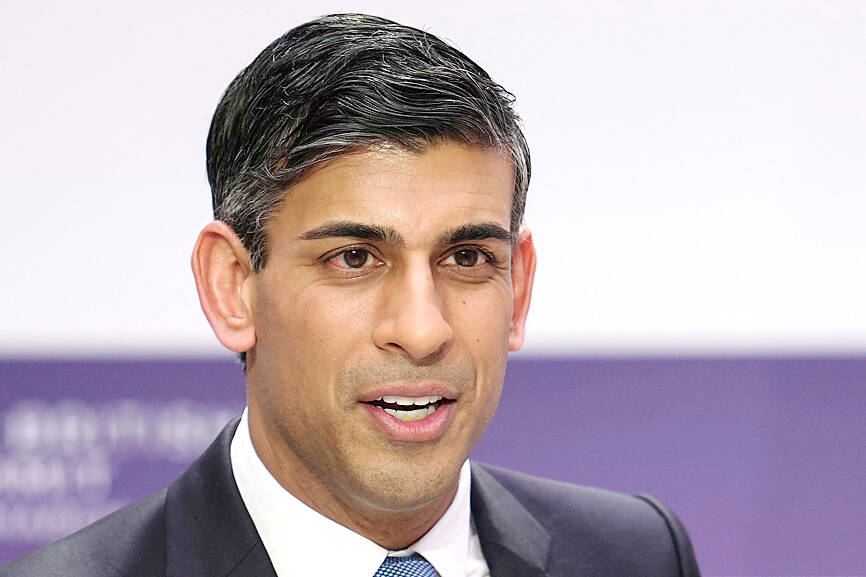
Photo: AFP
The US might base nuclear submarines in Australia or sell the country Virginia-class submarines in the interim.
Australia’s new nuclear submarines have been planned on a modified British design with US parts and upgrades, the sources said.
Ahead of the announcement, the UK is planning an update to its 2021 Integrated Review of defense and security to set out its response to increased global volatility.
It is to address “increasingly concerning behavior” by Chinese President Xi Jinping (習近平), the “grave risks” posed by Russia after a renewed assault on Ukraine, and “hybrid threats” to the British economy and energy security, Sunak’s office said.
“In turbulent times, the UK’s global alliances are our greatest source of strength and security,” Sunak said in a statement.
“I am traveling to the United States today to launch the next stage of the AUKUS nuclear submarine program, a project which is binding ties to our closest allies and delivering security, new technology and economic advantage at home,” he said.
The UK has said the deal, the first time the US has shared its nuclear-propulsion technology since it did so with Britain in the 1950s, would help create new jobs in Britain and boost sluggish economic growth.
Chinese Ministry of Foreign Affairs spokeswoman Mao Ning (毛寧) on Thursday criticized the plan, telling reporters in Beijing that the three countries should “do more things that are conducive to regional peace and stability.”
Center for Strategic and International Studies senior adviser Charles Edel described the AUKUS pact as a calculated gamble.
“It’s a bet that by further integrating industrial capacities and increasing interoperability it will significantly augment the capabilities of our allies, make them more powerful, and ultimately change Beijing’s calculations about its security environment,” Edel said.
“It will help stabilize a region that has been badly destabilized by China’s rapid expansion of military capabilities and increasingly aggressive foreign policy,” he said.
Additional reporting by The Guardian

A new online voting system aimed at boosting turnout among the Philippines’ millions of overseas workers ahead of Monday’s mid-term elections has been marked by confusion and fears of disenfranchisement. Thousands of overseas Filipino workers have already cast their ballots in the race dominated by a bitter feud between President Ferdinand Marcos Jr and his impeached vice president, Sara Duterte. While official turnout figures are not yet publicly available, data from the Philippine Commission on Elections (COMELEC) showed that at least 134,000 of the 1.22 million registered overseas voters have signed up for the new online system, which opened on April 13. However,
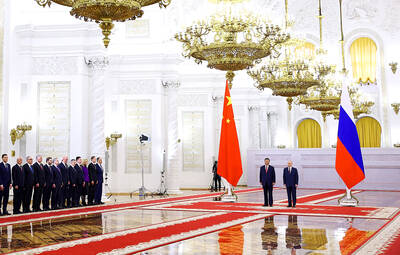
ALLIES: Calling Putin his ‘old friend,’ Xi said Beijing stood alongside Russia ‘in the face of the international counter-current of unilateralism and hegemonic bullying’ Chinese President Xi Jinping (習近平) yesterday was in Moscow for a state visit ahead of the Kremlin’s grand Victory Day celebrations, as Ukraine accused Russia’s army of launching air strikes just hours into a supposed truce. More than 20 foreign leaders were in Russia to attend a vast military parade today marking 80 years since the defeat of Nazi Germany in World War II, taking place three years into Russia’s offensive in Ukraine. Putin ordered troops into Ukraine in February 2022 and has marshaled the memory of Soviet victory against Nazi Germany to justify his campaign and rally society behind the offensive,

CONFLICTING REPORTS: Beijing said it was ‘not familiar with the matter’ when asked if Chinese jets were used in the conflict, after Pakistan’s foreign minister said they were The Pakistan Army yesterday said it shot down 25 Indian drones, a day after the worst violence between the nuclear-armed rivals in two decades. Pakistani Prime Minister Shehbaz Sharif vowed to retaliate after India launched deadly missile strikes on Wednesday morning, escalating days of gunfire along their border. At least 45 deaths were reported from both sides following Wednesday’s violence, including children. Pakistan’s military said in a statement yesterday that it had “so far shot down 25 Israeli-made Harop drones” at multiple location across the country. “Last night, India showed another act of aggression by sending drones to multiple locations,” Pakistan military spokesman Ahmed
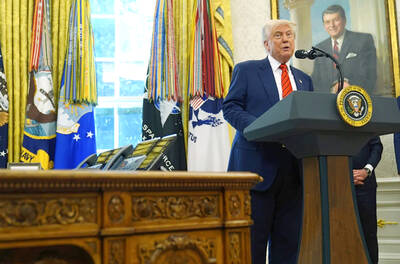
US President Donald Trump on Wednesday said that he would make a decision about how the US government would refer to the body of water commonly known as the Persian Gulf when he visits Arab states next week. Trump told reporters at the White House that he expects his hosts in Saudi Arabia, Qatar and the United Arab Emirates will ask him about the US officially calling the waterway the Arabian Gulf or Gulf of Arabia. “They’re going to ask me about that when I get there, and I’ll have to make a decision,” Trump said. “I don’t want to hurt anybody’s


 RSS
RSS