


Denmark yesterday inaugurated a project to store carbon emissions 1,800m beneath the North Sea, the first country in the world to bury carbon imported from abroad.
The emissions graveyard, where the carbon is injected to prevent further warming of the atmosphere, is on the site of an old oil field.
Led by British chemical giant Ineos and German oil company Wintershall Dea, the “Greensand” project is expected to store up to 8 million tonnes of carbon per year by 2030.
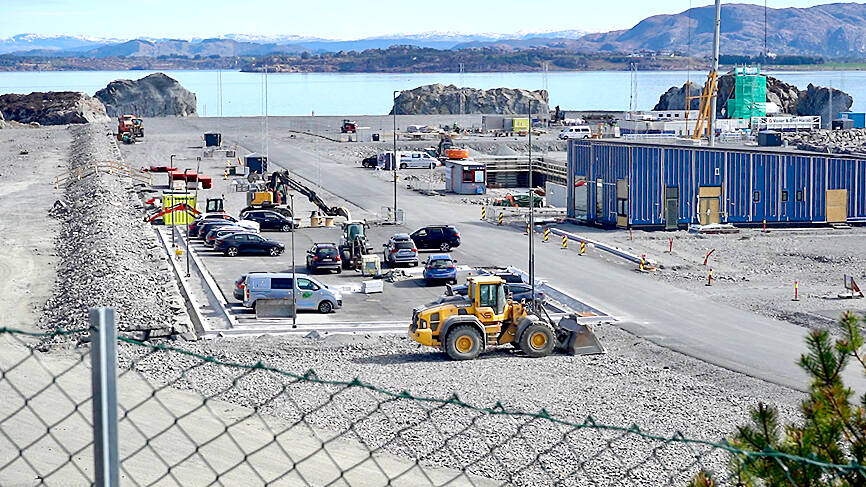
Photo: AFP
In December last year, it received an operating permit to start its pilot phase.
Still in their infancy and costly, carbon capture and storage projects aim to capture and then trap emissions to mitigate global warming.
About 30 projects are operational or under development in Europe.
However, unlike other projects that store carbon emissions from nearby industrial sites, Greensand distinguishes itself by bringing them in from far away.
First captured at the source, the carbon is liquefied — in Belgium in Greensand’s case — then transported, currently by ship, but potentially by pipelines, and stored in reservoirs such as geological cavities or depleted oil and gas fields.
At Greensand, the carbon is transported in special containers to the Nini West platform, where it is injected into an existing reservoir 1.8km under the seabed.
Once the pilot phase is completed, the plan is to use the neighboring Siri field as well.
Danish authorities, who have set a target of reaching carbon neutrality as early as 2045, said it is “a much needed tool in our climate toolkit.”
“It will help us reach our climate goals, and since our subsoil contains a storage potential far larger than our own emissions, we are able to store carbon from other countries as well,” Danish Minister for Climate, Energy and Utilities Lars Aagaard said.
The North Sea is particularly suitable for this type of project, as the region has pipelines and potential storage sites after decades of oil and gas production.
“The depleted oil and gas fields have many advantages because they are well understood and there are already infrastructures which can most likely be reused,” said Morten Jeppesen, director of the Danish Offshore Technology Center at the Technical University of Denmark.
Near the Greensand site, France’s TotalEnergies is also exploring the possibility of burying carbon emissions with the aim of trapping 5 million tonnes per year by 2030.
In Norway, carbon capture and storage facilities are in operation to offset domestic emissions, but the country is also planning to receive tonnes of liquefied carbon in a few years, transported from other European countries by ship.
As Western Europe’s largest producer of oil, Norway also has the largest potential for emissions storage on the continent, particularly in its depleted oil fields.
While measured in millions of tonnes, the quantities stored still remain a small fraction of overall emissions.
European Environment Agency data showed that the member states of the EU emitted 3.7 billion tonnes of greenhouse gases in 2020, a year that also saw reduced economic activity owing to the COVID-19 pandemic.
Long considered a complicated solution with marginal application, carbon capture has been embraced as necessary by the UN’s Intergovernmental Panel on Climate Change and the International Energy Agency, but it remains far from a miracle cure for global warming.
The energy-intensive process to capture and store carbon emits the equivalent of 21 percent of the gas captured, according to the Institute for Energy Economics and Financial Analysis, an Australian think tank.
The technology is not without risks, and potential leaks could have severe consequences, the institute said.
Furthermore, the cost of the project has not been made public.
“The cost of CO2 storage must be reduced further, so it will become a sustainable climate mitigation solution as the industry becomes more mature,” Jeppesen said.
The technology also faces opposition from environmentalists.
“It doesn’t fix the problem and prolongs the structures that are harmful,” Greenpeace Denmark climate and environmental policy head Helene Hage said.
“The method is not changing our deadly habits. If Denmark really wants to reduce its emissions, it should look into the sectors that are producing a lot of them,” she said, singling out sectors such as agriculture and transportation.

When a hiker fell from a 55m waterfall in wild New Zealand bush, rescuers were forced to evacuate the badly hurt woman without her dog, which could not be found. After strangers raised thousands of dollars for a search, border collie Molly was flown to safety by a helicopter pilot who was determined to reunite the pet and the owner. A week earlier, an emergency rescue helicopter found the woman with bruises and lacerations after a fall at a rocky spot at the waterfall on the South Island’s West Coast. She was airlifted on March 24, but they were forced to

CONFIDENCE BOOSTER: ’After parkour ... you dare to do a lot of things that you think only young people can do,’ a 67-year-old parkour enthusiast said In a corner of suburban Singapore, Betty Boon vaults a guardrail, crawls underneath a slide, executes forward shoulder rolls and scales a steep slope, finishing the course to applause. “Good job,” the 69-year-old’s coach cheers. This is “geriatric parkour,” where about 20 retirees learned to tackle a series of relatively demanding exercises, building their agility and enjoying a sense of camaraderie. Boon, an upbeat grandmother, said learning parkour has aided her confidence and independence as she ages. “When you’re weak, you will be dependent on someone,” she said after sweating it out with her parkour classmates in suburban Toa Payoh,

Chinese dissident artist Gao Zhen (高兟), famous for making provocative satirical sculptures of former Chinese leader Mao Zedong (毛澤東), was tried on Monday over accusations of “defaming national heroes and martyrs,” his wife and a rights group said. Gao, 69, who was detained in 2024 during a visit from the US, faces a maximum three-year prison sentence, said his wife, Zhao Yaliang (趙雅良), and Shane Yi, a researcher at the Chinese Human Rights Defenders group which operates outside the nation. The closed-door, one-day trial took place at Sanhe City People’s Court in Hebei Province neighboring the capital, Beijing, and ended without a
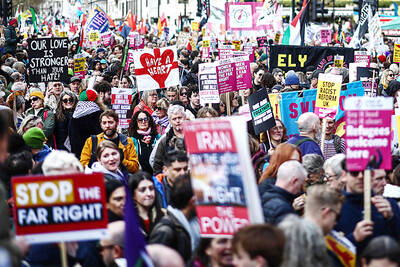
‘TOXIC CLIMATE’: ‘I don’t really recognize Labour anymore... The idea that you can implement far-right ideas in order to stop the far right is nonsense,’ a protester said Tens of thousands of people on Saturday marched through central London to protest against the far right, weeks ahead of local elections and six months after Britain saw one of its largest far-right demonstrations. Organized by hundreds of civic groups, including trade unions, anti-racism campaigners and Muslim representative bodies, Saturday’s Together Alliance event was billed as the biggest in UK history to counter right-wing extremism. A separate pro-Palestinian march had also converged with the main rally. While organizers claimed 500,000 had turned out in total, the police gave a figure of about 50,000. Protesters carrying placards with slogans such as


 RSS
RSS