


Like other businesses across Cuba, Nel Paradiso is grappling with a worker shortage amid unprecedented levels of people fleeing the country.
In just more than a year, the restaurant in central Havana has seen 50 employees leave.
“There wasn’t enough time to replace the personnel,” hiring manager Annie Zuniga said.

Photo: AFP
After being forced to close its doors due to the COVID-19 pandemic, Nel Paradiso had been open for only two months when Nicaragua, an ally of Havana, in November 2021 abolished visa requirements for Cubans.
The move lead to the country’s largest exodus since communists took over the Cuban government more than six decades ago.
“Nicaragua’s opening was a blow... From 50 workers, in one week we were left with 30,” Zuniga said.
Of the 60 employees recruited during the past 14 months, only 10 still live in Cuba, the 26-year-old manager said.
Replacing employees that emigrate has become a time-consuming and costly task.
“We haven’t been able to create a united and lasting team because when we think: ‘Good, this is the team’ ... one of them comes to me and says: ‘This is my last week, next week I’m leaving.’ It’s a catastrophe,” Zuniga said.
Last year, US border authorities intercepted more than 313,000 Cubans who entered the country illegally, official data showed.
Most Cubans fleeing the country attempt to reach the US, usually via Central America.
However, sea crossings between Cuba and Florida — a treacherous 140km journey often made in unsuitable vessels — have also soared.
The wave of emigration comes as the country of 11.1 million people is aging and is wrangling with its worst economic crisis in three decades. Inflation is rampant, and daily lines to buy food and fuel are interminable, while it is near impossible to find many medicines and power cuts are frequent.
The lack of staff “puts us in difficulty,” Nel Paradiso head waiter Norberto Vazquez said.
Also a sommelier professor, Vazquez said he has trained more than 50 people who are no longer in Cuba.
“Some students tell me: ‘Professor, the only thing I’m thinking about is how I will leave,’” he said. “That gives me incalculable grief.”
Most Cubans that emigrate are highly educated and aged from 19 to 49, University of Havana data showed.
PANDEMIC DOWNTURN
Many industries are affected by the exodus, including tourism, a vital part of the country’s economy that was badly hit by the pandemic.
About 30 percent of employees at the Parque Central hotel, a business partly owned by the government and Spanish group Iberostar, emigrated and its executives were forced to contract students to cover the vacancies, a source said on condition of anonymity.
Frenchman Stephane Ferrux has been running a travel agency in Havana since 1995.
He said 60 of the agency’s service providers emigrated in one year, adding that it was not just for economic reasons, as some of them earned US$1,500 a month, a sum 45 times the Cuban average.
“When you cannot find anything” due to shortages of most products “and you feel you have no future, even if you have the means, that triggers the fleeing,” Ferrux said.
Even embassies and universities have been affected.
Last month, the “desperate cry” of a university science professor went viral on social media.
“The laboratories are emptying... The best ones are leaving,” the professor said.
Cuban President Miguel Diaz-Canel in October last year said that “emigration is high in Cuba,” and blamed US laws for encouraging it.
“Every young person who abandons their studies and work to emigrate” represents “a defeat” for the country, he said.
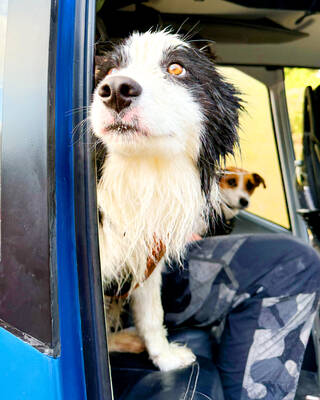
When a hiker fell from a 55m waterfall in wild New Zealand bush, rescuers were forced to evacuate the badly hurt woman without her dog, which could not be found. After strangers raised thousands of dollars for a search, border collie Molly was flown to safety by a helicopter pilot who was determined to reunite the pet and the owner. A week earlier, an emergency rescue helicopter found the woman with bruises and lacerations after a fall at a rocky spot at the waterfall on the South Island’s West Coast. She was airlifted on March 24, but they were forced to
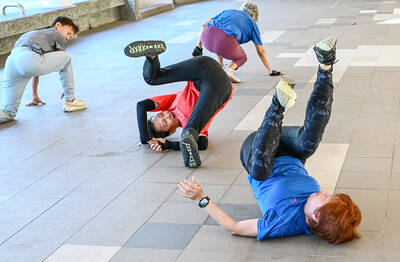
CONFIDENCE BOOSTER: ’After parkour ... you dare to do a lot of things that you think only young people can do,’ a 67-year-old parkour enthusiast said In a corner of suburban Singapore, Betty Boon vaults a guardrail, crawls underneath a slide, executes forward shoulder rolls and scales a steep slope, finishing the course to applause. “Good job,” the 69-year-old’s coach cheers. This is “geriatric parkour,” where about 20 retirees learned to tackle a series of relatively demanding exercises, building their agility and enjoying a sense of camaraderie. Boon, an upbeat grandmother, said learning parkour has aided her confidence and independence as she ages. “When you’re weak, you will be dependent on someone,” she said after sweating it out with her parkour classmates in suburban Toa Payoh,

Chinese dissident artist Gao Zhen (高兟), famous for making provocative satirical sculptures of former Chinese leader Mao Zedong (毛澤東), was tried on Monday over accusations of “defaming national heroes and martyrs,” his wife and a rights group said. Gao, 69, who was detained in 2024 during a visit from the US, faces a maximum three-year prison sentence, said his wife, Zhao Yaliang (趙雅良), and Shane Yi, a researcher at the Chinese Human Rights Defenders group which operates outside the nation. The closed-door, one-day trial took place at Sanhe City People’s Court in Hebei Province neighboring the capital, Beijing, and ended without a

‘TOXIC CLIMATE’: ‘I don’t really recognize Labour anymore... The idea that you can implement far-right ideas in order to stop the far right is nonsense,’ a protester said Tens of thousands of people on Saturday marched through central London to protest against the far right, weeks ahead of local elections and six months after Britain saw one of its largest far-right demonstrations. Organized by hundreds of civic groups, including trade unions, anti-racism campaigners and Muslim representative bodies, Saturday’s Together Alliance event was billed as the biggest in UK history to counter right-wing extremism. A separate pro-Palestinian march had also converged with the main rally. While organizers claimed 500,000 had turned out in total, the police gave a figure of about 50,000. Protesters carrying placards with slogans such as


 RSS
RSS