


Restaurants are removing meat dishes from their menus due to the impact of inflation and the rising popularity of Veganuary, researchers said.
Only 20 percent of all dishes served at restaurant chains last summer contained meat, according to the latest figures from Lumina Intelligence, a drop of 4 percentage points from last spring.
“It’s a notable decline,” said Katherine Prowse, senior insight manager at Lumina, who said the change was driven by a desire to cut costs and satisfy customers.
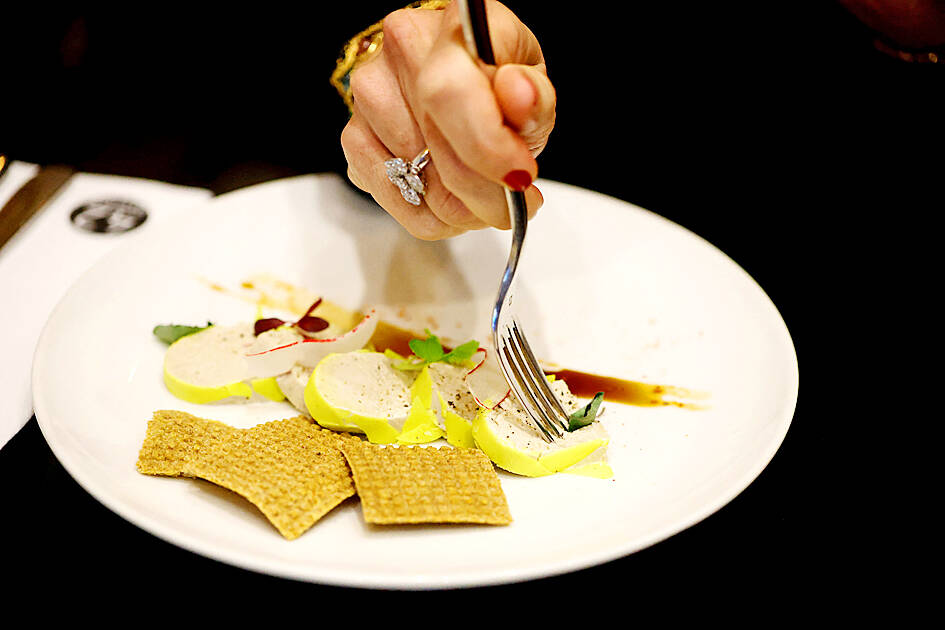
Photo: Reuters
The cost of a restaurant dish rose by 7.9 percent in just three months, and cutting down on expensive ingredients was part of the solution.
“We’re seeing trends around healthier living and around eating less meat, and restaurants are tapping into that,” she said. “The benefit is they can manage costs at the same time because they’re saving on meat and saving on portion sizes.”
Only 33 percent of main courses at major restaurant chains include meat, and just 12 percent of starters, Prowse said, citing data from Lumina’s menu tracker, which surveys more than 150 restaurant chains, and pub and bar operators. About half of pub main courses include meat.
Veganuary, the annual pledge to avoid animal products in January, has grown in significance since it began in 2014 and substantial numbers of people now adopt a flexitarian approach to food, cutting down on meat, but not cutting it out.
There has been an argument within the hospitality industty for years about how much restaurants should cater for vegans, Prowse said.
“We think it has potentially reached a ceiling in terms of how much menu share would be given to plant-based alternatives,” she added. “But we’re also seeing the expansion of vegan-only restaurants or with menus that are completely vegan. There are fine-dining restaurants in London that are now vegan and several smaller, but growing chains based on vegan concepts.”
Last year saw the expansion of Lewis Hamilton’s Neat Burger venture in the US, while Alexis Gauthier, a Michelin-starred chef, stopped selling any animal products at Gauthier Soho in 2021.
Despite the enormous growth in the number of plant-based food products, retailers and supermarkets were still unsure whether customers expect to see vegan sausages in an aisle for plant-based foods, or alongside meat sausages, Prowse said.
“Trends tend to start in the food service sector and trickle down to retail, so I think we’ll start seeing people cook more once they get used to the products that are on the market,” she said.
However, meat substitute products have also been hit by the cost of living crisis.
Mintel found that sales of products such as no-meat sausages and “tofish” and chips had doubled from £S289 million (US$359 million) in 2017 to reach £586 million 2021.
However, sales last year fell 6 percent, said Alice Pilkington, a senior food and drink analyst at market-research firm Mintel, even though 49 percent of people eat meat substitutes regularly.
“As household incomes have come under increasing pressure as the year has progressed, the relatively high price of meat substitutes has resulted in consumers cutting back on these products,” Pilkington said.
Although much of the emphasis has been on mimicking burgers and sausages, there is a gap in the market for “vegetable-forward products,” such as bean burgers, she added.
“Two-thirds of meat substitute buyers say they would be more likely to try products that don’t mimic meat,” she said.

An American scientist convicted of lying to US authorities about payments from China while he was at Harvard University has rebuilt his research lab in Shenzhen, China, to pursue technology the Chinese government has identified as a national priority: embedding electronics into the human brain. Charles Lieber, 67, is among the world’s leading researchers in brain-computer interfaces. The technology has shown promise in treating conditions such as amyotrophic lateral sclerosis and restoring movement in paralyzed people. It also has potential military applications: Scientists at the Chinese People’s Liberation Army have investigated brain interfaces as a way to engineer super soldiers by boosting

Indonesian police have arrested 13 people after shocking images of alleged abuse against small children at a daycare center went viral, sparking outrage across the nation, officials said on Monday. Police on Friday last week raided Little Aresha, a daycare center in Yogyakarta on Java island, following a report from a former employee. CCTV footage circulating on social media showed children, most younger than two, lying on the floor wearing only diapers, their hands and feet bound with rags. The police have confirmed that the footage is authentic. Police said they also found 20 children crammed into a room just 3m by 3m. “So

A highway bomb attack in a restive region of southwestern Colombia on Saturday killed 14 people and injured at least 38, the latest spate of violence ahead of next month’s presidential election. Authorities blamed the attack in the Cauca department — a conflict-ridden, coca-growing region — on dissidents of the now-disbanded FARC guerrilla army, who have been sowing violence across the country. “Those who carried out this attack ... are terrorists, fascists and drug traffickers,” Colombian President Gustavo Petro said on social media. “I want our very best soldiers to confront them,” he added. The leftist leader blamed the bombing
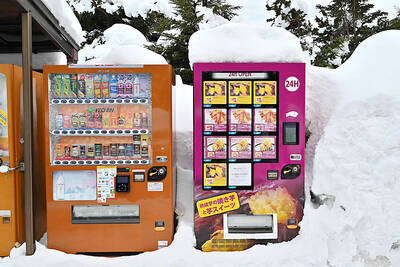
From post offices and parks to stations and even the summit of Mount Fuji, Japan’s vending machines are ubiquitous, but with the rapid pace of inflation cooling demand for their drinks, operators are being forced to rethink the business. Last month beverage giant DyDo Group Holdings announced it would remove about 20,000 vending machines — about 7 percent of their stock nationwide — by January next year, to “reconstruct a profitable network.” Pokka Sapporo Food & Beverage, based in Nagoya, also said last month it would sell its 40,000-machine operation to Osaka-based Lifedrink Co. “The strength of the vending machine


 RSS
RSS