


Light pollution is growing rapidly and in some places the number of stars visible to the naked eye in the night sky has been reduced by more than half in less than 20 years, a study released on Thursday said.
The researchers, whose findings were published in the journal Science, said the increase in light pollution — or sky glow — that they found was much larger than that measured by satellite observations of Earth at night.
For the study of the change in global sky brightness from artificial light, the researchers used stellar observations from 2011 to last year submitted by more than 51,000 “citizen scientists” around the world.
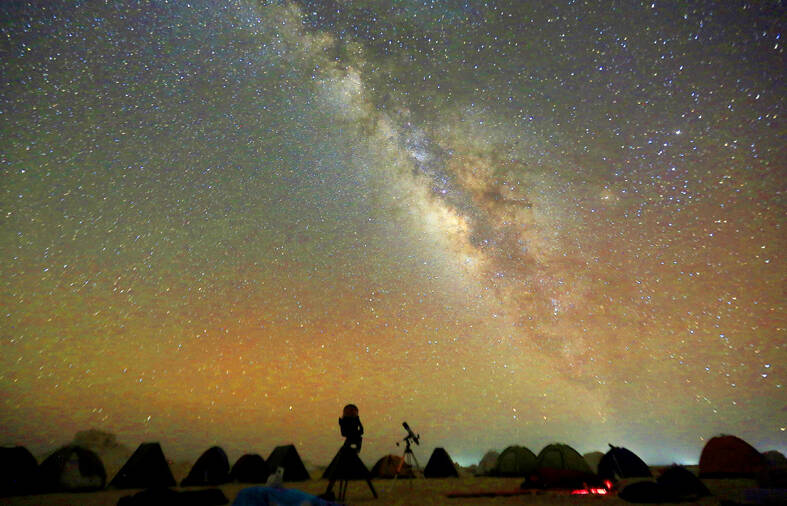
Photo: Reuters
Participants in the “Globe at Night” project run by the US National Optical-Infrared Astronomy Research Laboratory were given star maps and asked to compare them with the night sky at their location.
The change in the number of visible stars reported was equivalent to a 9.6 percent per year annual increase in sky brightness, averaged over the locations of the participants, the researchers said.
Over an 18-year period, given such star brightness change, a location with 250 visible stars would see that number reduced to 100.
Most of the naked-eye star observations came from Europe and the US, but there was also good participation in Uruguay, South Africa and Japan, study co-author Christopher Kyba said.
“The global trend in sky glow that we measure likely underestimates the trend in countries with the most rapid increases in economic development, because the rate of change in light emission is highest there,” the researchers said.
The study coincided with the replacement of many outdoor lights with LEDs, but the researchers said the impact on sky glow from the transition is unclear.
“Some researchers have predicted that it will be beneficial; others, that it could be harmful because of spectral changes or a rebound effect, in which the high luminous efficacy of LEDs leads to more or brighter lights being installed or longer hours of operation,” they said.
The study said the global LED market share for new general lighting grew from less than 1 percent in 2011 to 47 percent in 2019.
“The visibility of stars is deteriorating rapidly, despite (or perhaps because of) the introduction of LEDs in outdoor lighting applications,” the study said. “Existing lighting policies are not preventing increases in sky glow, at least on continental and global scales.”
Kyba, a physicist at the German Research Center for Geoscience, said that while the team was able to evaluate erosion of star visibility due to sky glow, not a lot of research has been done on its ecological impact.
“There’s tons of research on light shining directly on animals and plants,” he said. “But it’s really hard to do experiments on the impact of sky glow. You’re not going to do something like just turn off New York City and see what happens in the East River.”
Science aside, light pollution has changed the character of the night sky.
“For all of human history, when people went outside at nighttime, they were sort of confronted with the cosmos, at least on clear nights with no moon,” Kyba said.
“You’d walk outside and there’s the stars, there’s the Milky Way. It’s there and it’s shining down on you,” he said. “And now that’s like a really unusual experience.”

Swedish campaigner Greta Thunberg was deported from Israel yesterday, the Israeli Ministry of Foreign Affairs said, the day after the Israeli navy prevented her and a group of fellow pro-Palestinian activists from sailing to Gaza. Thunberg, 22, was put on a flight to France, the ministry said, adding that she would travel on to Sweden from there. Three other people who had been aboard the charity vessel also agreed to immediate repatriation. Eight other crew members are contesting their deportation order, Israeli rights group Adalah, which advised them, said in a statement. They are being held at a detention center ahead of a
A Chinese scientist was arrested while arriving in the US at Detroit airport, the second case in days involving the alleged smuggling of biological material, authorities said on Monday. The scientist is accused of shipping biological material months ago to staff at a laboratory at the University of Michigan. The FBI, in a court filing, described it as material related to certain worms and requires a government permit. “The guidelines for importing biological materials into the US for research purposes are stringent, but clear, and actions like this undermine the legitimate work of other visiting scholars,” said John Nowak, who leads field

Former Nicaraguan president Violeta Chamorro, who brought peace to Nicaragua after years of war and was the first woman elected president in the Americas, died on Saturday at the age of 95, her family said. Chamorro, who ruled the poor Central American country from 1990 to 1997, “died in peace, surrounded by the affection and love of her children,” said a statement issued by her four children. As president, Chamorro ended a civil war that had raged for much of the 1980s as US-backed rebels known as the “Contras” fought the leftist Sandinista government. That conflict made Nicaragua one of

NUCLEAR WARNING: Elites are carelessly fomenting fear and tensions between nuclear powers, perhaps because they have access to shelters, Tulsi Gabbard said After a trip to Hiroshima, US Director of National Intelligence Tulsi Gabbard on Tuesday warned that “warmongers” were pushing the world to the brink of nuclear war. Gabbard did not specify her concerns. Gabbard posted on social media a video of grisly footage from the world’s first nuclear attack and of her staring reflectively at the Hiroshima Peace Memorial. On Aug. 6, 1945, the US obliterated Hiroshima, killing 140,000 people in the explosion and by the end of the year from the uranium bomb’s effects. Three days later, a US plane dropped a plutonium bomb on Nagasaki, leaving abut 74,000 people dead by the


 RSS
RSS