


Brazilian President Luiz Inacio Lula da Silva was sworn in on Sunday, and in his first address expressed optimism about plans to rebuild while pledging that members of former Brazilian president Jair Bolsonaro’s administration would be held to account.
Lula is assuming office for the third time after thwarting far-right incumbent Bolsonaro’s re-election bid. His return to power marks the culmination of a political comeback that is thrilling supporters and enraging opponents in a fiercely polarized nation.
“Our message to Brazil is one of hope and reconstruction,” Lula said in a speech in the Chamber of Deputies after signing the document that formally instates him as president.
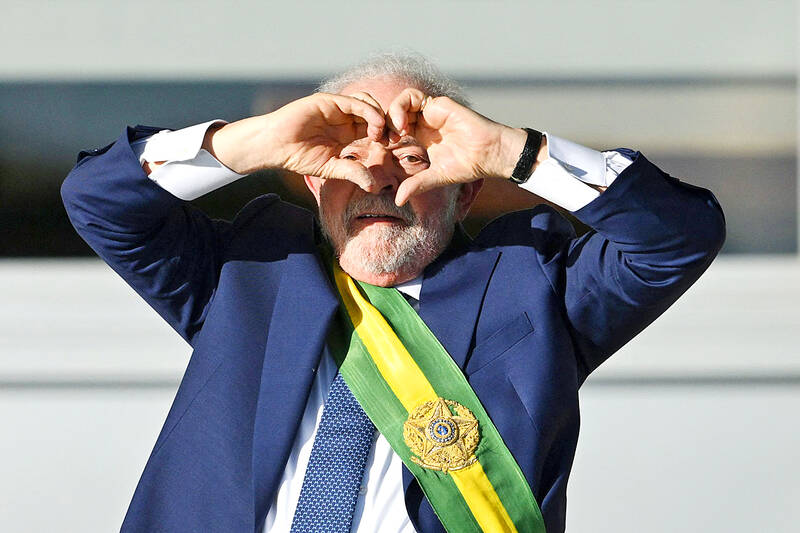
Photo: AFP
“The great edifice of rights, sovereignty and development that this nation built has been systematically demolished in recent years. To re-erect this edifice, we are going to direct all our efforts,” he said.
On Sunday afternoon in Brasilia’s main esplanade, tens of thousands of supporters decked out in the red of Lula’s Workers’ Party cheered after his swearing in.
They celebrated when the president said he would send a report about the prior administration to all lawmakers and judicial authorities, revoke Bolsonaro’s “criminal decrees” that loosened gun control and hold the prior administration responsible for its denial of the consequences of the COVID-19 pandemic.
“We do not carry any spirit of revenge against those who sought to subjugate the nation to their personal and ideological designs, but we are going to ensure the rule of law,” Lula said, without mentioning Bolsonaro by name.
“Those who erred will answer for their errors, with broad rights to their defense within the due legal process,” he added.
Lula’s presidency is unlikely to be like his previous two mandates, coming after the tightest presidential race in more than three decades in Brazil and resistance to his taking office by some of his opponents, political analysts said.
The leftist defeated Bolsonaro in last year’s Oct. 30 vote by less than 2 percentage points. For months, Bolsonaro had sown doubts about the reliability of Brazil’s electronic vote and his loyal supporters were loath to accept the loss.
Many have gathered outside military barracks since, questioning results and pleading with the armed forces to prevent Lula from taking office.
His most die-hard backers resorted to what some authorities and incoming members of Lula’s administration labeled acts of “terrorism” — which had prompted security concerns about inauguration day events.
Lula would have to navigate more challenging economic conditions than he enjoyed in his first two terms, when the global commodities boom proved a windfall for Brazil.
At the time, his administration’s flagship welfare program helped lift tens of millions of impoverished people into the middle class. He left office with a personal approval rating of 83 percent.
In the intervening years, Brazil’s economy plunged into two deep recessions — first, during the tenure of his handpicked successor, and then during the pandemic — and ordinary Brazilians suffered greatly.
Lula has said his priorities are fighting poverty, and investing in education and health. He has also said he would bring illegal deforestation of the Amazon to a halt.
He sought support from political moderates to form a broad front and defeat Bolsonaro, then tapped some of them to serve in his Cabinet.
In his first act as president on Sunday, Lula signed a decree to tighten gun control and set a 30-day deadline for the Office of the Comptroller General to evaluate various Bolsonaro decrees that placed official information under seal for 100 years.
He also signed a decree that guaranteed a monthly stipend for poor families, and reestablished the mainly Norway-financed Amazon fund for sustainable development in the rainforest.
Claudio Arantes, a 68-year-old pensioner, carried an old Lula campaign flag on his way to the esplanade. The lifelong Lula supporter attended his 2003 inauguration, and said that this time feels different.
“Back then, he could talk about Brazil being united. Now it is divided and won’t heal soon,” Arantes said. “I trust his intelligence to make this national unity administration work, so we never have a Bolsonaro again.”
Given the nation’s political fault lines, it is unlikely that Lula would reattain the popularity he once had, or even see his approval rating rise above 50 percent, said Mauricio Santoro, a professor of political science at Rio de Janeiro State University.
The credibility of Lula and his Workers’ Party were assailed by a sprawling corruption investigation, Santoro said, adding that party officials were jailed, including Lula — whose convictions were later annulled on procedural grounds — and the Supreme Court then ruled that the judge presiding over the case had colluded with prosecutors to secure a conviction.
Lula and his supporters have maintained he was railroaded. Others were willing to look past possible malfeasance as a means to unseat Bolsonaro and bring the nation back together.
“I always wanted to go the inauguration, I didn’t think I would have a chance to see Lula there after he was jailed,” said Tamires Valente, 43, a marketing professional from Brasilia. “I am very emotional, Lula deserves this.”
However, Bolsonaro’s backers refuse to accept someone they view as a criminal returning to the highest office. With tensions running hot, a series of events prompted fear that violence could erupt on inauguration day.
On Dec. 12, dozens of people tried to invade a federal police building in Brasilia, and burned cars and buses in other areas of the city. On Christmas Eve, police arrested a 54-year-old man who admitted to making a bomb that was found on a fuel truck headed to Brasilia’s airport.
He had been camped outside Brasilia’s army headquarters with hundreds of other Bolsonaro supporters since Nov. 12. He told police he was ready for war against communism, and planned the attack with people he had met at the protests, according to excerpts of his deposition released by local media.
Bolsonaro condemned the bomb plot in a Dec. 30 farewell address on social media, hours before flying to the US. His absence on inauguration day marks a break with tradition.
Instead of Bolsonaro, a group representing diverse segments of society presented Lula with the presidential sash atop the ramp of the presidential palace. Across the sea of people standing before the palace, supporters stretched a massive Brazilian flag over their heads.
Speaking to the crowd, Lula listed shortfalls in government funds that would affect Brazilians.
He said that, according to the transition team’s report on Bolsonaro’s government, textbooks have not been printed for public schools, there is insufficient free medication and COVID-19 vaccines, the threat looms of federal universities shutting down and civil defense authorities cannot work to prevent disasters.
“Who pays the price for this blackout is, once again, the Brazilian people,” he said.
The crowd promptly responded with the chant: “No amnesty! No amnesty! No amnesty!”
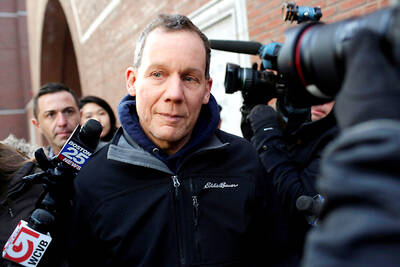
An American scientist convicted of lying to US authorities about payments from China while he was at Harvard University has rebuilt his research lab in Shenzhen, China, to pursue technology the Chinese government has identified as a national priority: embedding electronics into the human brain. Charles Lieber, 67, is among the world’s leading researchers in brain-computer interfaces. The technology has shown promise in treating conditions such as amyotrophic lateral sclerosis and restoring movement in paralyzed people. It also has potential military applications: Scientists at the Chinese People’s Liberation Army have investigated brain interfaces as a way to engineer super soldiers by boosting
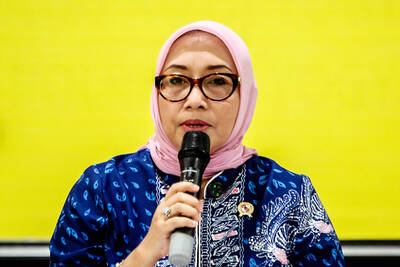
Indonesian police have arrested 13 people after shocking images of alleged abuse against small children at a daycare center went viral, sparking outrage across the nation, officials said on Monday. Police on Friday last week raided Little Aresha, a daycare center in Yogyakarta on Java island, following a report from a former employee. CCTV footage circulating on social media showed children, most younger than two, lying on the floor wearing only diapers, their hands and feet bound with rags. The police have confirmed that the footage is authentic. Police said they also found 20 children crammed into a room just 3m by 3m. “So
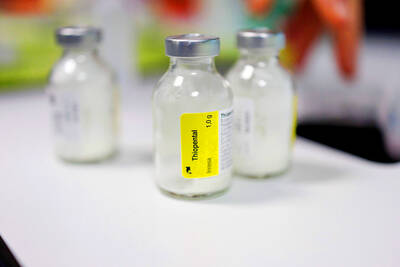
A grieving mother has ended her life at a clinic in Switzerland four years after the death of her only child. Wendy Duffy, 56, a physically healthy woman, died at the Pegasos clinic in Basel after struggling to cope with the death of her 23-year-old son, Marcus. The former care worker, from the West Midlands, England, had previously attempted to take her own life. The case comes as assisted dying would not become law in England and Wales after proposed legislation, branded “hopelessly flawed” by opponents, ran out of time. Ruedi Habegger, the founder of Pegasos, described Duffy’s death as
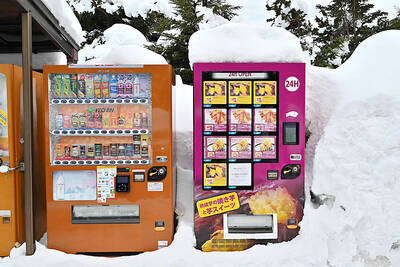
From post offices and parks to stations and even the summit of Mount Fuji, Japan’s vending machines are ubiquitous, but with the rapid pace of inflation cooling demand for their drinks, operators are being forced to rethink the business. Last month beverage giant DyDo Group Holdings announced it would remove about 20,000 vending machines — about 7 percent of their stock nationwide — by January next year, to “reconstruct a profitable network.” Pokka Sapporo Food & Beverage, based in Nagoya, also said last month it would sell its 40,000-machine operation to Osaka-based Lifedrink Co. “The strength of the vending machine


 RSS
RSS