


Thousands gathered in central Wuhan, China, on Saturday night to count down to the start of what many hoped would be a much better year after a “tough” last year filled with lockdowns and a major new outbreak of COVID-19 last month.
Many released balloons into the sky when the clocks struck midnight, as per tradition in the central Chinese city, where the COVID-19 pandemic began three years ago, before taking selfies with their friends.
“In the past year, I feel that COVID-19 was very serious and some of my family members have been hospitalized,” a 17-year-old high-school student surnamed Wang told reporters shortly after midnight. “I hope they will be healthy in the new year. This is the most important thing.”
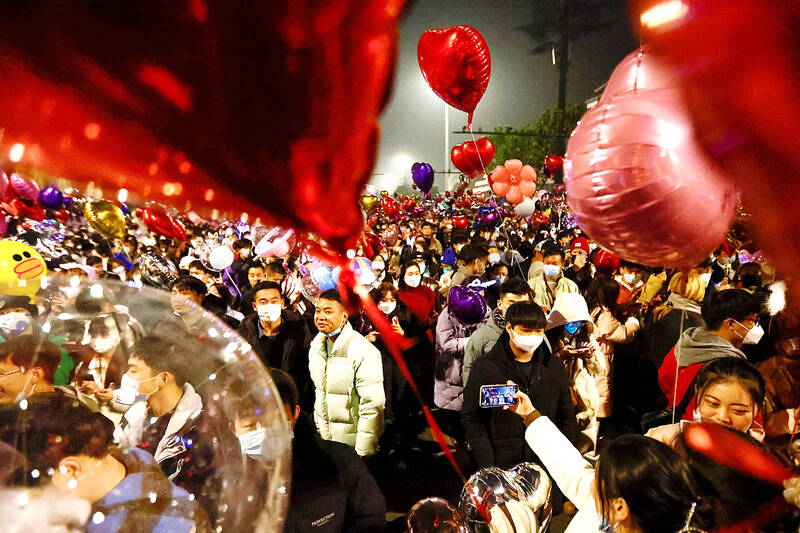
Photo: Reuters
Some came in fancy dress and almost everyone present wore masks as the country sees a wave of COVID-19, which accelerated after curbs were dropped and which has since infected large swathes of the population, with deaths reaching an estimated 9,000 a day, according to UK-based health data firm Airfinity.
“I am afraid,” a woman surnamed Jin said, referring to the possibility of being reinfected with COVID-19. “I was still afraid when I came out tonight, but I just wanted to come out, because everyone has come out.”
The crowds, including Jin, who were especially tightly packed in front of the old clock tower at Wuhan’s Hankou Customs House, were watched by large numbers of police officers, SWAT teams, unidentified plain-clothed personnel and other security workers.
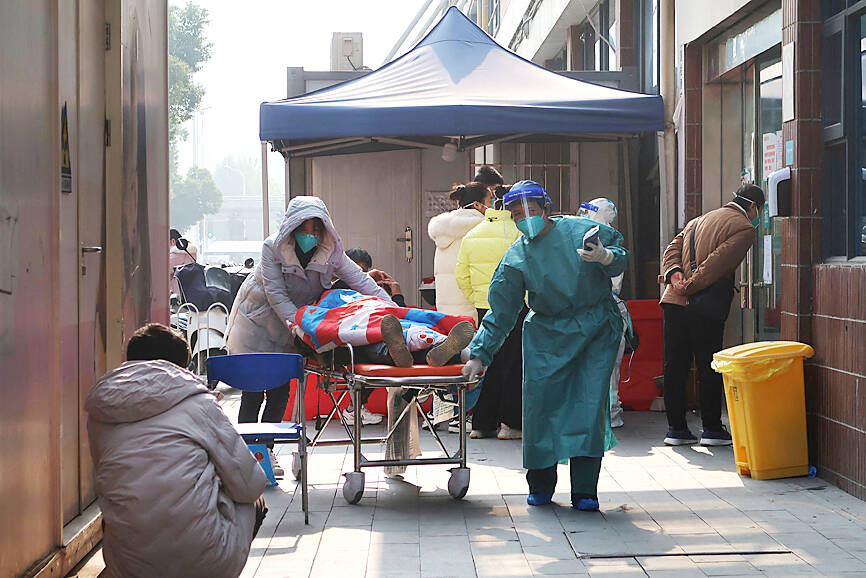
Photo: Reuters
In late November last year, hundreds of people took part in lockdown demonstrations on the streets of cities across the country, including Wuhan. Following those protests, China abandoned its strict “zero COVID-19” policy of stringent curbs.
“Those restrictions were in place for too long, so perhaps people were pretty unhappy,” a 24-year-old Wuhan-based e-commerce worker surnamed Chen said. “It had been a long time since things were lively and vibrant.”
Police used loudspeakers at a number of locations, blasting out a short message on a loop telling people not to gather, to which people appeared to take little or no notice.
People just wanted to have a nice time.
“I’m looking forward to the new year, but I’m also very nervous,” said Wuhan resident Lily Zhao, 37, who works as a kindergarten teacher. “I’m wondering when this epidemic will be completely over.“
A long line of people formed at the emergency department of Wuhan’s Tongji Hospital, a major facility for COVID-19 patients, such as a 72-year-old man surnamed Huang.
“I don’t feel well. I have no energy. I can’t breathe. I used to be in good health. I had X-rays to check my lungs... This hospital is a lot of trouble, you have to wait a long time,” he said.
the country’s abrupt U-turn on COVID-19 controls — as well as the accuracy of its case and mortality data — have come under increasing scrutiny at home and overseas.
The surge in cases has raised fresh worries about the health of the economy.
In his first public comments since the change in policy, Chinese President Xi Jinping (習近平) in a New Year’s address called for more effort and unity as China enters a “new phase.”
China reported one new COVID-19 death on Saturday, the same as a day earlier, the Chinese Center for Disease Control and Prevention said yesterday.
The accumulated official death toll in China now stands at 5,249, far lower than in other large countries. The Chinese government has rejected claims that it has deliberately underreported the total number of fatalities.
At the Hankou funeral home on the outskirts of Wuhan, an intermittent stream of mourners and hearse drivers were arriving yesterday.
Staff at the site’s heavily guarded entrance declined to answer questions about their recent workloads, but funeral homes in other cities in China — including Chengdu and Beijing — said they were busier than ever since China abruptly ditched its COVID-19 curbs.
In Shanghai, which like many Chinese cities was put under a lengthy lockdown last year, many on Saturday thronged the historic riverside walkway, the Bund.
“We’ve all traveled in from Chengdu to celebrate in Shanghai,” said Da Dai, a 28-year-old digital media executive who was traveling with two friends. “We’ve already had COVID, so now feel it’s safe to enjoy ourselves.”
While there were enough people on the Bund to warrant police directing the flow of those there, local eateries were less busy than in 2021.
“It’s not nearly as busy as it was last year,” said a waiter at the Lost Heaven restaurant close to the Bund.
Some tables were empty, which would not normally be the case on New Year’s Eve, he said, declining to be named as he was not authorized to speak to the media.
The restaurant had more than 200 bookings, but typically has 20 to 30 percent more, he said.
“People have been afraid to come out since the COVID policy was loosened,” he said. “Hopefully it’ll be better next year.”
ROCKY RELATIONS: The figures on residents come as Chinese tourist numbers drop following Beijing’s warnings to avoid traveling to Japan The number of Chinese residents in Japan has continued to rise, even as ties between the two countries have become increasingly fractious, data released on Friday showed. As of the end of December last year, the number of Chinese residents had increased by 6.5 percent from the previous year to 930,428. Chinese people accounted for 22.6 percent of all foreign residents in Japan, making them by far the largest group, Japanese Ministry of Justice data showed. Beijing has criticized Tokyo in increasingly strident terms since Japanese Prime Minister Sanae Takaichi last year suggested that a military conflict around Taiwan could
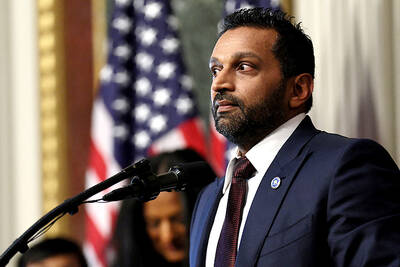
A pro-Iran hacking group claimed to breach FBI Director Kash Patel’s personal e-mail inbox and posted some of the contents online. The e-mails provided by the hacking group include travel details, correspondence with leasing agents in Washington and global entry, and loyalty account numbers. The e-mail address the hackers claim to have compromised has been previously tied to Patel’s personal details, and the leaked e-mails contain photos of Patel and others, in addition to correspondence with family members and colleagues. “The FBI is aware of malicious actors targeting Director Patel’s personal email information,” the agency said in a statement on
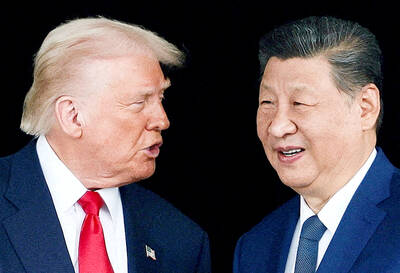
RIVALRY: ‘We know that these are merely symbolic investigations initiated by China, which is in fact the world’s most profligate disrupter of supply chains,’ a US official said China has started a pair of investigations into US trade practices, retaliating against similar probes by US President Donald Trump’s administration as the superpowers stake out positions before an expected presidential summit in May. The move, announced by the Chinese Ministry of Commerce on Friday, is a direct mirror of steps Trump took to revive his tariff agenda after the US Supreme Court last month struck down some of his duties. “China expresses its strong dissatisfaction and firm opposition to these actions,” a ministry spokesperson said in a statement, referring to the so-called Section 301 investigations initiated on March 11.

When a hiker fell from a 55m waterfall in wild New Zealand bush, rescuers were forced to evacuate the badly hurt woman without her dog, which could not be found. After strangers raised thousands of dollars for a search, border collie Molly was flown to safety by a helicopter pilot who was determined to reunite the pet and the owner. A week earlier, an emergency rescue helicopter found the woman with bruises and lacerations after a fall at a rocky spot at the waterfall on the South Island’s West Coast. She was airlifted on March 24, but they were forced to


 RSS
RSS