


The bodies of 70 inmates from the Philippines’ largest prison were yesterday laid to rest in a mass burial, weeks after their decomposing remains were discovered in a Manila funeral home.
They were among 176 corpses police found during an investigation into the death of an inmate, who was accused of being involved in the killing of a journalist in early October.
Most of the deaths were due to “natural causes,” Philippine Bureau of Corrections health and welfare services head Cecilia Villanueva said.
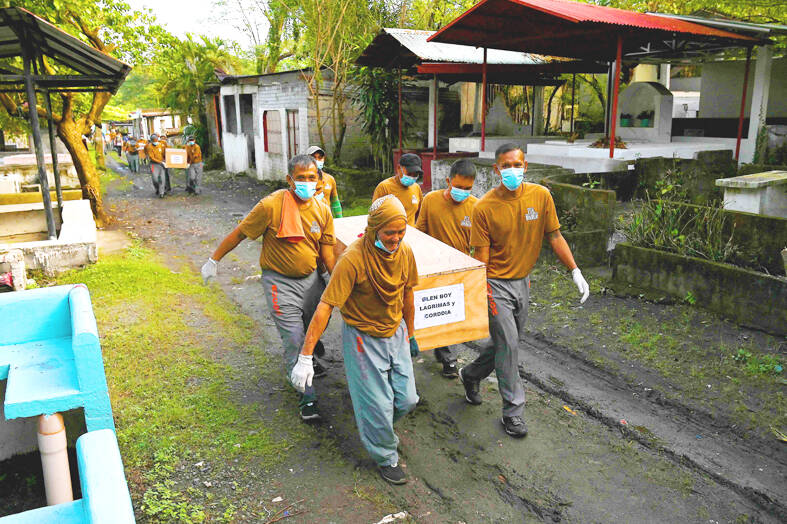
Photo: AFP
Among them was a Japanese national.
Villanueva said 127 of the 140 bodies buried so far were badly decomposed and could not be autopsied again.
The bodies began piling up in the funeral home in December last year after their families — most of them poor — did not claim them.
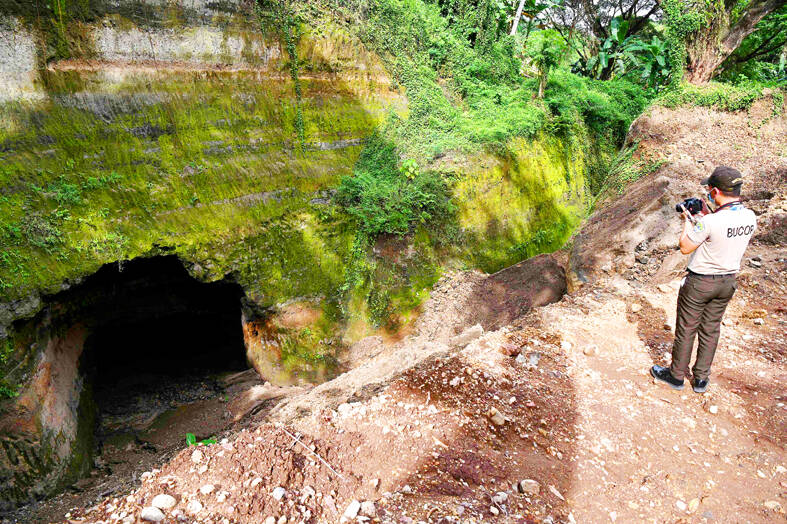
Photo: AFP
Villanueva blamed “constraints” for the failure of corrections staff to ensure the inmates were given timely burials.
Bodies are normally held at the accredited funeral home for three months to give relatives time to retrieve them.
Yesterday’s mass burial was the biggest ever by the Bureau of Corrections, Villanueva told reporters.
Minimum security inmates carried the 70 plywood coffins to their final resting place — concrete tombs in a cemetery inside the prison complex.
The gruesome discovery at the funeral home was only the latest scandal to rock the troubled bureau, which runs the country’s overcrowded prison system.
Bureau Director-General Gerald Bantag is accused of ordering the killing of radio broadcaster Percival Mabasa, as well as Cristito Villamor Palana, an inmate who allegedly passed on the kill order to the gunman.
After Bantag was suspended from his job as director general, a huge pit was discovered next to his former official residence inside the prison complex.
Bantag claims it was for scuba diving, not an escape tunnel for inmates.
Among the remaining bodies still at the funeral home, eight would be re-examined by Raquel Fortun, one of the country’s two forensic pathologists.
Villanueva said an average of one to two prisoners died every day inside the New Bilibid Prison, where about 29,000 inmates are held in a facility designed for 6,435. There were only five doctors to treat the prisoners, but the bureau was trying to hire more.
“We are doing everything we can, we try to provide healthcare, just as healthcare is provided to the public, but there are so many constraints,” Villanueva said.

An American scientist convicted of lying to US authorities about payments from China while he was at Harvard University has rebuilt his research lab in Shenzhen, China, to pursue technology the Chinese government has identified as a national priority: embedding electronics into the human brain. Charles Lieber, 67, is among the world’s leading researchers in brain-computer interfaces. The technology has shown promise in treating conditions such as amyotrophic lateral sclerosis and restoring movement in paralyzed people. It also has potential military applications: Scientists at the Chinese People’s Liberation Army have investigated brain interfaces as a way to engineer super soldiers by boosting

Indonesian police have arrested 13 people after shocking images of alleged abuse against small children at a daycare center went viral, sparking outrage across the nation, officials said on Monday. Police on Friday last week raided Little Aresha, a daycare center in Yogyakarta on Java island, following a report from a former employee. CCTV footage circulating on social media showed children, most younger than two, lying on the floor wearing only diapers, their hands and feet bound with rags. The police have confirmed that the footage is authentic. Police said they also found 20 children crammed into a room just 3m by 3m. “So
A grieving mother has ended her life at a clinic in Switzerland four years after the death of her only child. Wendy Duffy, 56, a physically healthy woman, died at the Pegasos clinic in Basel after struggling to cope with the death of her 23-year-old son, Marcus. The former care worker, from the West Midlands, England, had previously attempted to take her own life. The case comes as assisted dying would not become law in England and Wales after proposed legislation, branded “hopelessly flawed” by opponents, ran out of time. Ruedi Habegger, the founder of Pegasos, described Duffy’s death as

From post offices and parks to stations and even the summit of Mount Fuji, Japan’s vending machines are ubiquitous, but with the rapid pace of inflation cooling demand for their drinks, operators are being forced to rethink the business. Last month beverage giant DyDo Group Holdings announced it would remove about 20,000 vending machines — about 7 percent of their stock nationwide — by January next year, to “reconstruct a profitable network.” Pokka Sapporo Food & Beverage, based in Nagoya, also said last month it would sell its 40,000-machine operation to Osaka-based Lifedrink Co. “The strength of the vending machine


 RSS
RSS