


Supervisors in San Francisco on Tuesday voted to give city police the ability to use potentially lethal, remote-controlled robots in emergency situations following a debate that reflected divisions on the board over support for law enforcement.
The vote was 8-3, with the majority agreeing to grant police the option despite strong objections from civil liberties and other police oversight groups.
Opponents said the authority would lead to the further militarization of a police force already too aggressive with poor and minority communities.

Photo: AP
San Francisco Supervisor Connie Chan, a member of the committee that forwarded the proposal to the full board, said she understood concerns over use of force, but that “according to state law, we are required to approve the use of these equipments. So here we are, and it’s definitely not a [sic] easy discussion.”
The San Francisco Police Department said it does not have pre-armed robots and has no plans to arm robots with guns.
However, the department could deploy robots equipped with explosive charges “to contact, incapacitate, or disorient violent, armed, or dangerous suspect” when lives are at stake, police spokeswoman Allison Maxie said in a statement.
“Robots equipped in this manner would only be used in extreme circumstances to save or prevent further loss of innocent lives,” Maxie said.
Supervisors amended the proposal to specify that officers could use robots only after using alternative force or de-escalation tactics, or concluding they would not be able to subdue the suspect through those alternative means.
Only a limited number of high-ranking officers could authorize use of robots as a deadly force option.
San Francisco police have a dozen functioning ground robots used to assess bombs or provide eyes in low-visibility situations, the department said.
They were acquired between 2010 and 2017, and not been used to deliver an explosive device, police officials said.
However, explicit authorization was required after a new California law went into effect this year requiring police and sheriffs departments to inventory military-grade equipment and seek approval for its use.
The state law was authored last year by San Francisco City Attorney David Chiu while he was an assembly member. It is aimed at giving the public a forum and voice in the acquisition and use of military-grade weapons that have a negative effect on communities, the legislation says.
San Francisco police said that no robots were obtained from military surplus, but some were purchased with federal grant money.
Debate ran for more than two hours, with members on both sides accusing the other of reckless fear mongering.
City Supervisor Rafael Mandelman, who voted in favor of the policy authorization, said he was troubled by rhetoric painting the police department as untrustworthy and dangerous.
“I think there’s larger questions raised when progressives and progressive policies start looking to the public like they are anti-police,” Mandelman said. “I think that is bad for progressives. I think it’s bad for this board of supervisors. I think it’s bad for Democrats nationally.”
Board President Shamann Walton, who voted against the proposal, said that his vote made him not anti-police, but “pro people of color.”
“We continuously are being asked to do things in the name of increasing weaponry and opportunities for negative interaction between the police department and people of color,” he said. “This is just one of those things.”
The San Francisco Public Defender’s office on Monday sent a letter to the board saying that granting police “the ability to kill community members remotely” goes against the city’s progressive values.
The public defender’s office wanted the board to reinstate language barring police from using robots against any person in an act of force.

An American scientist convicted of lying to US authorities about payments from China while he was at Harvard University has rebuilt his research lab in Shenzhen, China, to pursue technology the Chinese government has identified as a national priority: embedding electronics into the human brain. Charles Lieber, 67, is among the world’s leading researchers in brain-computer interfaces. The technology has shown promise in treating conditions such as amyotrophic lateral sclerosis and restoring movement in paralyzed people. It also has potential military applications: Scientists at the Chinese People’s Liberation Army have investigated brain interfaces as a way to engineer super soldiers by boosting

Indonesian police have arrested 13 people after shocking images of alleged abuse against small children at a daycare center went viral, sparking outrage across the nation, officials said on Monday. Police on Friday last week raided Little Aresha, a daycare center in Yogyakarta on Java island, following a report from a former employee. CCTV footage circulating on social media showed children, most younger than two, lying on the floor wearing only diapers, their hands and feet bound with rags. The police have confirmed that the footage is authentic. Police said they also found 20 children crammed into a room just 3m by 3m. “So
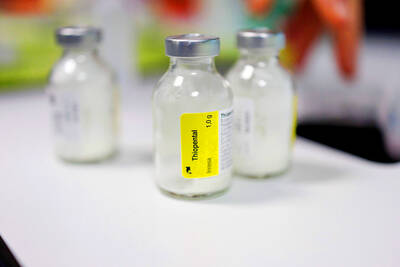
A grieving mother has ended her life at a clinic in Switzerland four years after the death of her only child. Wendy Duffy, 56, a physically healthy woman, died at the Pegasos clinic in Basel after struggling to cope with the death of her 23-year-old son, Marcus. The former care worker, from the West Midlands, England, had previously attempted to take her own life. The case comes as assisted dying would not become law in England and Wales after proposed legislation, branded “hopelessly flawed” by opponents, ran out of time. Ruedi Habegger, the founder of Pegasos, described Duffy’s death as
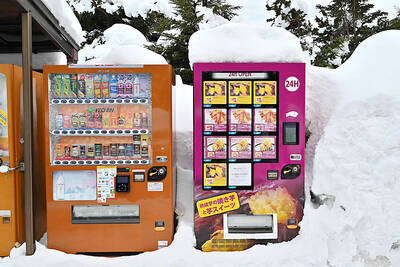
From post offices and parks to stations and even the summit of Mount Fuji, Japan’s vending machines are ubiquitous, but with the rapid pace of inflation cooling demand for their drinks, operators are being forced to rethink the business. Last month beverage giant DyDo Group Holdings announced it would remove about 20,000 vending machines — about 7 percent of their stock nationwide — by January next year, to “reconstruct a profitable network.” Pokka Sapporo Food & Beverage, based in Nagoya, also said last month it would sell its 40,000-machine operation to Osaka-based Lifedrink Co. “The strength of the vending machine


 RSS
RSS