


Nepal’s parliamentary elections tomorrow are the fourth since the Himalayan nation abolished a centuries-old monarchy and became a republic. Nepalis have seen little change since, with the same generation of leaders holding power through their control of the main political parties.
Many voters say they are tired of the same leaders retaining power and failing to deliver on promises to improve people’s lives while the country makes little progress.
Political instability has left Nepal with 13 different governments in the past 16 years. The frequent changes and squabbles among parties have been blamed for a slow economy.
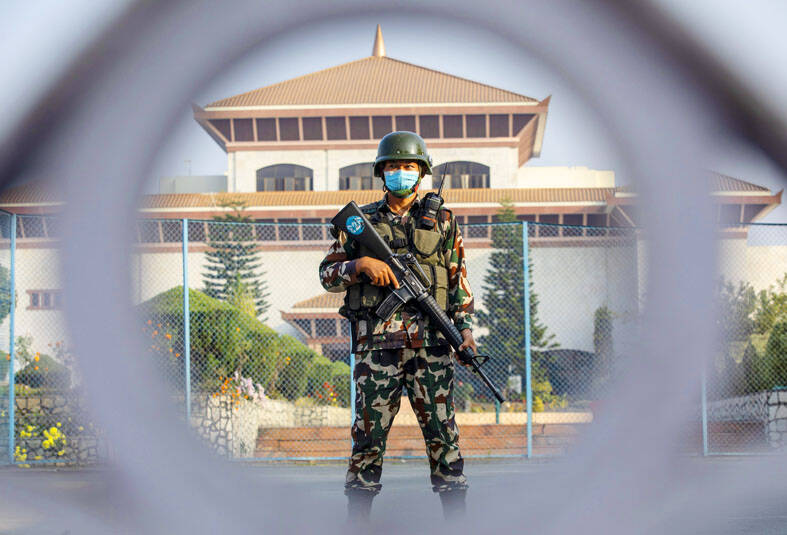
Photo: EPA-EFE
“My preference will be for young leaders, who will be able to be dedicated to work for the country,” business executive Hari Bhattarai, 40, said as he watched an election rally in the capital, Kathmandu.
“I don’t see any candidates other than the young leaders to be elected to move the country forward who will work for the economy, to boost the economy and repair the economy that was pushed back by the [COVID-19] pandemic,” he said.
People are sharing on social media a “no not again” campaign asking others not to return the same old leaders to parliament who would eventually be leading the government.

Photo: AFP
“The ‘no not again’ campaign did not come just like that. All good changes in the world have been done by the younger leaders,” said Yagya Mani Neupane, a lawyer. “The people who made changes in the 1990 democracy movement when they were younger are still leading the country, but have made little difference in the country now.”
Nepalese Prime Minister Sher Bahadur Deuba, 76, has been in the position five times. Both prominent leaders of the communist parties, Pushpa Kamal Dahal, 67, and Khadga Prasad Oli, 70, have been prime minister twice each.
Meanwhile, Nepal’s population is young, with 49 percent age 24 or under.
Analysts said that many voters are seeking fresh leadership and although changes are being seen, it was unlikely in the next elected government.
“They [voters] want to change the old guards who have failed to ensure good governance, rule of law in this country and justice,” said Bhojraj Pokharel, an independent analyst who is also the country’s former head election commissioner.
The desire for change in political leadership was evident in April, when, Balen Shah, a moderately known rap musician was elected Kathmandu mayor.
Shah, who is not affiliated with any political party, won a comfortable majority of votes while defeating well-known politicians.
Pokharel said that tomorrow’s election is unlikely to bring many young leaders to parliament because most of the candidates fielded by political parties are from the older generation.
“For the new generation to take over the government, we will have to wait until the next election,” he said.
Even a small number of young members can have influence and that a good track record once they are elected can create an environment to bring more of their voices into parliament, he said.
“This election will be major warning for the traditional parties,” Pokharel said. “I don’t expect it will totally influence the government and the system, however, it will strongly knock the doors of the traditional parties and they will be compelled to change themselves.”
One of the most prominent candidates in the younger generation is Gagan Thapa of the ruling Nepali Congress Party.
He has announced that after the election he will contest within the party against Deuba to be the candidate for the next prime minister.
“My preparation is for contesting as the prime minster candidate and I am making my public position with that goal,” Thapa said. “Just not me, I am appealing to all the other candidates in the party who win the election to be part of the change.”
The politicians leading the country and parties have been blamed for squabbling with each other for power while the country was struggling with the COVID-19 pandemic and its economic impact.
“Our economy is in bad shape, people are really frustrated, without working with sense of urgency we will not yield positive results, if we continue the old ways of working following the traditional format of governance there will be no results,” Thapa said. “For that there needs to be change in the core place of governance.”
“Without sitting in the driving seat there is not going to be any big change,” he said.
Election results are likely to take days if not weeks, as some ballot boxes need to be carried from remote villages in mountainous areas.
Once all votes are counted, the elected members in parliament will chose a prime minister who will have to get support of half the total members.
The next government, likely a coalition, is going to face challenges of keeping a stable political administration, revive the tourism industry and balance relations between China and India.

ROCKY RELATIONS: The figures on residents come as Chinese tourist numbers drop following Beijing’s warnings to avoid traveling to Japan The number of Chinese residents in Japan has continued to rise, even as ties between the two countries have become increasingly fractious, data released on Friday showed. As of the end of December last year, the number of Chinese residents had increased by 6.5 percent from the previous year to 930,428. Chinese people accounted for 22.6 percent of all foreign residents in Japan, making them by far the largest group, Japanese Ministry of Justice data showed. Beijing has criticized Tokyo in increasingly strident terms since Japanese Prime Minister Sanae Takaichi last year suggested that a military conflict around Taiwan could
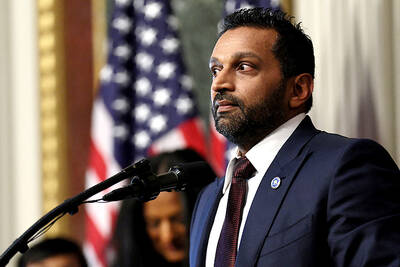
A pro-Iran hacking group claimed to breach FBI Director Kash Patel’s personal e-mail inbox and posted some of the contents online. The e-mails provided by the hacking group include travel details, correspondence with leasing agents in Washington and global entry, and loyalty account numbers. The e-mail address the hackers claim to have compromised has been previously tied to Patel’s personal details, and the leaked e-mails contain photos of Patel and others, in addition to correspondence with family members and colleagues. “The FBI is aware of malicious actors targeting Director Patel’s personal email information,” the agency said in a statement on
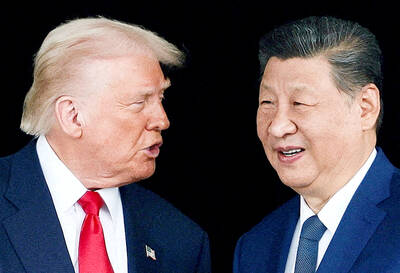
RIVALRY: ‘We know that these are merely symbolic investigations initiated by China, which is in fact the world’s most profligate disrupter of supply chains,’ a US official said China has started a pair of investigations into US trade practices, retaliating against similar probes by US President Donald Trump’s administration as the superpowers stake out positions before an expected presidential summit in May. The move, announced by the Chinese Ministry of Commerce on Friday, is a direct mirror of steps Trump took to revive his tariff agenda after the US Supreme Court last month struck down some of his duties. “China expresses its strong dissatisfaction and firm opposition to these actions,” a ministry spokesperson said in a statement, referring to the so-called Section 301 investigations initiated on March 11.

When a hiker fell from a 55m waterfall in wild New Zealand bush, rescuers were forced to evacuate the badly hurt woman without her dog, which could not be found. After strangers raised thousands of dollars for a search, border collie Molly was flown to safety by a helicopter pilot who was determined to reunite the pet and the owner. A week earlier, an emergency rescue helicopter found the woman with bruises and lacerations after a fall at a rocky spot at the waterfall on the South Island’s West Coast. She was airlifted on March 24, but they were forced to


 RSS
RSS