


More than 2,000 years after it was probably hung from the door of a mud-brick house in northern Spain to bring luck, a flat, life-size bronze hand engraved with dozens of strange symbols could help academics trace the development of one of the world’s most mysterious languages.
Although the piece — known as the Hand of Irulegi — was discovered last year by archeologists from the Aranzadi Science Society who have been digging near the city of Pamplona since 2017, its importance has only recently become clear.
Experts studying the hand and its inscriptions now believe it is the oldest written example of Proto-Basque, a find that “upends” much of what was previously known about the Vascones, a late iron age tribe that inhabited the area before the arrival of the Romans, and from whose ancient language modern Basque is thought to descend.
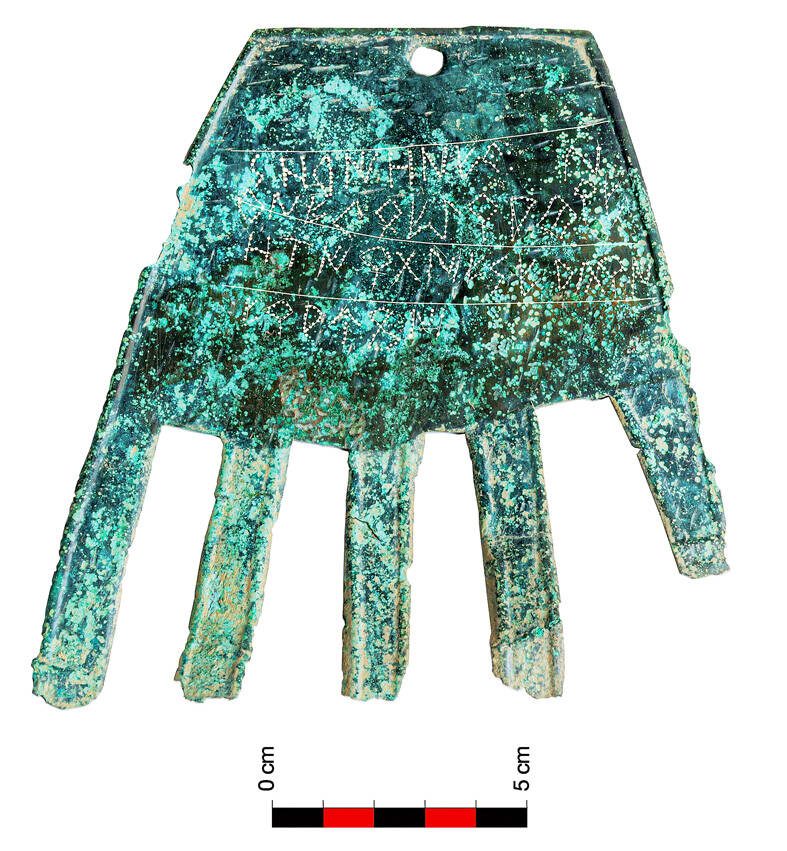
Photo: AFP / GOVERNMENT OF NAVARRA
Until now, academics believed that the Vascones had no written language — save for words found on coins — and only began writing after the Romans introduced the Latin alphabet.
However, the five words written in 40 characters identified as Vasconic, suggest otherwise.
The first — and only word — to be identified so far is sorioneku, a forerunner of the modern Basque word zorioneko, meaning good luck or good omen.

Photo: AFP
“This is the first document undoubtedly written in the Vasconic language and in characters that are also Vasconic,” said Javier Velaza, a professor of Latin philology at the University of Barcelona and one of the experts who deciphered the hand. “The writing system used is odd — it’s a writing system derived from the Iberian system, although there have been some adaptations to represent some sounds and phonemes that don’t exist in Iberian characters, but which have been seen in coins minted in Vascones territory.”
As a result, the artifact proves the existence of a specifically Vasconic writing system in use at the time it was made, Velaza said.
His colleague Joaquin Gorrochategui, a professor of Indo-European Linguistics at the University of the Basque Country, said the hand’s secrets would change the way academmics looked at the Vascones.
“This piece upends how we’d thought about the Vascones and writing until now,” he said. “We were almost convinced that the ancient Vascones were illiterate and didn’t use writing except when it came to minting coins.”
Mattin Aiestaran, the director of the Irulegi dig, said the site owes its survival to the fact that the original village was burned and then abandoned during the Sertorian war between two rival Roman factions in the 1st century BC.
The objects they left behind were buried in the ruins of their mud-brick houses.
“That’s a bit of luck for archeologists and it means we have a snapshot of the moment of the attack,” Aiestaran said. “That means we’ve been able to recover a lot of day-to-day material from people’s everyday lives. It’s an exceptional situation and one that has allowed us to find an exceptional piece.”
However, not every recent Basque-language discovery has lived up to its billing.
Two years ago, a Spanish archeologist was found guilty of faking finds that included pieces of third-century pottery engraved with one of the first depictions of Jesus, Egyptian hieroglyphics and Basque words that predated the earliest known written examples of the language by 600 years.
Although the archeologist, Eliseo Gil, said the pieces would “rewrite the history books,” an expert committee examined them and found traces of modern glue, as well as references to 17th-century French philosopher Rene Descartes.

PHISHING: The con might appear convincing, as the scam e-mails can coincide with genuine messages from Apple saying you have run out of storage For a while you have been getting messages from Apple saying “your iCloud storage is full.” They say you have exceeded your storage plan, so documents are no longer being backed up, and photos you take are not being uploaded. You have been resisting Apple’s efforts to get you to pay a minimum of £0.99 (US$1.33) a month for more storage, but it seems that you cannot keep putting off the inevitable: You have received an e-mail which says your iCloud account has been blocked, and your photos and videos would be deleted very soon. To keep them you need

For two decades, researchers observed members of the Ngogo chimpanzee group of Kibale National Park in Uganda spend their days eating fruits and leaves, resting, traveling and grooming in their tropical rainforest abode, but this stable community then fractured and descended into years of deadly violence. The researchers are now describing the first clearly documented example of a group of wild chimpanzees splitting into two separate factions, with one launching a series of coordinated attacks against the other. Adult males and infants were targeted, with 28 deaths. “Biting, pounding the victim with their hands, dragging them, kicking them — mostly adult males,

The Israeli military has demolished entire villages as part of its invasion of south Lebanon, rigging homes with explosives and razing them to the ground in massive remote detonations. The Guardian reviewed three videos posted by the Israeli military and on social media, which showed Israel carrying out mass detonations in the villages of Taybeh, Naqoura and Deir Seryan along the Israel-Lebanon border. Lebanese media has reported more mass detonations in other border villages, but satellite imagery was not readily available to verify these claims. The demolitions came after Israeli Minister of Defense Israel Katz called for the destruction of

SUPERFAN: The Japanese PM played keyboard in a Deep Purple tribute band in middle school and then switched to drums at university, she told the British rock band Legendary British rock band Deep Purple yesterday made Japanese Prime Minister Sanae Takaichi’s day with a brief visit to their high-profile superfan as they returned to the nation they first toured more than half a century ago. Takaichi’s reputation as an amateur drummer, and a fan of hard rock and heavy metal has been well documented, and she has referred to Deep Purple as one of her favorite bands along with the likes of Black Sabbath and Iron Maiden. “You are my god,” a giddy Takaichi said in English to Deep Purple drummer Ian Paice, presenting him with a set of made-in-Japan


 RSS
RSS