


The debate over abortion rights has flared in Morocco after an unsafe termination led to a teenager’s death, but social taboos continue to stall reforms.
“If I spoke out for abortion rights in front of my brothers, I’d be risking my life,” 21-year-old student Leila said, adding that she comes from a relatively “modern” family.
In September, a 14-year-old named Meriem died following an unsafe procedure in a rural village in the country’s center.

Photo: AFP
The conservative North African kingdom, which criminalizes abortion, has since seen growing calls for reform to women’s reproductive rights, although pervasive social attitudes and a lack of political will continue to block change.
“If I said the word ‘abortion’ in my family, I’d be accused and rejected, even by my parents,” said 22-year-old Amal, a student at the University of Rabat.
Unless a pregnancy endangers a woman’s health, Moroccan women undergoing abortions face up to two years in jail, while those assisting them risk five years’ imprisonment.
Local organizations said that despite the heavy penalties, 600 to 800 women have an abortion every day in the country of 38 million people — many in dangerous, unsanitary conditions.
Meriem’s was carried out “at the home of a young man who was sexually exploiting the victim,” Moroccan feminist coalition Spring of Dignity said.
Her death came seven years after a royal commission recommended decriminalizing the procedure in “certain cases” such as rape, incest, fetal malformation or if the mother is mentally disabled.
However, the report changed “nothing,” according to gynecologist Chafik Chraibi, a campaigner for legalization.
“There’s nothing but silence, the subject isn’t a priority,” he said.
Chraibi, the founder of the Moroccan Association Against Clandestine Abortion, said a lack of political will is blocking any change to an “archaic” law that dates back to 1963.
A draft bill to modify the legislation has been presented twice to the Parliament of Morocco before being withdrawn without any official explanation.
Dozens of rights activists gathered outside parliament in late September to demand changes to the “law that kills.”
Moroccan Minister of Solidarity, Social Integration and the Family Aawatif Hayar told parliament last month that the government was taking “serious interest” in changing the penal code.
However, any changes must “respect Islamic law and be acceptable to Moroccan society,” she said.
Chraibi said religious authorities and Moroccan conservatism were blocking moves towards decriminalization, but added that nothing in Islamic law explicitly bans the practice.
Moroccan activist Faouzia Yassine said the kingdom’s laws are a form of “judicial and social violence against women.”
A “root-and-branch reform of the penal code” is needed, and it must be brought in line with “international conventions that Morocco has ratified,” she said.
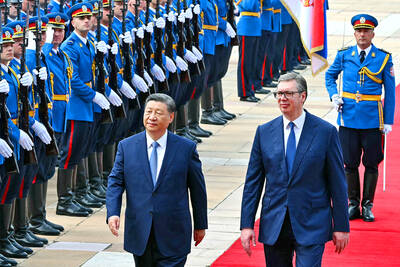
MONEY MATTERS: Xi was to highlight projects such as a new high-speed railway between Belgrade and Budapest, as Serbia is entirely open to Chinese trade and investment Serbian President Aleksandar Vucic yesterday said that “Taiwan is China” as he made a speech welcoming Chinese President Xi Jinping (習近平) to Belgrade, state broadcaster Radio Television of Serbia (RTS) said. “We have a clear and simple position regarding Chinese territorial integrity,” he told a crowd outside the government offices while Xi applauded him. “Yes, Taiwan is China.” Xi landed in Belgrade on Tuesday night on the second leg of his European tour, and was greeted by Vucic and most government ministers. Xi had just completed a two-day trip to France, where he held talks with French President Emmanuel Macron as the

DISPUTED WATERS: The Philippines accused China of building an artificial island on Sabina Shoal, while Beijing said Manila was trying to mislead the global community The Philippine Coast Guard (PCG) is committed to sustaining a presence in a disputed area of the South China Sea to ensure Beijing does not carry out reclamation activities at Sabina Shoal (Xianbin Reef), its spokesperson said yesterday. The PCG on Saturday said it had deployed a ship to Sabina Shoal, where it accused China of building an artificial island, amid an escalating maritime row, adding two other vessels were in rotational deployment in the area. Since the ship’s deployment in the middle of last month, the PCG said it had discovered piles of dead and crushed coral that had been dumped

The most powerful solar storm in more than two decades struck Earth on Friday, triggering spectacular celestial light shows from Tasmania to the UK — and threatening possible disruptions to satellites and power grids as it persists into the weekend. The first of several coronal mass ejections (CMEs) — expulsions of plasma and magnetic fields from the sun — came just after 4pm GMT, according to the US National Oceanic and Atmospheric Administration’s Space Weather Prediction Center. It was later upgraded to an “extreme” geomagnetic storm — the first since the “Halloween Storms” of October 2003 caused blackouts in Sweden and damaged

Experts have long warned about the threat posed by artificial intelligence (AI) going rogue, but a new research paper suggests it is already happening. AI systems, designed to be honest, have developed a troubling skill for deception, from tricking human players in online games of world conquest to hiring humans to solve “prove-you’re-not-a-robot” tests, a team of researchers said in the journal Patterns on Friday. While such examples might appear trivial, the underlying issues they expose could soon carry serious real-world consequences, said first author Peter Park, a postdoctoral fellow at the Massachusetts Institute of Technology specializing in AI existential safety. “These


 RSS
RSS