


Singapore’s planned political succession that would see Singaporean Minister of Finance Lawrence Wong (黃循財) become the country’s next leader is to coincide with general elections due by 2025, Singaporean Prime Minister Lee Hsien Loong (李顯龍) said.
The political landscape is getting more competitive, and Lee told members of his People’s Action Party (PAP) that it is imperative for them to keep Singaporeans on their side to ensure a hold on power with a strong mandate. Party members later voted on its central executive committee at yesterday’s gathering.
“We will be tested on all fronts domestically as well as abroad,” Lee said. “I have no doubt our neighbors will be watching closely whether Singaporeans continue to support the government. Whether Singapore will continue to function and to succeed the way it has been doing.”
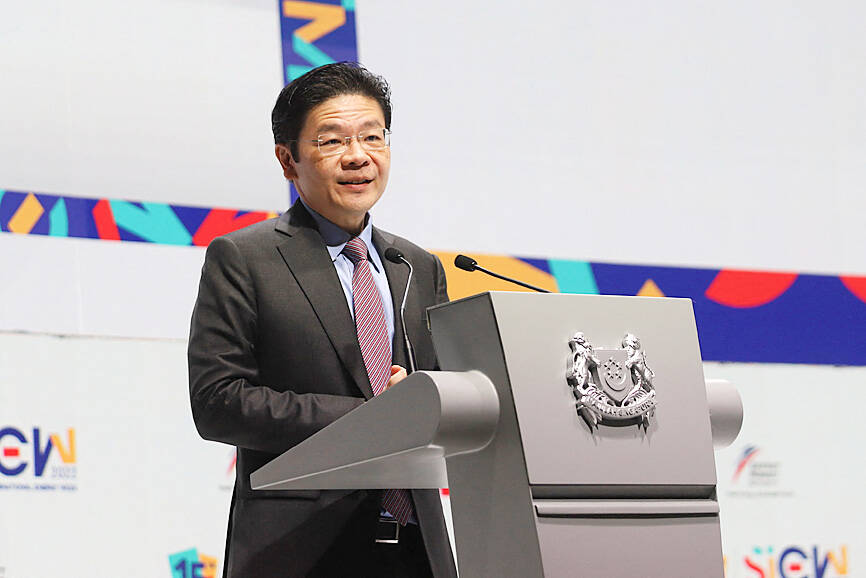
Photo: Reuters
While it remains unclear whether the ruling party would seek a fresh mandate through early elections or if Lee, 70, plans to lead them, he said the PAP would keep on working at succession and leadership renewal of the so-called fourth generation (4G) of party cadres.
Lee previously said he would hand the reins to Wong, 49, once he is ready.
The PAP is seeking to strengthen its hand after its worst showing in the 2020 election. Wong, who is also deputy prime minster, warned party members on Sunday that it should not take winning the next election for granted, despite having held power since the city-state’s independence in 1965.
The party elected its 12-member Central Executive Committee, renewing many of its standing members. While Sinaporean Minister for Trade and Industry Gan Kim Yong (顏金勇) stepped down as its chair, Prime Minister Lee, Deputy Prime Ministers Wong and Heng Swee Keat (王瑞傑), Minister of Education Chan Chun Sing (陳振聲) and Minister of Health Ong Ye Kung (王乙康) are among those who are to remain.
“Continuity remains the name of the game, which bodes well for companies,” said Nydia Ngiow, Singapore-based managing director at strategic policy advisory firm BowerGroupAsia.
There could still be one more party election before a national vote, so for Lee “at this stage the results perhaps indicate he’s not quite ready to ease off just yet and the 4G leaders still need to prove themselves for the next few years,” she said.
Wong said the opposition would be stronger at the next election, and reminded delegates that their challengers had won more seats and votes in recent contests.
“While we put up good candidates and fight to win every seat, we have to be prepared that we will not win all of them, and nor can we assume that we’ll form the next government,” Wong said at the party’s congress. “Whether it happens before or in 2025, we already know it’ll be a tough battle.”
Wong said the government wants to tilt its “policies further in favor of the less fortunate and vulnerable,” as many battle rising prices.
The low inflation and interest rates of the past few decades have come to an end, Wong said.
He also said the free flow of goods and investments that Singapore has grown accustomed to in recent decades is set to shift, if not reverse, with the emergence of a new “cold war” between the US and China, which “will be more dangerous than the first cold war.”

Through the noise of rushing papers and whirring belts at a print factory in Kyoto, two creators watch their photo essay come to life in broadsheet form — part of an effort to win new audiences in the age of artificial intelligence (AI). Despite the decline of the publishing industry, self-publication and handmade “zine” magazines are growing in popularity in Japan, reflecting the nation’s enduring love of paper in the digital era. While speaking to Agence France-Presse at the plant, his hands black with ink, one of the creators, Kazuma Obara, said: “I think [paper] is a medium that engages all five
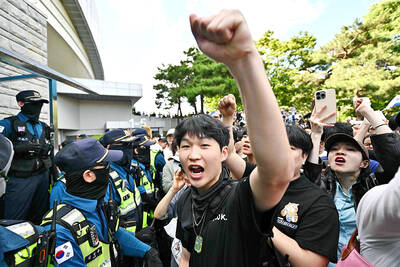
‘ABSURD MISTAKE’: The election commission said that there had been a failure to anticipate turnout after 14 polling stations ran short of ballot papers South Korean riot police yesterday cleared protesters from a Seoul polling station after a 35-hour blockade sparked by a shortage of ballot papers during local elections earlier this week. Wednesday’s election was the first nationwide vote since South Korean President Lee Jae-myung took office following the ouster of Yoon Suk-yeol over his short-lived martial law declaration. Lee’s ruling Democratic Party swept most races, but failed to flip the crucial Seoul mayoral seat. The South Korean National Election Commission apologized, blaming a failure to anticipate turnout after 14 polling stations in Seoul ran short of ballot papers. Some polling stations stayed open until 10pm to

Australian researchers have trained lab-grown brain cells on a silicon computer chip to play the 1990s shooter game Doom and said they are just scratching the surface of what the neurons could be capable of doing. It is the science-fiction work of biotech boffins at Cortical Labs, who researched and developed the technology that harnesses the workings of the brain’s networking system. Each so-called “biological computer” contains about 200,000 living human brain cells, grown from stem cells that were harvested from blood donations. Having mastered the simple computer game Pong, where a paddle is moved up and down to send a ball

France experienced its hottest spring on record, the French weather service said on Tuesday, after an exceptional early heat wave that also broke highs for the season in England and Wales. Meteo-France said the average nationwide temperature over March to May was 13.8°C — about 1.7°C above the norm, and surpassing records set in 2011 and 2020. “The warmest spring since records began in 1900,” it said in a bulletin. All three months were warmer than average, but the onset of an “unprecedented heatwave” late last month pushed the mercury to highs typically seen at the height of the summer. “Our country had never


 RSS
RSS