


Russia’s defense minister held a rare telephone talk with his US counterpart on Friday, after Russian-installed officials said they were turning Ukraine’s southern city of Kherson into a “fortress” as Kyiv’s forces advance.
Few details emerged of the conversation between Russian Minister of Defense Sergei Shoigu and US Secretary of Defense Lloyd Austin, but both sides confirmed they had discussed Ukraine.
“Topical issues of international security, including the situation in Ukraine, were discussed,” the Russian Ministry of Defense said.

Photo: AP
“Secretary Austin emphasized the importance of maintaining lines of communication amid the ongoing war against Ukraine,” a Washington spokesman said.
It was only the second call between the ministers since Moscow invaded Ukraine on Feb. 24.
Austin in May had urged Moscow to implement an “immediate ceasefire.”
At the time, Russia’s invading force had been beaten back from Kyiv, but were making steady gains in the eastern Donbas and Kharkiv regions, and had consolidated their position in the south.
Six months on, however, Ukraine’s forces have pushed back.
Kyiv’s forces in recent weeks — aided by Western weapons — have been advancing along the west bank of the Dnieper River toward the region’s main city, also called Kherson.
Being the first major city to fall to Moscow’s troops, retaking it would be a major prize in Ukraine’s counter-offensive.
Kyiv on Friday said it had retaken 88 towns and villages in the region since launching its offensive to retake Kherson in the late summer, while Ukrainian President Volodymyr Zelenskiy welcomed the capture of Russian arms by his forces in the region.
Moscow-installed authorities in the region on Friday accused Kyiv’s forces of attacking a bridge being used by civilians.
“Four people were killed,” Russian-installed official Kirill Stremousov wrote on social media. “The city of Kherson, like a fortress, is preparing for its defense.”
Russian investigators said later that two of the dead were journalists, and 13 people had been wounded.
Ukrainian military spokeswoman Nataliya Gumenyuk denied that Kyiv’s forces were responsible, saying they did not target local populations.
Kyiv has denounced the organized movement of Kherson residents to Russia and other Moscow-controlled regions, calling them “deportations” of Ukrainian citizens.
Zelenskiy told European leaders on Thursday that Russian forces had stripped the nearby Kakhovka hydroelectric power plant with the intent of blowing it up.
Its destruction could cause flash-flooding that would affect hundreds of thousands of people, he said.
Ukrainian Prime Minister Denys Shmygal on Friday called for an international monitoring mission at the dam.
Cutting water supplies to the south could also hit the cooling systems of the Zaporizhzhia nuclear power plant, Europe’s largest, he added.
Both sides have accused the other of repeatedly shelling the facility, endangering operations.
Ukraine’s push in the south comes after a sweeping counter-offensive in the northeast Kharkiv region that has badly impaired Russia’s supply routes and logistics corridors in the eastern Donbas region.
However, Russian forces have continued shelling the region’s largest city, Kharkiv, and the Ukrainian president’s office said six people were wounded Friday when “industrial infrastructure” was hit in the city.
The president’s office also said that Russian forces were shelling sections along the entire front line of Donbas, and that two had been killed in the Donetsk region.
Zelenskiy on Friday accused Russia of “deliberately delaying the passage of ships” exporting grain from Ukrainian ports bound for countries in Africa and Asia.
“Russia is doing everything to ensure that at least hundreds of thousands of these people become forced migrants, who will seek asylum” or “die of hunger,” he said in his nightly video address.
More than 150 ships had been affected, he said, listing Algeria, Bangladesh, China, Egypt, Indonesia, Iraq, Lebanon, Morocco and Tunisia among the countries hit by the delays.
Turkey and the UN in July brokered a landmark deal with Moscow and Kyiv that designated three Black Sea ports for Ukraine to send much-needed grain supplies through a Russian blockade.
Russia said that its own exports have suffered, and contended that most deliveries were arriving within Europe, rather than going to poor countries where grain is most needed.
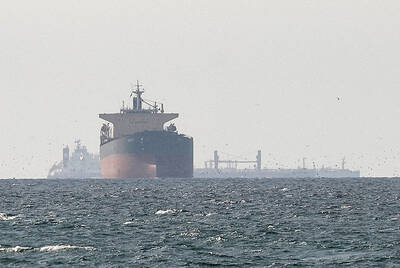
A ship that appears to be taking on the identity of a scrapped gas carrier exited the Strait of Hormuz on Friday, showing how strategies to get through the waterway are evolving as the Middle East war progresses. The vessel identifying as liquefied natural gas (LNG) carrier Jamal left the Strait on Friday morning, ship-tracking data show. However, the same tanker was also recorded as having beached at an Indian demolition yard in October last year, where it is being broken up, according to market participants and port agent’s reports. The ship claiming to be Jamal is likely a zombie vessel that

Cannabis-based medicines have shown little evidence of effectiveness for treating most mental health and substance-use disorders, according to a large review of past studies published in a major medical journal on Monday. Medical use of cannabinoids has been expanding, including in the US, Canada and Australia, where many patients report using cannabis products to manage conditions such as anxiety, post-traumatic stress disorder and sleep problems. Researchers reviewed data from 54 randomized clinical trials conducted between 1980 and May last year involving 2,477 participants for their analysis published in The Lancet. The studies assessed cannabinoids as a primary treatment for mental disorders or substance-use

NATIONWIDE BLACKOUT: US President Donald Trump cut off Venezuelan oil shipments to Cuba, strangling the Caribbean island’s already antiquated grid Cuba’s national electric grid collapsed on Monday, the nation’s grid operator said, leaving about 10 million people without power amid a US-imposed oil blockade that has crippled the already obsolete generation system. Grid operator UNE on social media said that it is investigating the causes of the blackout, the latest in a series of widespread outages that last for hours or days and that this weekend sparked a rare violent protest in the communist-run nation. Officials ruled out a major power plant failure, but had still not pinpointed the root cause of the grid collapse, suggesting a problem with transmission. Officials said that

‘HEALTH ISSUE’: More than 250 women are hospitalized every day due to complications from unsafe abortions, and about three die, a study showed Jane had been bleeding heavily for days before finally seeking help, not from a hospital, but from the man who sold her the pills meant to end her six-week pregnancy. Abortions are strictly outlawed in the mainly Catholic Philippines, forcing women to turn to a patchwork of providers operating in the online shadows. While rare in practice, Philippine law allows for prison terms of up to six years for abortion patients and providers, leaving thousands of Filipinas to search for solutions in online forums where unlicensed sellers promote abortifacients. “It was very painful, as if my abdomen was being twisted,” said Jane, whose


 RSS
RSS