


An overnight Russian missile strike killed 17 people in Zaporizhzhia, local authorities said yesterday, in the latest deadly attack to hit the southern Ukrainian city that President Volodymyr Zelenskiy called “absolute evil.”
The strike came a day after a key bridge linking Russia with Crimea — seen as a symbol of the Kremlin’s annexation of the peninsula — was partially destroyed by an explosion Moscow blamed on a truck bomb.
“After night missile attack on Zaporizhzhia, at least 20 houses and about 50 multistory buildings were damaged. Seventeen people died, as of now,” Zaporizhzhia City Council Secretary Anatoliy Kurtev wrote on Telegram.
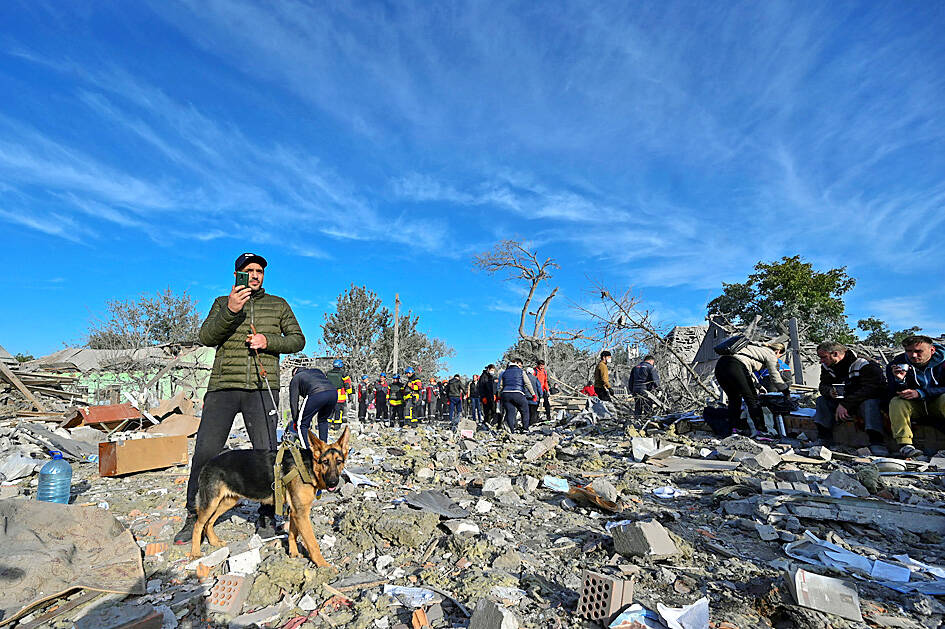
Photo: Reuters
Four educational institutions were also damaged, he added.
Zelenskiy and regional official Oleksandr Starukh provided a lower death toll of 12, with the latter saying that more victims might be under the rubble as a search-and-rescue operation was launched.
At least 17 people including a child died when seven Russian missiles hit Zaporizhzhia before dawn on Thursday, Ukrainian authorities announced in an upwardly revised toll on Saturday.
“Zaporizhzhia again. Merciless strikes on peaceful people again. On residential buildings, just in the middle of the night,” Zelenskiy wrote on Telegram of yesterday’s attack, adding that 49 people including six children were in hospital.
“Absolute meanness. Absolute evil. Savages and terrorists. From the one who gave this order to everyone who fulfilled this order. They will bear responsibility. For sure. Before the law and before people,” he said.
On Saturday, traffic resumed over the 19km Kerch Bridge, on a strait between the Black Sea and the Sea of Azov, which was struck in blast earlier in the day.
The bridge was hit by a blast around dawn on Saturday, killing three people, setting several oil tankers ablaze and collapsing two car lanes, Russian investigators said.
The explosion drew celebrations from Ukrainians and others on social media, but Zelenskiy made no direct mention of it in his nightly address and officials made no claim of responsibility.
Russian Deputy Prime Minister Marat Khusnullin told reporters that “traffic has been fully restored” on the bridge’s railway, state news agency RIA Novosti reported, without specifying when operations resumed.
Khusnullin had confirmed the resumption is for “both freight and passenger traffic” in an earlier post on Telegram, and said one of the destroyed lanes would be restored “in the near future.”
Local officials had said earlier in the day that the bridge had been reopened to motor traffic with vehicles subject to stringent screening.
Rail operator Grand Service Express said the first trains had left the peninsula for Moscow and St Petersburg.
Dramatic social media footage posted less than 24 hours before Moscow’s statements showed the bridge on fire with parts plunging into the water.
Following the blast, the bodies of an unidentified man and a woman were pulled out of the water.
They were likely passengers in a vehicle driving near the exploded truck, Moscow said.
Authorities had identified the owner of the truck as a resident of Russia’s southern Krasnodar region, saying his home was being searched.
The Kremlin on Saturday also announced the appointment of a new general to lead its Ukraine offensive following a series of battlefield setbacks that triggered unprecedented criticism of its army at home.
Russian General Sergei Surovikin is to take over its forces in Ukraine. He previously led Russia’s forces in southern Ukraine. He has combat experience in the 1990s conflicts in Tajikistan and Chechnya, as well as, more recently, in Syria.
The decision, which — unusually — was made public, comes after growing discontent among the elite over the army’s leadership.


Showcasing phallus-shaped portable shrines and pink penis candies, Japan’s annual fertility festival yesterday teemed with tourists, couples and families elated by its open display of sex. The spring Kanamara Matsuri near Tokyo features colorfully dressed worshipers carrying a trio of giant phallic-shaped objects as they parade through the street with glee. The festival, as legend has it, honors a local blacksmith in the Edo Period (1603-1868) who forged an iron dildo to break the teeth of a sharp-toothed demon inhabiting a woman’s vagina that had been castrating young men on their wedding nights. A 1m black steel phallus sits in the courtyard of

JAN. 1 CLAUSE: As military service is voluntary, applications for permission to stay abroad for over three months for men up to age 45 must, in principle, be granted A little-noticed clause in sweeping changes to Germany’s military service policy has triggered an uproar after it emerged that the law requires men aged up to 45 to get permission from the armed forces before any significant stay abroad, even in peacetime. The legislation, which went into effect on Jan. 1 aims to bolster the military and demands all 18-year-old men fill out a questionnaire to gauge their suitability to serve in the armed forces, but stops short of conscription. If the “modernized” model fails to pull in enough recruits, parliament will be compelled to discuss the reintroduction of compulsory service, German
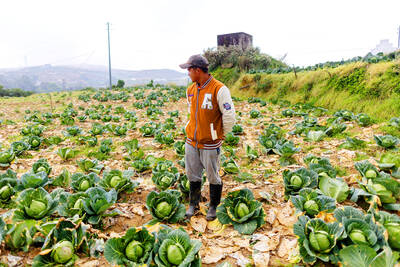
Filipino farmers like Romeo Wagayan have been left with little choice but to let their vegetables rot in the field rather than sell them at a loss, as rising oil prices linked to the Iran war drive up the cost of harvesting, labor and transport. “There’s nothing we can do,” said Wagayan, a 57-year old vegetable farmer in the northern Philippine province of Benguet. “If we harvest it, our losses only increase because of labor, transportation and packing costs. We don’t earn anything from it. That’s why we decided not to harvest at all,” he said. Soaring costs caused by the Middle East

Hungarian Prime Minister Viktor Orban’s officially declared wealth is fairly modest: some savings and a jointly owned villa in Budapest. However, voters in what Transparency International deems the EU’s most corrupt country believe otherwise — and they might make Orban pay in a general election this Sunday that could spell an end to his 16-year rule. The wealth amassed by Orban’s inner circle is fueling the increasingly palpable frustration of a population grappling with sluggish growth, high inflation and worsening public services. “The government’s communication machine worked well as long as our economic situation remained relatively good,” said Zoltan Ranschburg, a political analyst


 RSS
RSS