


Australia has a golden opportunity to expand its solar energy manufacturing capacity, as the industry booms and nations scramble to cut their over-dependence on China, a report by the Australian Photovoltaic Institute said.
The country has been installing 4 gigawatts (GW) of solar photovoltaic (PV) capacity each year, but meeting just 3 percent of that from a local supplier, Adelaide’s Tindo Solar.
That annual installation tally, though, is predicted to triple by 2050, particularly if Australia becomes a major supplier of hydrogen produced by renewable energy for export.

Photo: Bloomberg
“We have a pressing need, we have the natural resources and we have a very sizeable market,” the report said. “Unless Australia gains control over the most strategic parts of the PV value chain, the development of any ‘green’ export market will be completely dependent on foreign powers.”
Renate Egan, the institute secretary and head of the Australian Centre for Advanced Photovoltaics, said China should remain an important supplier of panels to Australia, but it is important to diversify supply, including by using local firms.
“You can liken it to Europe’s reliance on gas from Russia,” Egan said, referring to shortages and soaring gas prices after Moscow imposed export curbs in retaliation to sanctions.
“The world is relying increasingly on solar energy generation for the energy transition [from fossil fuels],” she said. “They’re becoming aware of the risks in that over 90 percent of the tech comes from China.”
The COVID-19 pandemic helped spur demand for more local manufacturing capability when Australia struggled to secure supplies of vaccines and medical equipment.
Ongoing supply chain disruptions, particularly as China maintains its “zero COVID” policies, have given added impetus to calls for more domestic production capability.
The present trade tensions between Australia and China exacerbated “the potential threat to supply restrictions or sudden price changes,” the report said.
“Adding to this risk is the growing concern over the possible use of forced labor in parts of China, where much of the silicon, wafers and steel used in PV components are produced,” it said.
Egan said Australian technology was used in 90 percent of PV panels made today, underscoring the country’s scientific pedigree in the field. The country does not need to make all of the components in modules, but could specialize.
Local firms could make glass, aluminum frames, polymers or the electronics such as inverters, while leaving production of polysilicon — a key raw material — to others.
“I think it’s at the top end of silicon refining and then module assembly,” Egan said. “We need to be making some smart decisions and deploying at scale.”
The paper cited existing suppliers, including Selectronic, one of the world’s oldest makers of inverters. SunDrive is a firm considering commercial-size silicon-based solar cell fabrication in Australia, while 5B is aiming at fast, low-cost PV deployment to supply some of the multi-gigawatt solar farms planned for northern Australia.
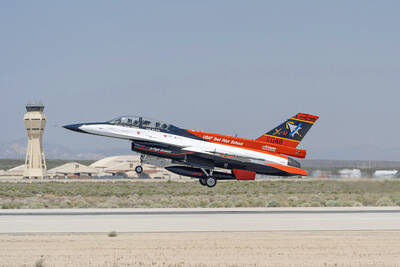
With the midday sun blazing, an experimental orange and white F-16 fighter jet launched with a familiar roar that is a hallmark of US airpower, but the aerial combat that followed was unlike any other: This F-16 was controlled by artificial intelligence (AI), not a human pilot, and riding in the front seat was US Secretary of the Air Force Frank Kendall. AI marks one of the biggest advances in military aviation since the introduction of stealth in the early 1990s, and the US Air Force has aggressively leaned in. Even though the technology is not fully developed, the service is planning
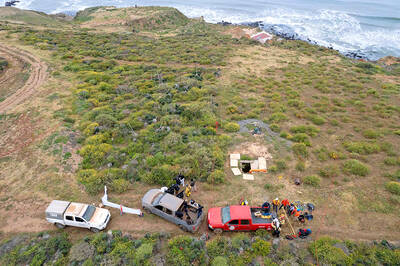
INTERNATIONAL PROBE: Australian and US authorities were helping coordinate the investigation of the case, which follows the 2015 murder of Australian surfers in Mexico Three bodies were found in Mexico’s Baja California state, the FBI said on Friday, days after two Australians and an American went missing during a surfing trip in an area hit by cartel violence. Authorities used a pulley system to hoist what appeared to be lifeless bodies covered in mud from a shaft on a cliff high above the Pacific. “We confirm there were three individuals found deceased in Santo Tomas, Baja California,” a statement from the FBI’s office in San Diego, California, said without providing the identities of the victims. Australian brothers Jake and Callum Robinson and their American friend Jack Carter

UNDER INVESTIGATION: Members of the local Muslim community had raised concerns with the police about the boy, who officials said might have been radicalized online A 16-year-old boy armed with a knife was shot dead by police after he stabbed a man in the Australian west coast city of Perth, officials said yesterday. The incident occurred in the parking lot of a hardware store in suburban Willetton on Saturday night. The teen attacked the man and then rushed at police officers before he was shot, Western Australian Premier Roger Cook told reporters. “There are indications he had been radicalized online,” Cook told a news conference, adding that it appeared he acted alone. A man in his 30s was found at the scene with a stab wound to his back.
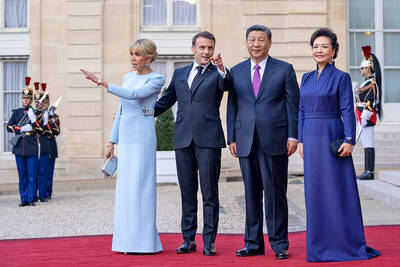
CUSTOMS DUTIES: France’s cognac industry was closely watching the talks, fearing that an anti-dumping investigation opened by China is retaliation for trade tensions French President Emmanuel Macron yesterday hosted Chinese President Xi Jinping (習近平) at one of his beloved childhood haunts in the Pyrenees, seeking to press a message to Beijing not to support Russia’s war against Ukraine and to accept fairer trade. The first day of Xi’s state visit to France, his first to Europe since 2019, saw respectful, but sometimes robust exchanges between the two men during a succession of talks on Monday. Macron, joined initially by EU Commission President Ursula von der Leyen, urged Xi not to allow the export of any technology that could be used by Russia in its invasion


 RSS
RSS