


The amount of vacant top-tier office space has more than doubled in Hong Kong over the past three years as companies downsize operations, researchers have found, warning that demand could remain soft even if COVID-19 pandemic controls are lifted.
The data add to warnings that Hong Kong’s shine as a business hub has been dulled by political unrest and a subsequent crackdown. Pandemic curbs have also kept the territory internationally isolated while rivals reopen.
Empty Grade A office space spiked from 390,000m2 to 892,000m2 in the three years leading up to March, a report by real-estate investment firm CBRE showed.
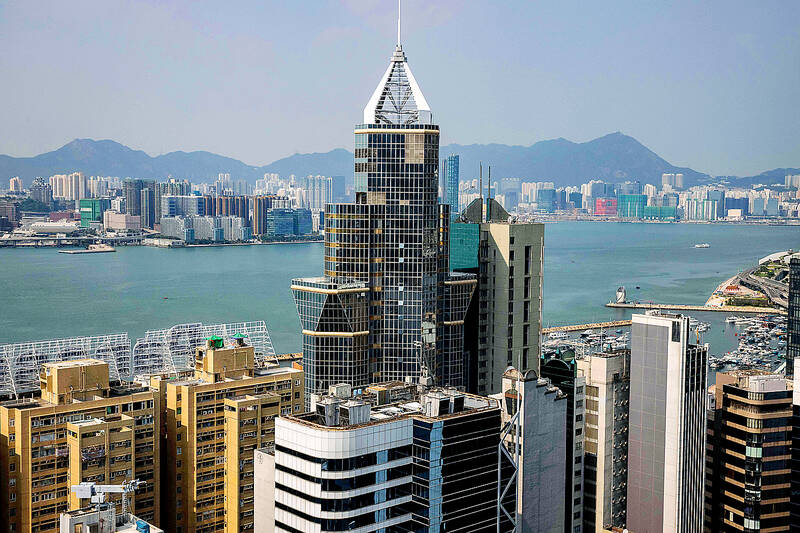
Photo: AFP
The jump came as a result of downsizing by nearly 950 companies, it said — a record high vacancy rate.
Occupancy fell by 210,000m2 in that same three-year period — sinking to 6.78 million square meters — making up Hong Kong’s “biggest and longest office market downcycle in history,” the report said.
Rents also dropped nearly 30 percent.
“The economic recession has prompted businesses to look at the office costs more carefully and reduce office footprint over the past few years,” CBRE head of research Marcos Chan (陳錦平) said.
Hong Kong had huge democracy protests in 2019, which often spilled over into core business districts and helped tip the territory briefly into a recession.
Beijing responded with a crackdown that has purged the territory of dissent and transformed its once outspoken vibe.
Meanwhile, throughout the pandemic Hong Kong has stuck to a version of Beijing’s “zero COVID-19” strategy, quashing outbreaks with travel curbs, targeted lockdowns and social distancing rules.
Foreign businesses have chafed at the strict pandemic-era border controls, which have kept Hong Kong internationally cut off, with some multinational firms relocating their regional headquarters or some staff to rival cities such as Singapore.
CBRE said that departing firms from the US, Europe, the Middle East and Asia were behind the reduced office occupancy while mainland Chinese companies saw mild growth in their footprint.
However, “there is no evidence of a widespread corporate exit from Hong Kong,” the report said.
From 2019 to this year, most sectors cut down on office space with the exceptions being the legal, real-estate and healthcare industries, as well as government departments, CBRE said.
The firm projected “gradual and moderate” growth in office demand after Hong Kong relaxes travel restrictions, citing Chinese enterprises as key growth drivers.
“New and expansionary demand from mainland Chinese companies will grow at a rate of no less than 770,000 square feet [71,535m2] per annum,” CBRE said.

The Bolivian government on Friday struck a deal with protesting miners, but was still grappling with blockades and demonstrations by other workers across La Paz. Other groups are still blocking access roads into the city, which is also the seat of the government. Police on Thursday prevented the miners from entering the main square by using tear gas, while the demonstrators hurled stones and explosives with slingshots. Protests against the policies of Bolivian President Rodrigo Paz have convulsed the Andean nation since early this month, and roadblocks were choking routes into La Paz throughout Friday, the national road authority said. Miners demanded that Paz
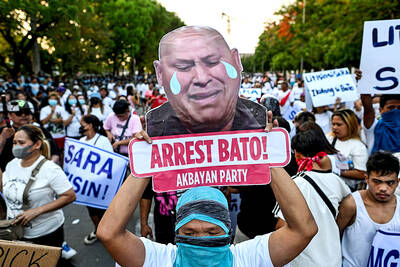
The Philippines said it has asked the country’s Supreme Court to allow it to arrest former Philippine president Rodrigo Duterte’s chief drug war enforcer to stand trial in an international tribunal. The International Criminal Court (ICC) last week unsealed an arrest warrant against Philippine Senator Ronald dela Rosa, accusing him along with Duterte and other “coperpetrators” of the “crime against humanity of murder.” Dela Rosa briefly sought refuge in the Philippine Senate last week while asking the Philippine Supreme Court to stop an ongoing attempt by government agents to arrest him. “By his own conduct, he has placed himself outside the protection of
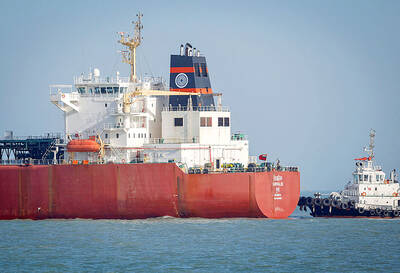
A ship anchored off the United Arab Emirates (UAE) was seized and taken toward Iran and another — a cargo ship near Oman — sank after being attacked, authorities said on Thursday, as tensions escalated near the Strait of Hormuz. It was not immediately clear who was behind these incidents, but they happened as a senior Iranian official reiterated his country’s claim of control over the waterway and another said it had a right to seize oil tankers connected to the US. The turmoil in the strait has been a sticking point for weeks in talks between the US and Iran to

The researchers in Ireland looked at their computer screen, marveling at a medieval book tracked down in a Roman library. They flipped through its digitized pages and found their sought-after treasure: the oldest surviving English poem. “We were extremely surprised. We were speechless. We couldn’t believe our eyes when we first saw that,” said Elisabetta Magnanti, a visiting research fellow at Trinity College Dublin’s school of English. The poem was also within the main body of Latin text, she said, calling it “extraordinary.” Composed in Old English by a Northumbrian agricultural worker in the 7th century, Caedmon’s Hymn appears within some copies of


 RSS
RSS