


Cockatoos and humans are locked in what Australian researchers have described as “an interspecies innovation arms race.”
Sydney residents are resorting to increasingly sophisticated measures to prevent sulfur-crested cockatoos from opening and raiding trash bins, detailed in new research published in the journal Current Biology.
The study, led by Barbara Klump of the Max Planck Institute of Animal Behavior in Germany, documented 52 combinations of techniques used by humans to deter the birds from their bin-raiding antics.
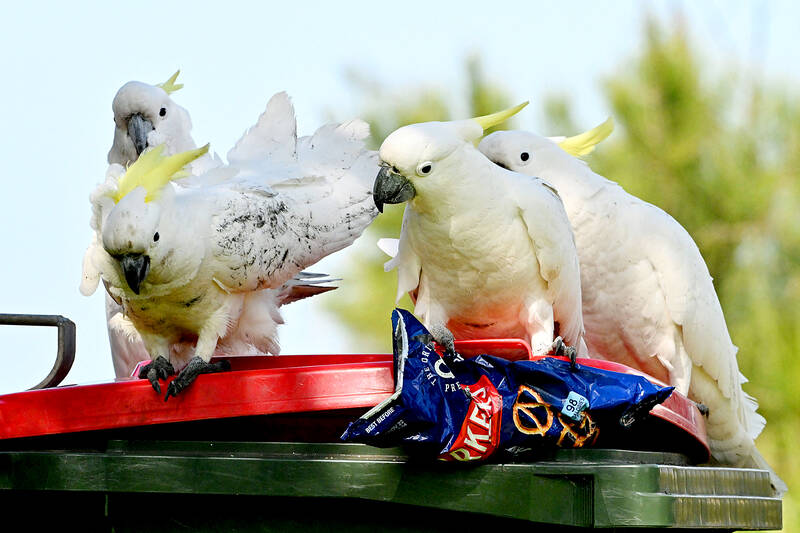
Photo: AFP
The researchers have previously described how cockatoos across the greater Sydney region learned their bin-opening skills from one another, with the behavior spreading from sightings in three suburbs before 2018 to 44 suburbs by the end of 2019.
Attracted by food waste, the highly intelligent parrots use their beaks and maneuver themselves to swing bin lids open.
The researchers conducted a census of 3,283 bins across four Sydney suburbs. In Stanwell Park, where the bin raiding was most common, they said that more than half of the bins had protection mechanisms in place.
They also surveyed more than 1,100 residents in the greater Sydney and Wollongong regions. Of the respondents, 172 people from 51 suburbs reported protecting their bins against cockatoos.
The challenge for humans is to secure the bins in a way that still allows them to be opened and emptied by automated garbage trucks.
The most basic cockatoo deterrent was the use of a brick or other heavy item to weigh down a lid.
“We have definitely seen cockatoos frequently pushing those off,” said Richard Major, a senior fellow at the Australian Museum and one of the study’s coauthors. “It’s a lot of fun watching a cockatoo pushing a brick off — you almost sense the satisfaction it gets as it does it.”
“Bricks seemed to work for a while, but cockies got too clever,” one survey respondent said.
One solution was to wedge a pair of running shoes near the hinge of the bin lid.
“When the bin truck lifts it up and turns it over, the lid is heavy enough to compress the sand shoe so that the lid can still open and dump rubbish,” Major said. “But [it] was a bit too much for a cockatoo to lift.”
Another successful technique was to strap full water bottles to the bin lid using zip ties. Some people tried putting rubber snakes on their bin lids, while others installed spikes around rims.
“The thing that this paper did was look seriously at the spatial variation in humans’ bin-opening solutions,” Major said. “Some of the techniques that people used appeared to be clustered spatially ... some people would use the same technique as their neighbor.”
The researchers consider the bin standoff to be an “innovation arms race” that involves “learned behavioral change in two populations/species.”
“Cockatoos — because of their large brain size and their sociality — they’ve adapted brilliantly to living with humans. And I guess now, with this arms race, we’re showing that humans are adapting brilliantly to live with cockatoos,” Major said.
Sulfur-crested cockatoos are capable of dancing in time to music, one of few nonhuman species recognized to possess the ability. They are notorious in Australia for their behavior and screeching.
“They’re a wonderful bird ... beautiful, charismatic, but they’re also bloody annoying,” Major said.

An American scientist convicted of lying to US authorities about payments from China while he was at Harvard University has rebuilt his research lab in Shenzhen, China, to pursue technology the Chinese government has identified as a national priority: embedding electronics into the human brain. Charles Lieber, 67, is among the world’s leading researchers in brain-computer interfaces. The technology has shown promise in treating conditions such as amyotrophic lateral sclerosis and restoring movement in paralyzed people. It also has potential military applications: Scientists at the Chinese People’s Liberation Army have investigated brain interfaces as a way to engineer super soldiers by boosting
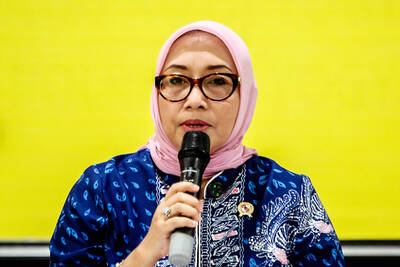
Indonesian police have arrested 13 people after shocking images of alleged abuse against small children at a daycare center went viral, sparking outrage across the nation, officials said on Monday. Police on Friday last week raided Little Aresha, a daycare center in Yogyakarta on Java island, following a report from a former employee. CCTV footage circulating on social media showed children, most younger than two, lying on the floor wearing only diapers, their hands and feet bound with rags. The police have confirmed that the footage is authentic. Police said they also found 20 children crammed into a room just 3m by 3m. “So
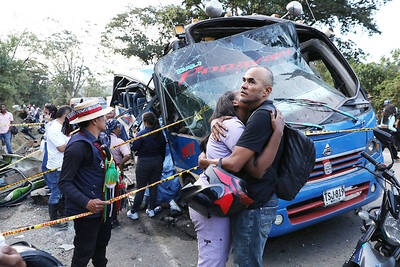
A highway bomb attack in a restive region of southwestern Colombia on Saturday killed 14 people and injured at least 38, the latest spate of violence ahead of next month’s presidential election. Authorities blamed the attack in the Cauca department — a conflict-ridden, coca-growing region — on dissidents of the now-disbanded FARC guerrilla army, who have been sowing violence across the country. “Those who carried out this attack ... are terrorists, fascists and drug traffickers,” Colombian President Gustavo Petro said on social media. “I want our very best soldiers to confront them,” he added. The leftist leader blamed the bombing
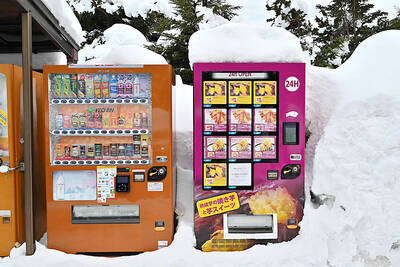
From post offices and parks to stations and even the summit of Mount Fuji, Japan’s vending machines are ubiquitous, but with the rapid pace of inflation cooling demand for their drinks, operators are being forced to rethink the business. Last month beverage giant DyDo Group Holdings announced it would remove about 20,000 vending machines — about 7 percent of their stock nationwide — by January next year, to “reconstruct a profitable network.” Pokka Sapporo Food & Beverage, based in Nagoya, also said last month it would sell its 40,000-machine operation to Osaka-based Lifedrink Co. “The strength of the vending machine


 RSS
RSS