


South Korea’s weather agency said there could be casualties as the nation prepares for the most powerful storm in its history is expected to make landfall this morning.
Oil refiners to chemical operations and the nation’s oldest nuclear power plant began taking precautions with Super Typhoon Hinnamnor expected to hammer the resort island of Jeju and the key industrial city of Ulsan on the country’s southeast coast after disrupting ports and air traffic across China and Japan.
“We’re now entering a phase where we have to minimize casualties,” Korea Meteorological Administration chief forecaster Han Sang-un said at a news conference yesterday.
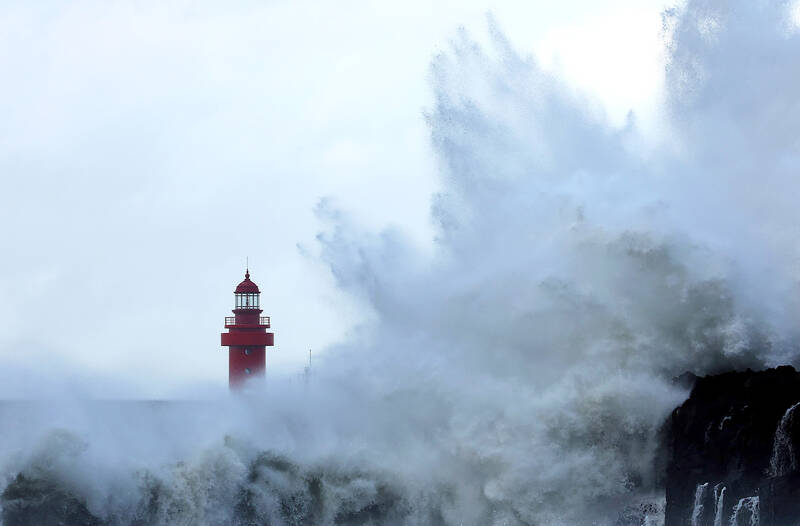
Photo: Reuters
He urged residents of southern coastal areas to remain indoors rather than perform maintenance to prepare for the storm’s arrival.
“It’s a massive typhoon with a 400km radius, which is big enough to cover Seoul to Busan. Most regions in Korea will experience intense rain and wind,” he said.
The typhoon is likely to hit Jeju at about 1am, and southern coastal cities at about 7am, the agency said.
Run rates of three reactors at the Kori Nuclear Power Plant were lowered to less than 30 percent to prepare for the storm, while liquefied natural gas traders said there would be delays to some shipments as the storm is avoided.
South Korea’s biggest oil refiner, SK Innovation Co, suspended crude vessels from entering its Ulsan port and is working on securing backup power supply at the plant, a company spokesman said.
GS Caltex Corp evacuated ships to a safety zone, and LG Chem Ltd is operating under an emergency response plan with bolstered safety monitoring of its plants in Yeosu and Ulsan.
State-owned Korea Electric Power Corp was taking measures to ensure a stable supply of electricity. Subsidiary Korea Hydro & Nuclear Power Co lowered output at the Kori nuclear plant preemptively to guard against any abrupt disruptions if reactors are directly impacted by Hinnamnor.
The storm, which is forecast to be even more destructive in South Korea than Typhoon Sarah in 1959 — the Pacific’s deadliest, with 2,000 killied — was heading north-northeast at about 17kph, about 300km south-southwest off the coast of Jeju as of noon yesterday, the weather agency said.
Hinnamnor is packing sustained winds of about 200kph with gusts as as fast as 250kph, the US Joint Typhoon Warning Center said.
South Korean President Yoon Suk-yeol said the government is remaining alert to protect the lives and safety of citizens, while South Korean Minister of Finance Choo Kyung-ho said there is a concern that worsening weather could affect consumer prices at a time when inflation remains high.
Hinnamnor has disrupted port operations, airline services and schools across Asia since developing last month. Shanghai’s major container port of Yangshan was preparing to resume terminal operations after an earlier halt, while South Korea’s Busan and Ulsan ports have closed.
Korean Air Lines Co and Asiana Airlines Inc canceled more than 170 domestic flights for yesterday and today, and some airline arrivals and departures in the Japanese prefecture of Okinawa were also scrapped. Some schools in South Korea and China will be closed for safety reasons.
South Korea’s top steelmaker, Posco Holdings Inc, is considering a partial closure of its plant in Pohang, and shipbuilders — including Korea Shipbuilding and Offshore Engineering Co, and Daewoo Shipbuilding and Marine Engineering Co — were debating whether to halt production, the companies said yesterday.
About 200 residents in coastal areas of Busan, the nation’s second-most populous city, were yesterday asked to evacuate to shelters, while stores at Marine City in the Haeundae beach district were told to temporarily close.
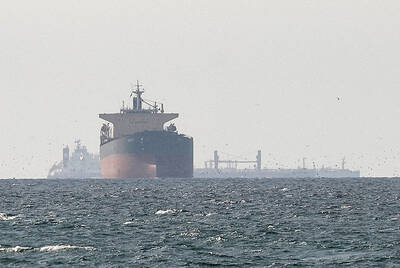
A ship that appears to be taking on the identity of a scrapped gas carrier exited the Strait of Hormuz on Friday, showing how strategies to get through the waterway are evolving as the Middle East war progresses. The vessel identifying as liquefied natural gas (LNG) carrier Jamal left the Strait on Friday morning, ship-tracking data show. However, the same tanker was also recorded as having beached at an Indian demolition yard in October last year, where it is being broken up, according to market participants and port agent’s reports. The ship claiming to be Jamal is likely a zombie vessel that

Cannabis-based medicines have shown little evidence of effectiveness for treating most mental health and substance-use disorders, according to a large review of past studies published in a major medical journal on Monday. Medical use of cannabinoids has been expanding, including in the US, Canada and Australia, where many patients report using cannabis products to manage conditions such as anxiety, post-traumatic stress disorder and sleep problems. Researchers reviewed data from 54 randomized clinical trials conducted between 1980 and May last year involving 2,477 participants for their analysis published in The Lancet. The studies assessed cannabinoids as a primary treatment for mental disorders or substance-use

NATIONWIDE BLACKOUT: US President Donald Trump cut off Venezuelan oil shipments to Cuba, strangling the Caribbean island’s already antiquated grid Cuba’s national electric grid collapsed on Monday, the nation’s grid operator said, leaving about 10 million people without power amid a US-imposed oil blockade that has crippled the already obsolete generation system. Grid operator UNE on social media said that it is investigating the causes of the blackout, the latest in a series of widespread outages that last for hours or days and that this weekend sparked a rare violent protest in the communist-run nation. Officials ruled out a major power plant failure, but had still not pinpointed the root cause of the grid collapse, suggesting a problem with transmission. Officials said that

‘HEALTH ISSUE’: More than 250 women are hospitalized every day due to complications from unsafe abortions, and about three die, a study showed Jane had been bleeding heavily for days before finally seeking help, not from a hospital, but from the man who sold her the pills meant to end her six-week pregnancy. Abortions are strictly outlawed in the mainly Catholic Philippines, forcing women to turn to a patchwork of providers operating in the online shadows. While rare in practice, Philippine law allows for prison terms of up to six years for abortion patients and providers, leaving thousands of Filipinas to search for solutions in online forums where unlicensed sellers promote abortifacients. “It was very painful, as if my abdomen was being twisted,” said Jane, whose


 RSS
RSS