


From the “leaning tower of pizza” to a fish slicing and cooking itself, and a dragon emerging from a dragon fruit, Japanese artisans’ quirky plastic food sculptures went on display last week at an exhibition in Tokyo.
The models were made with the same painstaking detail as the rock-solid noodle soups and crispy-looking plastic snacks that have long been displayed outside Japanese restaurants where they are called shokuhin sampuru, or “sample food products.”
Sampuru have been common sights outside ramen shops and family restaurants across Japan since a century ago, when stores began using wax models to advertise their menus to a growing middle class.
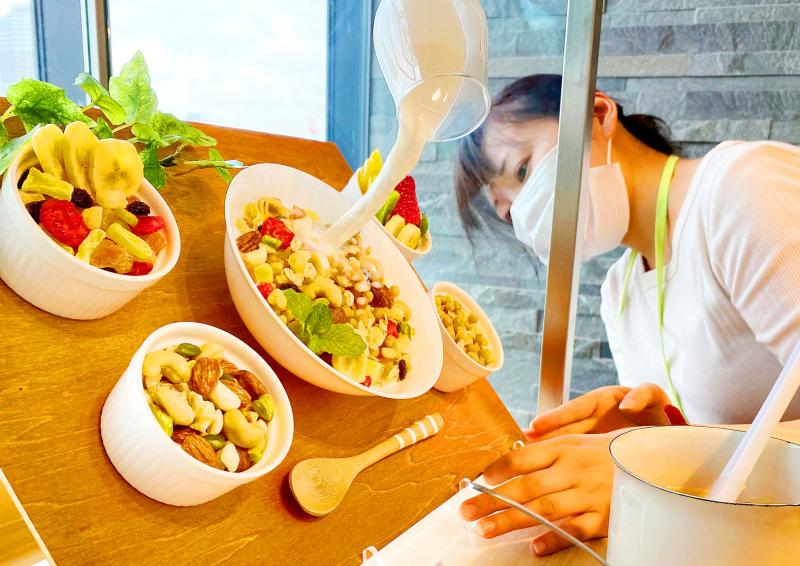
Photo: AFP
“Normally we have to follow orders from clients. We take their views on board when we’re making items,” plastic food artist Shinichiro Hatasa said.
When dreaming up fun designs, however, “you can use your imagination. How it ends up is totally up to you,” he said.
For the exhibition, Hatasa crafted an ear of corn leisurely sunbathing on a beach.
Other creations on display included a deep-fried shrimp with four breaded legs roaming like a tiger on a mountain of shredded cabbage, and a Tetris game made of chicken.
A Japanese breakfast dish of fermented soybeans called natto appeared to spiral in the air, resembling a powerful cyclone — nicknamed, naturally, a “nattornado.”
About 60 sculptures were on display, some silly, but others designed to showcase the artists’ formidable skills.
“They are not real, but they look so real. It’s wonderful,” exhibition attendee Reiko Ichimaru said.
All the models were handmade by specialists at Iwasaki Group, Japan’s leading sampuru maker, which celebrates its 90th anniversary this year.
At an Iwasaki factory in Yokohama near Tokyo, artisans first take molds of ingredients from actual meals cooked by the firm’s restaurant clients.
Then they begin the meticulous work of decorating the samples to look as realistic as possible, from moisture droplets on chilled glass to subtle bruises on a fruit’s surface.
“Fresh things are more difficult to make. Fresh vegetables, fresh fish. Cooked items are easier,” because the colors are less complicated, factory head Hiroaki Miyazawa said.
“Hamburger patties are for beginners,” he added.
Fake food is a lucrative market in Japan, but sampuru production has been hit by the COVID-19 pandemic, which reduced demand for dining out.
Sampuru makers hope more tourists are soon allowed into the country to boost the restaurant industry, but they are also putting their unique skills to use elsewhere.
For example, Iwasaki artisans have made replica bananas at different degrees of ripeness for factories to use to train new employees.
Orders have also come in from IT sales merchants, who want to use mock 5G Wi-Fi routers in their presentations.
At the exhibition, some of the more unique offerings are delighting children and adults alike.
“I think the number of restaurants using plastic food displays is decreasing,” exhibition attendee Yutaka Nishio said. “It’s interesting to preserve this as art. It’s really great.”

An American scientist convicted of lying to US authorities about payments from China while he was at Harvard University has rebuilt his research lab in Shenzhen, China, to pursue technology the Chinese government has identified as a national priority: embedding electronics into the human brain. Charles Lieber, 67, is among the world’s leading researchers in brain-computer interfaces. The technology has shown promise in treating conditions such as amyotrophic lateral sclerosis and restoring movement in paralyzed people. It also has potential military applications: Scientists at the Chinese People’s Liberation Army have investigated brain interfaces as a way to engineer super soldiers by boosting

Indonesian police have arrested 13 people after shocking images of alleged abuse against small children at a daycare center went viral, sparking outrage across the nation, officials said on Monday. Police on Friday last week raided Little Aresha, a daycare center in Yogyakarta on Java island, following a report from a former employee. CCTV footage circulating on social media showed children, most younger than two, lying on the floor wearing only diapers, their hands and feet bound with rags. The police have confirmed that the footage is authentic. Police said they also found 20 children crammed into a room just 3m by 3m. “So
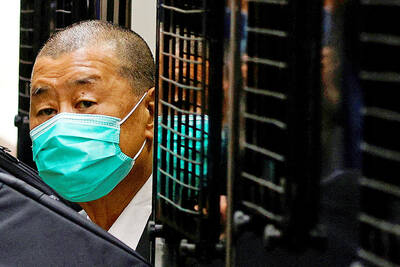
Jailed media entrepreneur Jimmy Lai (黎智英) has been awarded Deutsche Welle’s (DW) freedom of speech award for his contribution to Hong Kong’s pro-democracy movement. The German public broadcaster on Thursday said Lai would be presented in absentia with the 12th iteration of the award on June 23 at the DW Global Media Forum in Bonn. Deutsche Welle director-general Barbara Massing praised the 78-year-old founder of the now-shuttered news outlet Apple Daily for standing “unwaveringly for press freedom in Hong Kong at great personal risk.” “With Apple Daily, he gave journalists a platform for free reporting and a voice to the democracy movement in

PHILIPPINE COMMITTEE: The head of the committee that made the decision said: ‘If there is nothing to hide, there is no reason to hide, there is no reason to obstruct’ A Philippine congressional committee on Wednesday ruled that there was “probable cause” to impeach Philippine Vice President Sara Duterte after hearing allegations of unexplained wealth, misuse of state funds and threats to have the president assassinated. The unanimous decision of the 53-member committee in the Philippine House of Representatives sends the two impeachment complaints to deliberations and voting by the entire lower chamber, which has more than 300 lawmakers. The complaints centered on Duterte’s alleged illegal use and mishandling of intelligence funds from the vice president’s office, and from her time as education secretary under Philippine President Ferdinand Marcos Jr. Duterte and the


 RSS
RSS