


As 90-year-old Indian woman Reena Varma stood on the balcony of the house in Pakistan where she was born, visiting on Wednesday for the first in 75 years, she recalled her playful childhood.
“I would stand here and sing,” said Varma as her eyes filled with tears. “These are tears of joy.”
Varma has vivid memories of the day she and her family left the small, three-story home tucked away in the narrow alleys of the garrison city of Rawalpindi, where residents showered her with rose petals on her arrival on Wednesday.
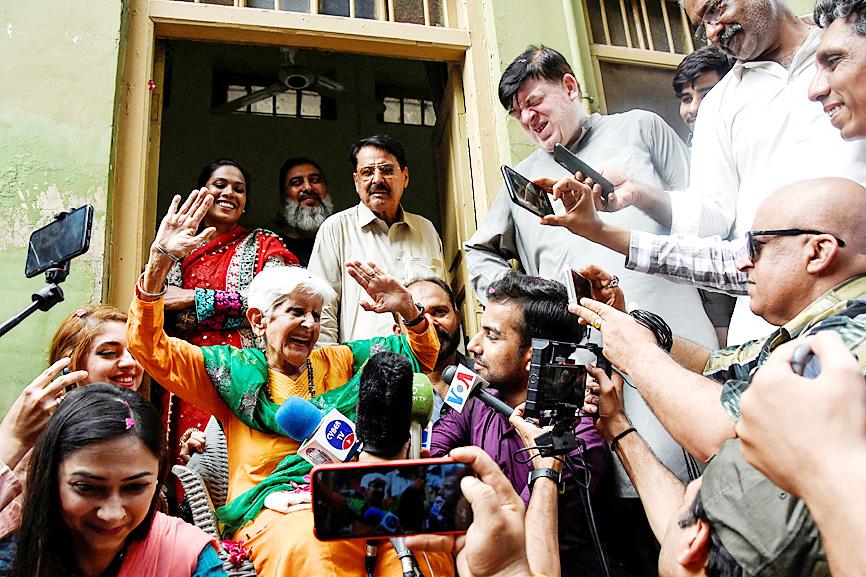
Photo: Reuters
She also danced with some of the residents who beat drums as she entered the street where she said she used to play from dawn to dusk.
Her family were among the millions whose lives were thrown into turmoil by the partition of colonial India into two states, mainly Hindu India and mostly Muslim Pakistan, when British rule ended in 1947.
One of the biggest mass migrations in history was marred by violence and bloodshed as about 15 million Muslims, Hindus and Sikhs swapped countries in a political upheaval that cost more than 1 million lives.
“I’m very happy to see that the house stood intact,” she said after spending several hours inside recalling memories of a childhood spent with her parents and five siblings.
At one point she burst into laughter over being unable to climb a staircase without a support, saying she had once tackled it “like a bird” countless times a day, according to a member of the family that now lives in the house.
Varma’s family fled to the western Indian city of Pune shortly before partition. She was 14 years old at the time. The rest of the family all died without seeing their former home again.
Pakistan and India have fought three wars since 1947 and relations have remained tense, making travel between the two countries nearly impossible.
However, after decades of attempts to get a visa, Varma crossed into Pakistan last week by road at a border crossing near the eastern city of Lahore.
The India Pakistan Heritage club run by Imran William and Sajjad Haider, which works to highlight the shared heritage of the two countries and reunite families separated by partition, helped with the process of finally getting permission to travel.
Varma urged both countries to ease their visa regimes to enable people of both countries to meet more frequently.
“I would urge the new generation that they work together to make things easy,” she said. “We have the same culture. We have the same things. We all want to live with love and peace.”
When she lived in Rawalpindi hers was a Hindu street, but Muslims, Christians and Sikhs all lived in her neighborhood peacefully, she said.
“I would say keep the humanity above everything,” she said. “All religions teach humanity.”

ACTIONABLE ADVICE: The majority of chatbots tested provided guidance on weapons, tactics and target selections, with Perplexity and Meta AI deemed to be the least safe From school shootings to synagogue bombings, leading artificial intelligence (AI) chatbots helped researchers plot violent attacks, according to a study published on Wednesday that highlighted the technology’s potential for real-world harm. Researchers from the nonprofit watchdog Center for Countering Digital Hate and CNN posed as 13-year-old boys in the US and Ireland to test 10 chatbots, including ChatGPT, Google Gemini, Perplexity, Deepseek and Meta AI. Eight of the chatbots assisted the make-believe attackers in more than half the responses, providing advice on “locations to target” and “weapons to use” in an attack, the study said. The chatbots had become a “powerful accelerant for

Australians were downloading virtual private networks (VPNs) in droves, while one of the world’s largest porn distributors said it was blocking users from its platforms as the country yesterday rolled out sweeping online age restriction. Australia in December became the first country to impose a nationwide ban on teenagers using social media. A separate law now requires artificial intelligence (AI)-powered chatbot services to keep certain content — including pornography, extreme violence and self-harm and eating disorder material — from minors or face fines of up to A$49.5 million (US$34.6 million). The country also joined Britain, France and dozens of US states requiring
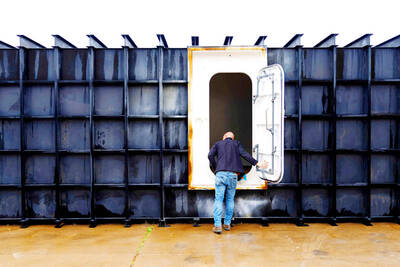
Since the war in the Middle East began nearly two weeks ago, the telephone at Ron Hubbard’s bomb shelter company in Texas has not stopped ringing. Foreign and US clients are rushing to buy his bunkers, seeking refuge in case of air raids, nuclear fallout or apocalypse. With the US and Israel pounding Iran, and Tehran retaliating with strikes across the region, Hubbard has seen demand for his product soar, mostly from Gulf nation customers in Bahrain, Qatar, Kuwait and the United Arab Emirates. “You can imagine how many people are thinking: ‘I wish I had a bomb shelter,’” Hubbard, 63, said in
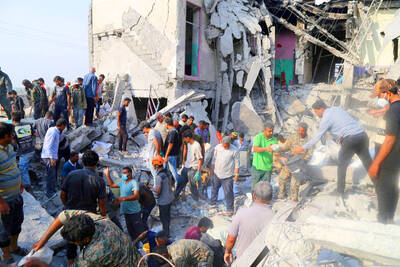
STILL IN POWER: US intelligence reports showed that the Iranian regime is not in danger of collapse and retains control of the public, casting doubt on Trump’s exit Nearly every US Senate Democrat on Wednesday signed a letter sent to US Secretary of Defense Pete Hegseth requesting a “swift investigation” of airstrikes on a girls’ school in Iran that killed scores of children and any other potential US military actions causing civilian harm. Reuters reported on Thursday last week that US military investigators believe it is likely that US forces were responsible for the Feb. 28 strike on the school, as US and Israeli forces launched attacks on Iran. “The results of this school attack are horrific. The majority of those killed in the strikes were girls between the ages


 RSS
RSS