


Iran’s president yesterday hosted his Russian and Turkish counterparts for talks on the Syrian war in a three-way summit overshadowed by fallout from Russia’s invasion of Ukraine.
The summit is the first hosted by ultra-conservative Iranian President Ebrahim Raisi since he took office last year, and the second trip abroad by Russian President Vladimir Putin since he ordered the invasion of Ukraine in February.
It comes days after US President Joe Biden visited the Middle East for the first time since taking office, with stops in Israel and Saudi Arabia — Iran’s regional foes.
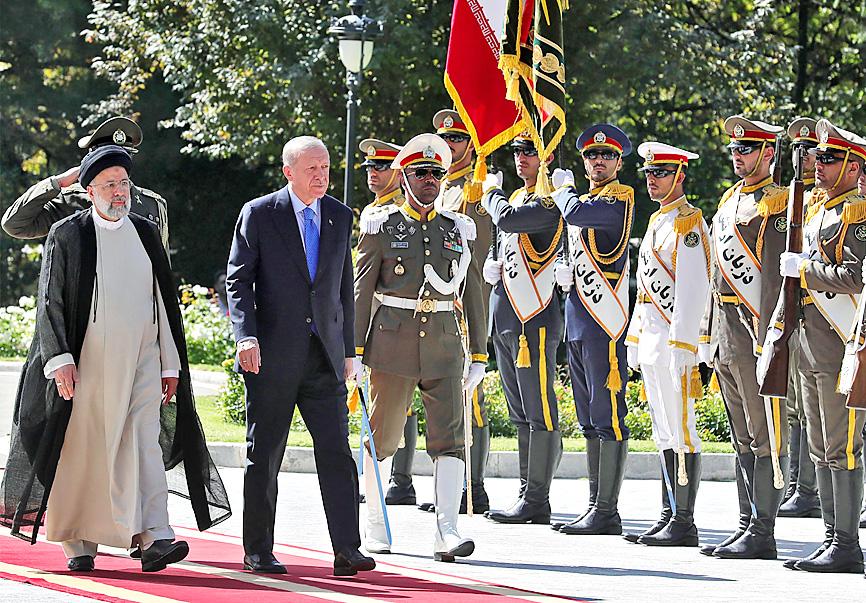
Photo: AFP / HO / Turkish Presidency
However, the trilateral summit is ostensibly centered on Syria, as part of the so-called Astana peace process to end more than 11 years of conflict in the Arab country.
All three are involved in Syria, with Iran and Russia supporting the regime of Syrian President Bashar al-Assad and Turkey backing rebel forces.
The gathering comes after Turkish President Recep Tayyip Erdogan late last year threatened to launch a new offensive in northern Syria against Kurdish militants.
Iran has already said that any Turkish military action in Syria could “destabilize the region.”
The summit would also enable Erdogan to hold his first meeting with Putin since Russia invaded Ukraine.
The Turkish president has for months been offering to meet the Russian leader in a bid to help resolve heightened global tensions since the war began.
“The timing of this summit is not a coincidence,” Russian analyst Vladimir Sotnikov said.
“Turkey wants to conduct a ‘special operation’ in Syria, just as Russia is implementing a ‘special operation’ in Ukraine,” he said.
Turkey has launched waves of attacks on Syria since 2016, targeting Kurdish militias, as well as Islamic State militants and forces loyal to Assad.
Putin and Erdogan, who arrived in Tehran on Monday, were to meet in the Iranian capital yesterday to discuss mechanisms to export grain from Ukraine, a Kremlin source said.
The Russian invasion of Ukraine has massively hampered shipments from one of the world’s biggest exporters of wheat and other grain, sparking fears of global food shortages.
Turkey — a NATO member on speaking terms with both Russia and Ukraine — has spearheaded efforts to resume the grain deliveries.
Ultimately, Erdogan is hoping to get “the green light” from Putin and Raisi for its military operation in Syria, said Sinan Ulgen, a visiting academic at Carnegie Europe who specializes in Turkish foreign policy.
The news that Putin and Erdogan are to meet came on a day that saw High Representative of the EU for Foreign Affairs and Security Policy Josep Borrell warn that Russia’s blockade of Ukrainian ports threatens supplies to countless thousands vulnerable to starvation.
He said the issue was “one of life and death for many human beings.”
On Sunday, a day after Biden ended his tour of the Middle East, Iran accused the US of provoking crises in the region.
Biden had said the US would not “tolerate efforts by any country to dominate another in the region through military buildups, incursions, and/or threats,” in a transparent reference to Iran.
In a speech in the Saudi Arabian city of Jeddah at a summit of Gulf Arab states, as well as Egypt, Jordan and Iraq, Biden assured the leaders gathered that the US would remain fully engaged in the Middle East.
“We will not walk away and leave a vacuum to be filled by China, Russia or Iran,” Biden said.
Following the meeting, a joint statement committed the leaders to “preserve regional security and stability.”
It also underscored efforts to prevent Iran from developing a nuclear weapon, a goal the Islamic republic has always denied having.
On Sunday, Iranian Ministry of Foreign Affairs spokesman Nasser Kanani accused the US of having “once again resorted to the failed policy of Iran-phobia, trying to create tensions and crises in the region.”
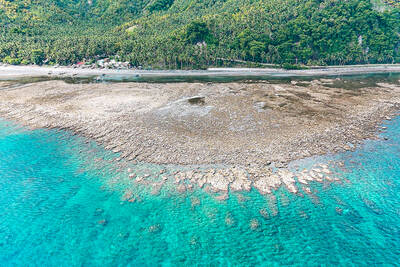
Arsenio Butil Jr fell to his knees and began to pray when last week’s deadly magnitude 7.8 earthquake began shaking his home on the coast of the southern Philippines. When he opened his eyes, he saw a once-familiar shoreline changing in real time, with swathes of previously submerged coral suddenly pushing above the waterline. The June 8 quake, driven by a shifting of the nearby Cotabato Trench, toppled buildings, triggered landslides and killed at least 76 people on the southern island of Mindanao. The tectonic forces at work also thrust chunks of the island’s coastline upward in a phenomenon known as “coastal uplift,”
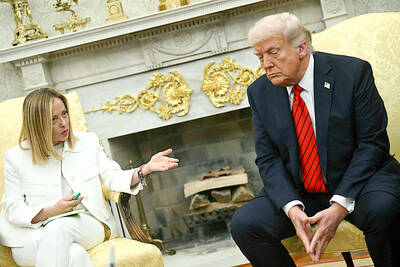
NATO ALLIES: The Italian PM accused Trump of ‘constant, unprovoked ... senseless’ attacks and said ‘my popularity is none of your concern. I suggest you focus on yours’ Italian Prime Minister Giorgia Meloni on Saturday fired back at US President Donald Trump, saying his “constant, unprovoked attacks are senseless” after he escalated a diplomatic row by accusing her of repeatedly seeking a photograph with him. The clash has opened an unusually personal rift between Trump and one of Europe’s most prominent right-wing leaders, who had sought to cast herself as a bridge between Washington and the continent during Trump’s return to power. Trump had initially told Italian broadcaster La7 that Meloni “begged” him for a picture at last week’s G7 summit in France, saying he agreed only because
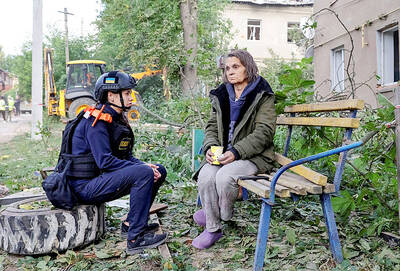
President Volodymyr Zelenskiy on Saturday said that Russian forces were preparing an impending massive attack on Ukraine and warned residents to take special care as Russian strikes in different regions killed at least six people. “Tonight and in the coming hours, it is especially important to pay close attention to air raid warnings,” Zelenskiy said in his nightly video address. “The Russians have prepared for a massive attack. Please take care of yourselves.” Russian forces have staged a series of heavy attacks on Kyiv in the past few weeks and in other major cities. Strikes on Monday last week killed
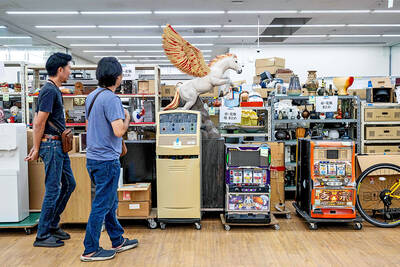
YUCK OR YUM? While it is difficult to sell second-hand goods that are more than seven years old in Japan, they are still popular in foreign markets, an executive said Under a scorching sun in a Bangkok suburb, a whistle blew, and shouts filled the air as dozens of shoppers rushed into a warehouse bearing the sign “Japanese Second-Hand Store.” From bags and bicycles to surfboards and suitcases, the Japanese second-hand market is booming, with quality-conscious buyers in other Asian countries increasingly tapping into the circular economy trend. “What is considered garbage for them can still be useful in Thailand,” said 36-year-old Lookpoo Sathitpanyapon, who runs an online store selling toy keychains. “That bag, that bag,” one shopper shouted while racing through the warehouse, filled with everything from colorful toys


 RSS
RSS