


Mango farmers in Pakistan say production of the prized fruit has fallen by up to 40 percent in some areas because of high temperatures and water shortages in a country identified as one of the most vulnerable to climate change.
The arrival of mango season in Pakistan is eagerly anticipated, with about two dozen varieties arriving through the hot, humid summers. This year, however, temperatures rose sharply in March — months earlier than usual — followed by heatwaves that damaged crops and depleted water levels in canals that farmers depend on for irrigation.
“Usually I pick 24 truckloads of mangoes... this year I have only got 12,” Fazle Elahi said while counting the bags lined up by his farm. “We are doomed.”
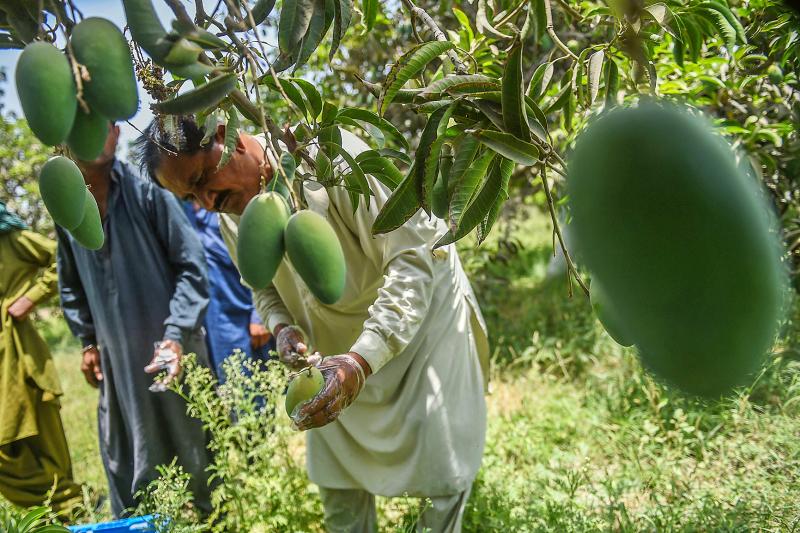
Photo: AFP
The country is among the world’s top exporters of mangoes, harvesting nearly 2 million tonnes annually across southern parts of Punjab and Sindh provinces.
The total harvest is yet to be measured, but production is already short by at least 20 to 40 percent in most areas, Sindh Agriculture Department Deputy Director Gohram Baloch said.
Umar Bhugio, who owns swaths of orchards outside Mirpur Khas — locally known as the city of mangoes — said his crops received less than half the usual amount of water this year.
“Mango growers confronted two problems this year. One was the early rise in temperatures, and secondly the water shortage,” he said.
Pakistan is one of the most water-stressed countries in the world, a problem made worse by poor infrastructure and mismanagement of resources. It also ranks as the country eighth most-vulnerable to extreme weather due to climate change, according to the Global Climate Risk Index compiled by environmental group Germanwatch.
Floods, droughts and cyclones in the past few years have killed and displaced thousands, destroyed livelihoods and damaged infrastructure.
“The early rise of temperatures increased the water intake by crops. It became a contest among different crops for water consumption,” Sustainable Development Policy Institute executive director Abid Suleri said.
A rise in temperature is generally expected in the mango belt in early May, which helps the fruit ripen before picking starts in June and July.
However, the arrival of summer as early as March damaged the mango flowers, a key part of the reproductive cycle.
“The mango should weigh over 750 grams, but this year we picked very undersized fruit,” Elahi said.
Known in South Asia as the “king of fruits,” the mango originated in the Indian subcontinent.
The country’s most treasured variety is the golden-yellow Sindhri, known for its rich flavor and juicy pulp.

An American scientist convicted of lying to US authorities about payments from China while he was at Harvard University has rebuilt his research lab in Shenzhen, China, to pursue technology the Chinese government has identified as a national priority: embedding electronics into the human brain. Charles Lieber, 67, is among the world’s leading researchers in brain-computer interfaces. The technology has shown promise in treating conditions such as amyotrophic lateral sclerosis and restoring movement in paralyzed people. It also has potential military applications: Scientists at the Chinese People’s Liberation Army have investigated brain interfaces as a way to engineer super soldiers by boosting

Indonesian police have arrested 13 people after shocking images of alleged abuse against small children at a daycare center went viral, sparking outrage across the nation, officials said on Monday. Police on Friday last week raided Little Aresha, a daycare center in Yogyakarta on Java island, following a report from a former employee. CCTV footage circulating on social media showed children, most younger than two, lying on the floor wearing only diapers, their hands and feet bound with rags. The police have confirmed that the footage is authentic. Police said they also found 20 children crammed into a room just 3m by 3m. “So
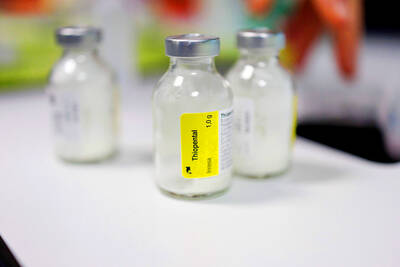
A grieving mother has ended her life at a clinic in Switzerland four years after the death of her only child. Wendy Duffy, 56, a physically healthy woman, died at the Pegasos clinic in Basel after struggling to cope with the death of her 23-year-old son, Marcus. The former care worker, from the West Midlands, England, had previously attempted to take her own life. The case comes as assisted dying would not become law in England and Wales after proposed legislation, branded “hopelessly flawed” by opponents, ran out of time. Ruedi Habegger, the founder of Pegasos, described Duffy’s death as

From post offices and parks to stations and even the summit of Mount Fuji, Japan’s vending machines are ubiquitous, but with the rapid pace of inflation cooling demand for their drinks, operators are being forced to rethink the business. Last month beverage giant DyDo Group Holdings announced it would remove about 20,000 vending machines — about 7 percent of their stock nationwide — by January next year, to “reconstruct a profitable network.” Pokka Sapporo Food & Beverage, based in Nagoya, also said last month it would sell its 40,000-machine operation to Osaka-based Lifedrink Co. “The strength of the vending machine


 RSS
RSS