


New Zealand stargazers were left puzzled and awed by strange, spiraling light formations in the night sky on Sunday night.
At about 7:25pm, Alasdair Burns, a stargazing guide on Stewart Island, also called Rakiura, received a text from a friend saying to go outside and look at the sky.
He went out and saw a huge, blue spiral of light amid the darkness.
“It looked like an enormous spiral galaxy, just hanging there in the sky,” Burns said. “Quite an eerie feeling.”
“We quickly banged on the doors of all our neighbors to get them out as well. And so there were about five of us, all out on our shared veranda looking up and just kind of, well, freaking out just a little bit,” he said.
The country’s stargazing and amateur astronomy social media groups lit up with people posting photographs and questions about the phenomenon, which was visible from most of the South Island. Theories abounded, from UFOs to foreign rockets to commercial light displays.
The reality was likely a little more prosaic, said Richard Easther, a physicist at Auckland University, who called the phenomenon “weird but easily explained.”
Clouds of that nature sometimes occur when a rocket carries a satellite into orbit, he said.
“When the propellant is ejected out the back, you have what’s essentially water and carbon dioxide that briefly forms a cloud in space — that’s illuminated by the sun,” Easther said.
“The geometry of the satellite’s orbit and also the way that we’re sitting relative to the sun — that combination of things was just right to produce these completely wacky looking clouds that were visible from the South Island,” he said.
Easther said the rocket in question was likely the Globalstar launch from SpaceX, which the company sent into low-earth orbit from Florida on Sunday.
Burns had guessed the spiral was likely a rocket, having read about a similar phenomenon in 2009, when a Russian missile launch created huge blue spirals over Norway.
“None of us had ever seen anything like that before. It was spectacular,” he said.

Through the noise of rushing papers and whirring belts at a print factory in Kyoto, two creators watch their photo essay come to life in broadsheet form — part of an effort to win new audiences in the age of artificial intelligence (AI). Despite the decline of the publishing industry, self-publication and handmade “zine” magazines are growing in popularity in Japan, reflecting the nation’s enduring love of paper in the digital era. While speaking to Agence France-Presse at the plant, his hands black with ink, one of the creators, Kazuma Obara, said: “I think [paper] is a medium that engages all five
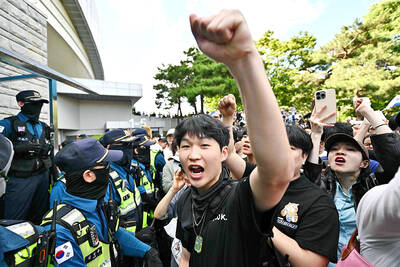
‘ABSURD MISTAKE’: The election commission said that there had been a failure to anticipate turnout after 14 polling stations ran short of ballot papers South Korean riot police yesterday cleared protesters from a Seoul polling station after a 35-hour blockade sparked by a shortage of ballot papers during local elections earlier this week. Wednesday’s election was the first nationwide vote since South Korean President Lee Jae-myung took office following the ouster of Yoon Suk-yeol over his short-lived martial law declaration. Lee’s ruling Democratic Party swept most races, but failed to flip the crucial Seoul mayoral seat. The South Korean National Election Commission apologized, blaming a failure to anticipate turnout after 14 polling stations in Seoul ran short of ballot papers. Some polling stations stayed open until 10pm to
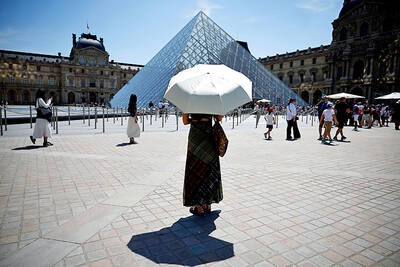
France experienced its hottest spring on record, the French weather service said on Tuesday, after an exceptional early heat wave that also broke highs for the season in England and Wales. Meteo-France said the average nationwide temperature over March to May was 13.8°C — about 1.7°C above the norm, and surpassing records set in 2011 and 2020. “The warmest spring since records began in 1900,” it said in a bulletin. All three months were warmer than average, but the onset of an “unprecedented heatwave” late last month pushed the mercury to highs typically seen at the height of the summer. “Our country had never

A Sherpa guide was found crawling to base camp on Mount Everest a week after he went missing and was reunited with his family, who had given up hope he would return. Dawa Sherpa was last seen on Friday last week descending the mountain, but he did not reach base camp even though his client did. The pair were among the last climbers on the mountain as the climbing season came to an end and the route was dismantled. Dawa was located by a cleaning crew on Thursday morning as he was crawling down the snowy slopes around the Khumbu Icefall, just above


 RSS
RSS