


Pakistan and India have fought three wars and countless skirmishes, but their people are united by love for a cooling 115-year-old pink libation with a secret recipe.
The ultra-sweet concoction of herbs and fruits, Rooh Afza — which translates as “refresher of the soul” — has not only survived the 1947 partition of the two countries, but thrived on both sides of the border.
On a furnace-hot recent day in Old Delhi, a formidable vendor named Firoza chops up in a metal cauldron an ice block delivered to her by motorbike down the tight alleyways.
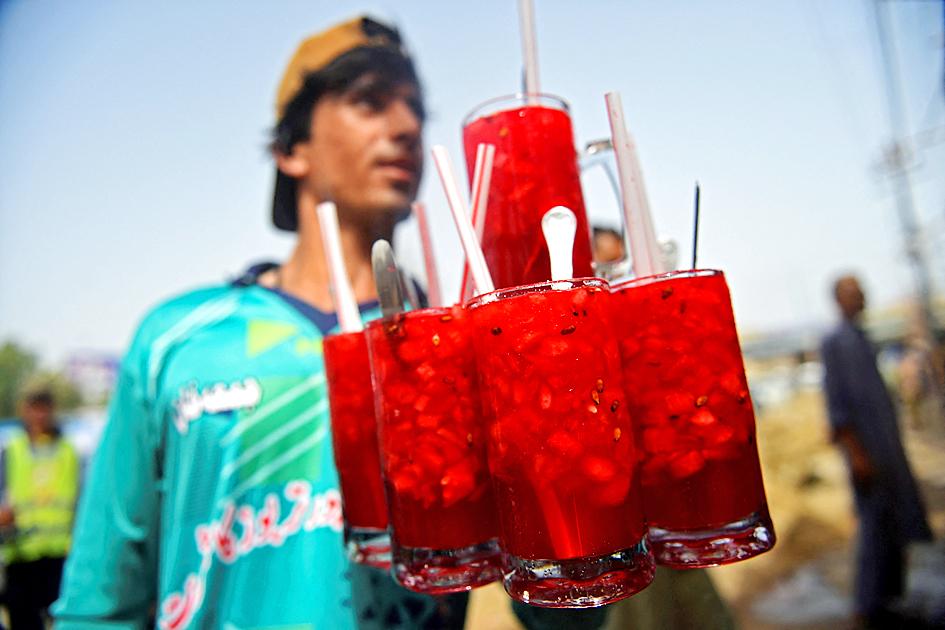
Photo: AFP
She then stabs the top of a bottle of Rooh Afza and squeezes in the viscous, lipstick-red concentrate before attacking a milk carton and adding that too, along with pieces of watermelon.
This is the 50-year-old’s own special version, “Sharbat e Mohabbat” (“Drink of Love”) — every vendor has their own — which she sells for 20 rupees (US$0.25) per plastic goblet.
“We use more than 12 bottles of Rooh Afza and 20 boxes of milk, even 30 at times, and up to 40 when business is good,” Firoza told reporters in her booming voice, hoarse from hawking her elixir.
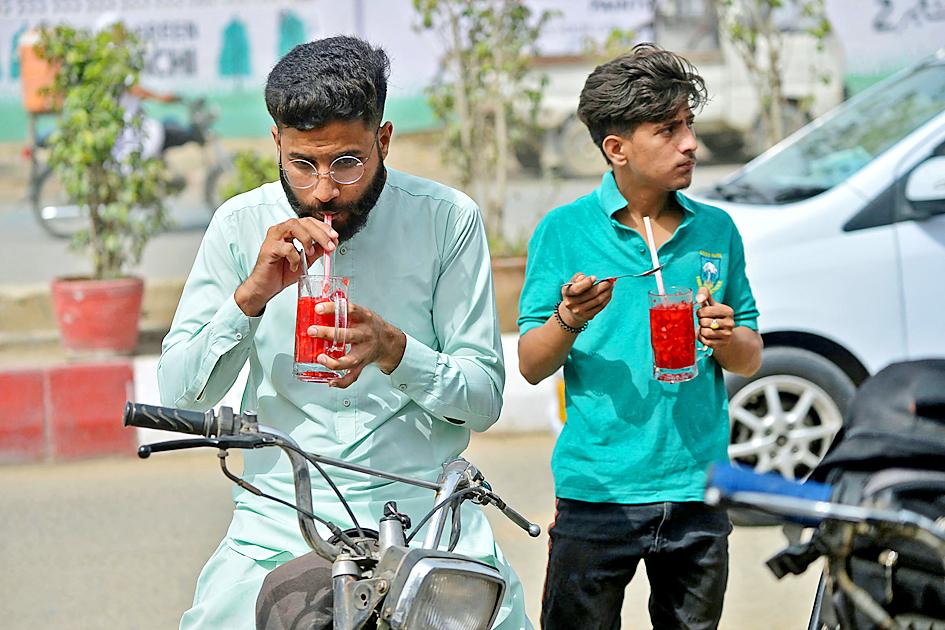
Photo: AFP
“I took over this shop a decade ago when my husband passed away,” she said. “He started selling Rooh Afza here some 40, 50 years ago. It’s my only source of income.”
In Pakistan, the drink is a particular favorite during the month of Ramadan, when it is served as an evening thirst-quencher with the Iftar feast, when Muslims break their fast.
However, served in desserts, milk and custards, it remains popular throughout Pakistan’s summer season, during which temperatures can reach 50°C.
At one roadside stall in the megacity of Karachi, owner Muhammad Akram handles a hectic cash flow of dog-eared banknotes proffered by eager customers.
“A homeless man once suggested that if I blended Rooh Afza with diced watermelon, it would be delicious,” he told reporters. “The taste was marvellous.”
At the same stall, Abdul Qahar works 12-hour shifts commanding a dozen staff serving tankards of Rooh Afza brimming with chunks of ruby watermelon, topped with a date and speared with a straw.
“It soothes the spirit,” said 25-year-old housewife Neelam Fareed, who traveled 5km on a moped with her husband just for a drink.
Rooh Afza was first sold in 1907 in Old Delhi, the congested heart of the Indian capital, by Hakim Hafiz Abdul Majeed, a traditional healing practitioner.
In 1947, with the partition of British India, one son stayed in Delhi while the other departed for the then-new Pakistan.
They set up factories in each country — as well as one in East Pakistan, which became Bangladesh in 1971 after a bloody independence war — under two firms, Hamdard India and Hamdard Pakistan.
Hamid Ahmed, a great-grandson of the founder, who runs the Indian business, said that the recipe has not changed in the past 115 years.
“It’s a big secret; even the people at the factory will not know it... There would be, I think, three people who would know it,” the 45-year-old told reporters with a chuckle.
Apart from being served ice cold, the drink’s blend of fruits and herbs is thought to help with the northern subcontinent’s dusty summer winds, which are known as the loo.
“I think with global warming, temperatures are increasing ... the relevance of Rooh Afza is not going anywhere soon,” Ahmed said. “Sales are increasing.”

An American scientist convicted of lying to US authorities about payments from China while he was at Harvard University has rebuilt his research lab in Shenzhen, China, to pursue technology the Chinese government has identified as a national priority: embedding electronics into the human brain. Charles Lieber, 67, is among the world’s leading researchers in brain-computer interfaces. The technology has shown promise in treating conditions such as amyotrophic lateral sclerosis and restoring movement in paralyzed people. It also has potential military applications: Scientists at the Chinese People’s Liberation Army have investigated brain interfaces as a way to engineer super soldiers by boosting

Jailed media entrepreneur Jimmy Lai (黎智英) has been awarded Deutsche Welle’s (DW) freedom of speech award for his contribution to Hong Kong’s pro-democracy movement. The German public broadcaster on Thursday said Lai would be presented in absentia with the 12th iteration of the award on June 23 at the DW Global Media Forum in Bonn. Deutsche Welle director-general Barbara Massing praised the 78-year-old founder of the now-shuttered news outlet Apple Daily for standing “unwaveringly for press freedom in Hong Kong at great personal risk.” “With Apple Daily, he gave journalists a platform for free reporting and a voice to the democracy movement in
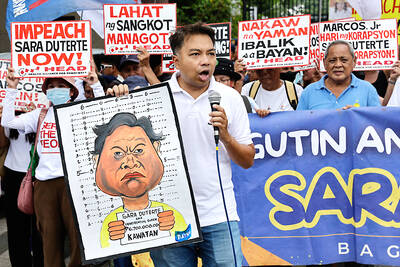
PHILIPPINE COMMITTEE: The head of the committee that made the decision said: ‘If there is nothing to hide, there is no reason to hide, there is no reason to obstruct’ A Philippine congressional committee on Wednesday ruled that there was “probable cause” to impeach Philippine Vice President Sara Duterte after hearing allegations of unexplained wealth, misuse of state funds and threats to have the president assassinated. The unanimous decision of the 53-member committee in the Philippine House of Representatives sends the two impeachment complaints to deliberations and voting by the entire lower chamber, which has more than 300 lawmakers. The complaints centered on Duterte’s alleged illegal use and mishandling of intelligence funds from the vice president’s office, and from her time as education secretary under Philippine President Ferdinand Marcos Jr. Duterte and the

Burmese President Min Aung Hlaing yesterday cut all prisoners’ sentences by one-sixth, a blanket measure that a source close to deposed leader Aung San Suu Kyi said would further shorten her detention. Aung San Suu Kyi has been sequestered since a 2021 military coup, but the senior member of her dissolved National League for Democracy (NLD) party said that while her term had been reduced, her remaining sentence is still unclear. “We also don’t know exactly how many years she has left,” the source told reporters, speaking on condition of anonymity for security reasons. The military toppled Aung San Suu Kyi’s elected government


 RSS
RSS