


Samoan Prime Minister Fiame Naomi Mata’afa has suggested it was unreasonable for China to expect a Pacific trade and security deal to be rushed through this week, as she warmly welcomed the new Australian government’s climate policy.
Australian Minister for Foreign Affairs Penny Wong (黃英賢) announced during a joint press conference in Samoa yesterday that Canberra would provide it with a new Guardian-class patrol vessel to replace the one that was grounded last year.
Wong’s second visit to the region since being sworn in last week signals the intensifying competition with China for influence, although the former climate minister has emphasized she wants to listen to and respect Pacific priorities.
Fiame played down the bilateral cooperation agreements her country signed when Chinese Minister of Foreign Affairs Wang Yi (王毅) visited the country.
Fiame said the signing ceremony was for bilateral programs and projects, most of which “had started a number of years ago, and it was a formalizing process.”
“It just seemed a bit abnormal because the minister of foreign affairs was here and there was this particular proposal from the Chinese, that they were seeking regional agreement on,” Fiame told reporters yesterday.
“Our position was that you cannot have regional agreement when the region hasn’t met to discuss it, and to be called in to have that discussion and to have an expectation that there would be a comprehensive decision or outcome was something that we could not agree to,” she said.
In a setback for China, Pacific countries declined to sign up to a sweeping regional economic and security deal proposed by Beijing, after a crucial meeting of Pacific foreign ministers and their Chinese counterpart on Monday. Ten Pacific countries were to be part of the deal.
Samoa’s position was that regionwide agreements must first be taken to the Pacific Islands Forum.
Fiame said she believed Pacific countries had concluded that “we need to meet as a region to consider any proposal that is put to us by our development partners that requires a regional agreement.”
Wong, who joined Fiame for a media conference after talks in Apia, praised Samoa’s leader for her “very wise intervention” on the issue.
“Your prime minister has shown a lot of leadership and wisdom, not only now, but I think in many of her statements about the importance of robust regional architecture, respectful regional processes to deal with some of the external circumstances we all find ourselves in,” she said.
Wong said Australia believed regional security was “an issue for the Pacific family.”
While each nation is sovereign, it is important to have “collective consideration” of decisions that could “ultimately have the potential to affect the nature of the security arrangements of the region,” she said.
China’s proposed deal, which was leaked last week, covered everything from a free-trade area with the region to providing humanitarian and COVID-19 relief.
It also laid out China’s vision for a much closer relationship with the Pacific, especially on security matters, with China proposing to be involved in training police, cybersecurity, sensitive marine mapping and gaining greater access to natural resources.
After consideration of the deal was deferred on Monday, China released a “position paper on mutual respect and common development with Pacific island countries.”


Through the noise of rushing papers and whirring belts at a print factory in Kyoto, two creators watch their photo essay come to life in broadsheet form — part of an effort to win new audiences in the age of artificial intelligence (AI). Despite the decline of the publishing industry, self-publication and handmade “zine” magazines are growing in popularity in Japan, reflecting the nation’s enduring love of paper in the digital era. While speaking to Agence France-Presse at the plant, his hands black with ink, one of the creators, Kazuma Obara, said: “I think [paper] is a medium that engages all five
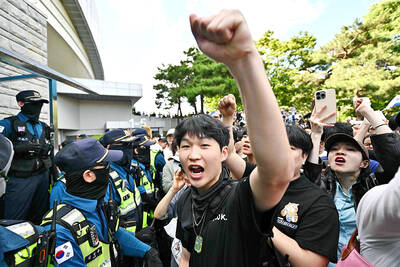
‘ABSURD MISTAKE’: The election commission said that there had been a failure to anticipate turnout after 14 polling stations ran short of ballot papers South Korean riot police yesterday cleared protesters from a Seoul polling station after a 35-hour blockade sparked by a shortage of ballot papers during local elections earlier this week. Wednesday’s election was the first nationwide vote since South Korean President Lee Jae-myung took office following the ouster of Yoon Suk-yeol over his short-lived martial law declaration. Lee’s ruling Democratic Party swept most races, but failed to flip the crucial Seoul mayoral seat. The South Korean National Election Commission apologized, blaming a failure to anticipate turnout after 14 polling stations in Seoul ran short of ballot papers. Some polling stations stayed open until 10pm to

France experienced its hottest spring on record, the French weather service said on Tuesday, after an exceptional early heat wave that also broke highs for the season in England and Wales. Meteo-France said the average nationwide temperature over March to May was 13.8°C — about 1.7°C above the norm, and surpassing records set in 2011 and 2020. “The warmest spring since records began in 1900,” it said in a bulletin. All three months were warmer than average, but the onset of an “unprecedented heatwave” late last month pushed the mercury to highs typically seen at the height of the summer. “Our country had never

A Sherpa guide was found crawling to base camp on Mount Everest a week after he went missing and was reunited with his family, who had given up hope he would return. Dawa Sherpa was last seen on Friday last week descending the mountain, but he did not reach base camp even though his client did. The pair were among the last climbers on the mountain as the climbing season came to an end and the route was dismantled. Dawa was located by a cleaning crew on Thursday morning as he was crawling down the snowy slopes around the Khumbu Icefall, just above


 RSS
RSS