


China blasted Japan for a “selfish” claim over an area of the Pacific Ocean larger than France, reigniting a long-standing territorial fight between Asia’s two largest economies.
Japan has long claimed Okinotori, which is about halfway between Taiwan and Guam, as its southernmost island. China says it is merely a reef, and does not entitle Japan to benefits such as a 200 nautical-mile (370.4km) radius exclusive economic zone that would apply to an island under international law.
“Japan, in pursuit of selfish interest, has illegally staked claim to nearly 700,000 square kilometers of jurisdictional waters based on the tiny reef,” Chinese Ministry of Foreign Affairs spokesman Zhao Lijian (趙立堅) said on Tuesday, adding that this “undermines the overall interests of the international community.”
The uninhabited territory consists of low-lying rocks that have been augmented with concrete by Japan, in a precursor to similar, but more ambitious projects undertaken by China in the South China Sea.
Recognition of Japan’s claims could potentially constrain China’s naval activities in the area. Beijing has stepped up surveys of surrounding waters and its academics recently published a number of reports disputing Japan’s analysis, the Sankei Shimbun reported.
According to the UN Convention on the Law of the Sea (UNCLOS), rocks which cannot sustain human habitation or economic life of their own bring no entitlement to an exclusive economic zone or continental shelf. Artificial islands do not have a territorial sea of their own under the law.
An international tribunal ruled in 2016 that China’s own efforts to assert control over the South China Sea, partly through territorial claims stemming from artificial islands, exceeded its legal rights under the UNCLOS. China refused to accept the ruling on procedural grounds.
In response to questions about China’s scientific reports on Okinotori, Japanese Chief Cabinet Secretary Hirokazu Matsuno on Monday said that the country’s 2008 application to the UNCLOS Commission on the Limits of the Continental Shelf was based on plentiful scientific evidence.
South Korea also disputes Japan’s claims.


Through the noise of rushing papers and whirring belts at a print factory in Kyoto, two creators watch their photo essay come to life in broadsheet form — part of an effort to win new audiences in the age of artificial intelligence (AI). Despite the decline of the publishing industry, self-publication and handmade “zine” magazines are growing in popularity in Japan, reflecting the nation’s enduring love of paper in the digital era. While speaking to Agence France-Presse at the plant, his hands black with ink, one of the creators, Kazuma Obara, said: “I think [paper] is a medium that engages all five
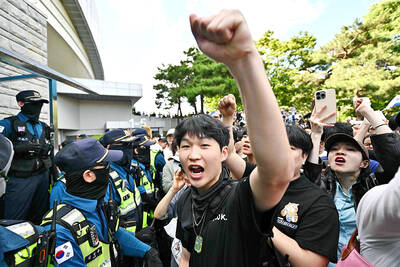
‘ABSURD MISTAKE’: The election commission said that there had been a failure to anticipate turnout after 14 polling stations ran short of ballot papers South Korean riot police yesterday cleared protesters from a Seoul polling station after a 35-hour blockade sparked by a shortage of ballot papers during local elections earlier this week. Wednesday’s election was the first nationwide vote since South Korean President Lee Jae-myung took office following the ouster of Yoon Suk-yeol over his short-lived martial law declaration. Lee’s ruling Democratic Party swept most races, but failed to flip the crucial Seoul mayoral seat. The South Korean National Election Commission apologized, blaming a failure to anticipate turnout after 14 polling stations in Seoul ran short of ballot papers. Some polling stations stayed open until 10pm to
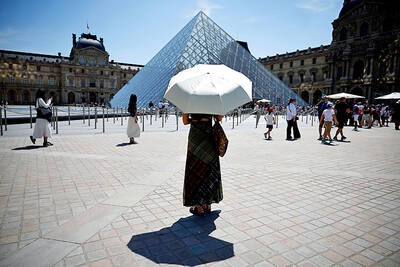
France experienced its hottest spring on record, the French weather service said on Tuesday, after an exceptional early heat wave that also broke highs for the season in England and Wales. Meteo-France said the average nationwide temperature over March to May was 13.8°C — about 1.7°C above the norm, and surpassing records set in 2011 and 2020. “The warmest spring since records began in 1900,” it said in a bulletin. All three months were warmer than average, but the onset of an “unprecedented heatwave” late last month pushed the mercury to highs typically seen at the height of the summer. “Our country had never

A Sherpa guide was found crawling to base camp on Mount Everest a week after he went missing and was reunited with his family, who had given up hope he would return. Dawa Sherpa was last seen on Friday last week descending the mountain, but he did not reach base camp even though his client did. The pair were among the last climbers on the mountain as the climbing season came to an end and the route was dismantled. Dawa was located by a cleaning crew on Thursday morning as he was crawling down the snowy slopes around the Khumbu Icefall, just above


 RSS
RSS