


China’s foreign minister yesterday arrived on the Pacific nation of Kiribati, where the future of a vast fishing ground is at stake.
The planned four-hour visit by Chinese Minister of Foreign Affairs Wang Yi (王毅) was his second stop on an eight-nation tour amid growing concerns about Beijing’s military and financial ambitions in the South Pacific region.
Kiribati closed its borders this year as it tries to stamp out an outbreak of COVID-19, but its government made a rare exception to allow Wang and his 20-person delegation into the country for face-to-face discussions.
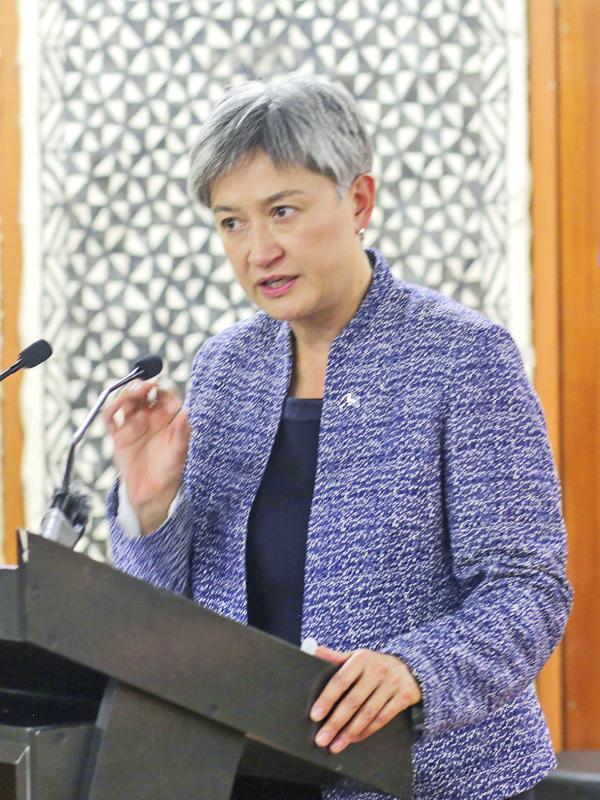
Photo: AP
At stake in Kiribati is the future of the Phoenix Islands Protected Area, a stretch of ocean the size of California that is a UNESCO World Heritage site.
In November last year, Kiribati President Taneti Maamau announced the government planned to end the commercial fishing ban that had been in place since 2015 and begin to sustainably fish the area.
Anna Powles, a senior lecturer in security studies at New Zealand’s Massey University, said she expected there would be some fisheries agreements between China and Kiribati that would come from Wang’s visit.
Powles said China, which already dominates fishing in the region, had offered to upgrade an airport runway and causeway in the Phoenix Islands.
“The worry is that this would essentially obliterate the fish stock,” she said. “That it would severely damage fish stocks that are already under pressure.”
She said there were also concerns that any kind of base for Chinese commercial fishing fleets in Kiribati could also be used as an additional hub for Beijing’s surveillance activities.
Kiribati’s president said that Wang would visit his residence for bilateral discussions during the visit, and emphasized the health protocols that were in place.
Maamau said in a statement that the Chinese delegation would need to take polymerase chain reaction tests before arriving and stay in a travel bubble while there, and that everybody who came into contact with them would need to quarantine afterward for a week — presumably including himself.
“The high-level state visit is an important milestone for Kiribati-China relations, as it will strengthen and promote partnership and cooperation between our two countries after the resumption of diplomatic ties in 2019,” Maamau said, in reference to the year it switched diplomatic allegiance from Taiwan to China.
A draft document showed that Wang is hoping to strike a deal with 10 Pacific nations during his visit. The sweeping agreement covers everything from security to fisheries and is seen by at least one Pacific leader as an attempt by Beijing to wrest control of the region.
Wang is hoping the countries would endorse the pre-written agreement as part of a joint communique after a May 30 meeting in Fiji with the other foreign ministers.
Australian Minister of Foreign Affairs Penny Wong (黃英賢) yesterday met with Fijian Prime Minister Frank Bainimarama.
Australian Prime Minister Anthony Albanese on Thursday said he had sent Wong to Fiji because Australia needed to “step up” its efforts in the Pacific.
“We need to respond to this, because this is China seeking to increase its influence in the region of the world where Australia has been the security partner of choice since the Second World War,” he told the Australian Broadcasting Corp.

‘IN A DIFFERENT PLACE’: The envoy first visited Shanghai, where he attended a Chinese basketball playoff match, and is to meet top officials in Beijing tomorrow US Secretary of State Antony Blinken yesterday arrived in China on his second visit in a year as the US ramps up pressure on its rival over its support for Russia while also seeking to manage tensions with Beijing. The US diplomat tomorrow is to meet China’s top brass in Beijing, where he is also expected to plead for restraint as Taiwan inaugurates president-elect William Lai (賴清德), and to raise US concerns on Chinese trade practices. However, Blinken is also seeking to stabilize ties, with tensions between the world’s two largest economies easing since his previous visit in June last year. At the
Nearly half of China’s major cities are suffering “moderate to severe” levels of subsidence, putting millions of people at risk of flooding, especially as sea levels rise, according to a study of nationwide satellite data released yesterday. The authors of the paper, published by the journal Science, found that 45 percent of China’s urban land was sinking faster than 3mm per year, with 16 percent at more than 10mm per year, driven not only by declining water tables, but also the sheer weight of the built environment. With China’s urban population already in excess of 900 million people, “even a small portion

UNSETTLING IMAGES: The scene took place in front of TV crews covering the Trump trial, with a CNN anchor calling it an ‘emotional and unbelievably disturbing moment’ A man who doused himself in an accelerant and set himself on fire outside the courthouse where former US president Donald Trump is on trial has died, police said yesterday. The New York City Police Department (NYPD) said the man was declared dead by staff at an area hospital. The man was in Collect Pond Park at about 1:30pm on Friday when he took out pamphlets espousing conspiracy theories, tossed them around, then doused himself in an accelerant and set himself on fire, officials and witnesses said. A large number of police officers were nearby when it happened. Some officers and bystanders rushed
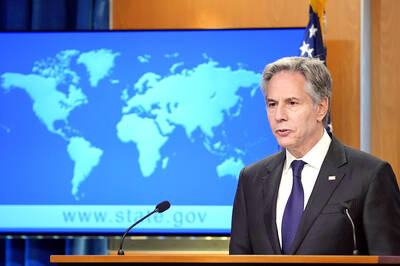
Beijing is continuing to commit genocide and crimes against humanity against Uyghurs and other Muslim minorities in its western Xinjiang province, U.S. Secretary of State Antony Blinken said in a report published on Monday, ahead of his planned visit to China this week. The State Department’s annual human rights report, which documents abuses recorded all over the world during the previous calendar year, repeated language from previous years on the treatment of Muslims in Xinjiang, but the publication raises the issue ahead of delicate talks, including on the war in Ukraine and global trade, between the top U.S. diplomat and Chinese


 RSS
RSS