


Thousands of COVID-19-negative Beijing residents were forcibly relocated to quarantine hotels overnight due to a handful of infections, as the Chinese capital begins to take more extreme control measures resembling virus-hit Shanghai.
Beijing has been battling its worst outbreak since the COVID-19 pandemic started. The Omicron variant of SARS-CoV-2 has infected more than 1,300 since late last month, leading city restaurants, schools and tourist attractions to be closed indefinitely.
China’s strategy to achieve zero COVID-19 cases includes strict border closures, lengthy quarantines, mass testing and rapid, targeted lockdowns.
More than 13,000 residents of the locked-down Nanxinyuan residential compound in southeast Beijing were relocated to quarantine hotels overnight on Friday due to 26 new infections discovered in the past few days, according to photographs and a government notice widely shared on social media.
“Experts have determined that all Nanxinyuan residents undergo centralized quarantine beginning midnight May 21 for seven days,” authorities from Chaoyang district said on Friday. “Please cooperate, otherwise you will bear the corresponding legal consequences.”
Social media photos showed hundreds of residents with luggage lining up in the dark to board buses parked outside the compound.
“Some of us have been locked down for 28 days since April 23, and we all tested negative throughout,” one resident wrote on Sina Weibo. “A lot of my neighbors are elderly or have young children.”
“The transfer really makes us feel like we’re in a wartime scene,” resident and real estate blogger Liu Guangyu posted on Weibo early yesterday.
Residents were told to pack their clothes and essential belongings, and that their homes would be disinfected afterward, according to screenshots shared on Weibo.
Last month, thousands of negative Shanghai residents were bused to makeshift quarantine centers hundreds of kilometers away as the metropolis of 25 million doubled down on efforts to contain the spread of the virus.
Weibo users expressed widespread anxiety that Beijing authorities were taking a similar approach to Shanghai, where residents have chafed under a months-long lockdown that has denied many people adequate access to food and medical care.
The Weibo hashtag “All residents of Nanxinyuan compound were dragged to quarantine” was blocked by yesterday morning.
“This is exactly the same as Shanghai, the first step is to cut off water and electricity, then demand keys ... then disinfect homes. Electrical appliances, wooden furniture, clothes, food — they’re all done for,” read one comment.
Beijing authorities yesterday extended work from home guidance to one more district, one day after halting the vast majority of public bus and subway services.

Crowds in Bangladesh are flocking to snap photographs with an unlikely social media star — an albino buffalo with flowing blond hair nicknamed “Donald Trump” that is due to be sacrificed within days. Owner Zia Uddin Mridha, 38, said his brother named the 700kg bull over its flowing helmet of hair resembling the signature look of the US president. “My younger brother picked this name because of the buffalo’s extraordinary hair,” he said at his farm in Narayanganj, just outside the capital, Dhaka. Mridha said that a constant stream of curious visitors — social media fans, onlookers and children — have come throughout

It began as a satirical online project. Now millions of young people in India are flocking to it as an outlet for their frustration. A parody political party called the Cockroach Janta Party, with the insect as its symbol, has exploded across India’s social media by turning absurdist humor into protest. Memes and short videos mocking corruption, joblessness and political dysfunction have flooded social media sites, where millions of users are embracing the cockroach — known for its ability to survive harsh conditions — as a tongue-in-cheek symbol of endurance. The online movement’s rise has been unusually rapid. The Cockroach Janta Party (CJP)
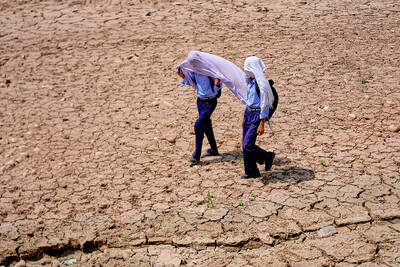
HOTTER: While Indians are accustomed to summer heat, climate change has caused northwestern India to warm faster than other parts of the country, an academic said Roads and markets have emptied during afternoons and some farmers have switched to nighttime work to avoid scorching temperatures as a heat wave grips large parts of India. The India Meteorological Department forecast maximum temperatures for yesterday of about 45°C in the capital, New Delhi, where authorities have opened temporary “cooling zones” to help people cope. The weather department warned that conditions would likely persist across several northern regions in the coming days, with temperatures staying well above seasonal averages. Authorities urged people to stay indoors during the hottest hours and take precautions against heat-related illnesses. India declares a heat wave whenever maximum temperatures

BIGGER ROLE: Beijing has said it maintains an impartial stance on the war in Ukraine, but by training Russian troops, China is far more involved than previously known China’s armed forces secretly trained about 200 Russian military personnel in China late last year, and some have since returned to fight in Ukraine, according to three European intelligence agencies and documents seen by Reuters. While China and Russia have held a number of joint military exercises since Moscow’s full-scale invasion of Ukraine in 2022, Beijing has repeatedly said that it is neutral in the conflict and presents itself as a peace mediator. The covert training sessions, which predominantly focused on the use of drones, were outlined in a dual-language Russian-Chinese agreement signed by senior Russian and Chinese officers in Beijing on


 RSS
RSS