


China’s police presence under a new security pact would boost the capabilities of the Solomon Islands, but they would not use techniques seen in Hong Kong, the Pacific island’s top diplomat to Australia said in a radio interview yesterday.
Already on guard about the pact because of concerns it gives China’s military a strategic foothold in the Pacific, Western allies are also worried that Chinese police sent there might use the same “ruthless” techniques previously used to quell protests against the government in Hong Kong.
The Solomon Islands is “beefing up their capability” after local police were unable to contain anti-government riots in the Chinatown section of the capital, Honiara, in November last year, Solomon Islands High Commissioner to Australia Robert Sisilo told ABC Radio.

Photo: AFP
Under the pact, Chinese military police could be called on, but would operate under the command of the Royal Solomon Islands Police Force — just like Australian police that have deployed there, he said.
“We will try and do our best in terms of dealing with them to make sure that what is happening in other countries where, like Hong Kong, doesn’t happen in our country,” he said.
While details of the security pact have not been disclosed, Solomon Islands Prime Minister Manesseh Sogavare has ruled out a Chinese military base and said it covers policing because an agreement with traditional partner Australia was “inadequate.”
“We are not seeking to move away from Australia, but seeking more cooperation with China,” Sisilo said.
Unemployment was a factor in the November riots, he said.
Canberra could “further advance our relations” by providing more work visas and permanent residency permits, he added.
Australia had granted 3,000 visas to Solomon Island citizens under a labor scheme that allows Pacific islanders to work in rural areas.
“If only the scheme could be extended to the whole of Australia’s metropolitan cities ... where the demand for plumbers, bricklayers, caregivers, domestic servants ... is huge,” he said.
The Solomon Islands has a population of about 700,000 and relies on foreign aid from Australia, and increasingly China, to bolster its economy.

The Bolivian government on Friday struck a deal with protesting miners, but was still grappling with blockades and demonstrations by other workers across La Paz. Other groups are still blocking access roads into the city, which is also the seat of the government. Police on Thursday prevented the miners from entering the main square by using tear gas, while the demonstrators hurled stones and explosives with slingshots. Protests against the policies of Bolivian President Rodrigo Paz have convulsed the Andean nation since early this month, and roadblocks were choking routes into La Paz throughout Friday, the national road authority said. Miners demanded that Paz
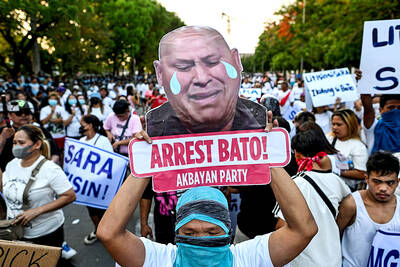
The Philippines said it has asked the country’s Supreme Court to allow it to arrest former Philippine president Rodrigo Duterte’s chief drug war enforcer to stand trial in an international tribunal. The International Criminal Court (ICC) last week unsealed an arrest warrant against Philippine Senator Ronald dela Rosa, accusing him along with Duterte and other “coperpetrators” of the “crime against humanity of murder.” Dela Rosa briefly sought refuge in the Philippine Senate last week while asking the Philippine Supreme Court to stop an ongoing attempt by government agents to arrest him. “By his own conduct, he has placed himself outside the protection of

A ship anchored off the United Arab Emirates (UAE) was seized and taken toward Iran and another — a cargo ship near Oman — sank after being attacked, authorities said on Thursday, as tensions escalated near the Strait of Hormuz. It was not immediately clear who was behind these incidents, but they happened as a senior Iranian official reiterated his country’s claim of control over the waterway and another said it had a right to seize oil tankers connected to the US. The turmoil in the strait has been a sticking point for weeks in talks between the US and Iran to

The researchers in Ireland looked at their computer screen, marveling at a medieval book tracked down in a Roman library. They flipped through its digitized pages and found their sought-after treasure: the oldest surviving English poem. “We were extremely surprised. We were speechless. We couldn’t believe our eyes when we first saw that,” said Elisabetta Magnanti, a visiting research fellow at Trinity College Dublin’s school of English. The poem was also within the main body of Latin text, she said, calling it “extraordinary.” Composed in Old English by a Northumbrian agricultural worker in the 7th century, Caedmon’s Hymn appears within some copies of


 RSS
RSS