


Japan yesterday described four disputed islands as “illegally occupied” by Russia for the first time in nearly two decades as ties sour between the countries over the war in Ukraine.
The two nations have long been engaged in attempts to agree on a post-World War II treaty, but the islands held by Moscow and claimed by Tokyo remain a key sticking point.
The Japanese Ministry of Foreign Affairs last used the expression to describe the islands, which Moscow calls the Kurils and Tokyo the Northern Territories, in its annual policy report in 2003.
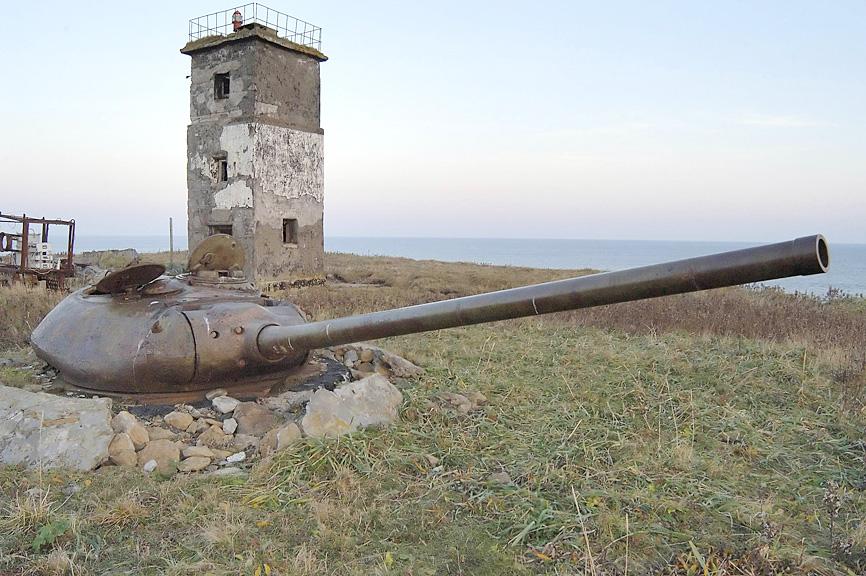
Photo: AP
This year’s Diplomatic Bluebook report comes at a time when tough sanctions are being imposed on Russia by Japan and its G7 partners, and ahead of a key revision to Japan’s national security strategy later this year.
“The greatest concern between Japan and Russia is the Northern Territories,” it said, calling them “Japanese territories over which Japan holds sovereign rights, but are currently illegally occupied by Russia.”
The ministry also said the Ukraine crisis would stall its treaty talks with Russia.
Moscow last month said it would drop the talks, citing the “impossibility” of continuing discussions, as Tokyo was “striving to cause harm to the interest of our country.”
Kremlin spokesman Dmitry Peskov yesterday said the islands are “inalienable territory of the Russian Federation.”
“At a time when Japan has become an unfriendly country and has joined in a whole series of hostile actions towards our country, it is really very difficult to talk about the continuation of the negotiation process,” he said.
The report took a cautious tone on China, although Japan has previously voiced concern over Beijing’s increasing maritime activities in the region.
“It is important to build a constructive and stable Japan-China relationship,” it said, while reiterating concern over Beijing’s “attempts to change the status quo by force in the East and South China Seas.”

‘CROSSING THE LINE’: China’s embassy in Seoul criticized US Forces Korea Commander General Xavier Brunson, asking if his ‘hostile’ remarks were authorized by Washington South Korea and the US are in talks over recent public remarks by the commander of US Forces Korea, Seoul’s presidential office said yesterday, after the comments drew sharp criticism from China. In a recent podcast interview, US Forces Korea Commander General Xavier Brunson described South Korea as “the dagger in the heart of Asia” from China’s east coast, prompting the Chinese embassy in Seoul to say that he had “truly crossed the line.” The interview came amid growing speculation that Washington might seek to expand the role of US Forces Korea in countering the growing regional influence of China, a key

Through the noise of rushing papers and whirring belts at a print factory in Kyoto, two creators watch their photo essay come to life in broadsheet form — part of an effort to win new audiences in the age of artificial intelligence (AI). Despite the decline of the publishing industry, self-publication and handmade “zine” magazines are growing in popularity in Japan, reflecting the nation’s enduring love of paper in the digital era. While speaking to Agence France-Presse at the plant, his hands black with ink, one of the creators, Kazuma Obara, said: “I think [paper] is a medium that engages all five

Australian researchers have trained lab-grown brain cells on a silicon computer chip to play the 1990s shooter game Doom and said they are just scratching the surface of what the neurons could be capable of doing. It is the science-fiction work of biotech boffins at Cortical Labs, who researched and developed the technology that harnesses the workings of the brain’s networking system. Each so-called “biological computer” contains about 200,000 living human brain cells, grown from stem cells that were harvested from blood donations. Having mastered the simple computer game Pong, where a paddle is moved up and down to send a ball

France experienced its hottest spring on record, the French weather service said on Tuesday, after an exceptional early heat wave that also broke highs for the season in England and Wales. Meteo-France said the average nationwide temperature over March to May was 13.8°C — about 1.7°C above the norm, and surpassing records set in 2011 and 2020. “The warmest spring since records began in 1900,” it said in a bulletin. All three months were warmer than average, but the onset of an “unprecedented heatwave” late last month pushed the mercury to highs typically seen at the height of the summer. “Our country had never


 RSS
RSS