


Officials ordered some Shanghai neighborhoods to throw away food they received from the government after complaints about quality issues, adding to frustration among residents locked in their homes for weeks as the city struggles to tame the country’s worst COVID-19 outbreak.
At least two districts in Shanghai’s east warned residents about problems with moldy braised duck and meatballs or issues with the packaging of food that had been distributed by the government to compounds still in lockdown, official notices seen by Bloomberg News showed.
Some residents complained on social media about stomachaches and diarrhea after eating food they had received on Wednesday. It was one of the top topics on China’s Internet yesterday, with the hashtag of netizens calling for a probe garnering more than 100 million views on Sina Weibo.
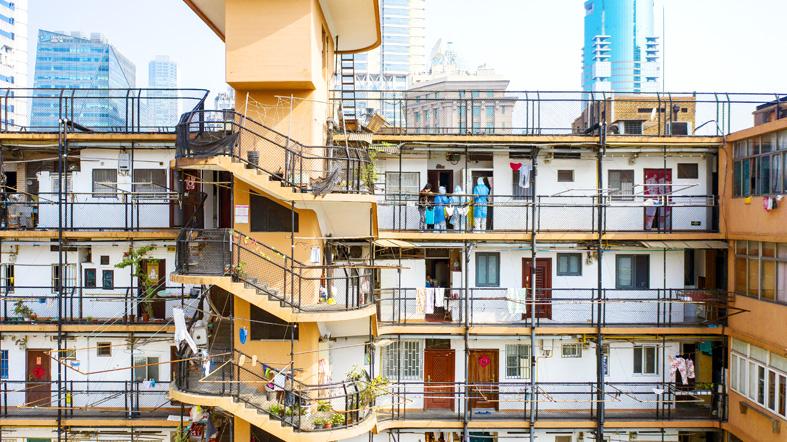
Photo: Bloomberg
Authorities have said they would investigate the issue.
Shanghai’s response to a record COVID-19 outbreak has been to impose an unprecedented lockdown that has brought a hefty social and economic toll to the financial hub. It has also spiraled into a logistical nightmare as the city’s 25 million residents — sealed off in their homes for several weeks — struggled to order basic groceries and government packages were not reliably delivered.
The simmering anger has also led to some of the strongest anti-government criticism in years from a public growing weary of harsh virus measures.
On WeChat, posts about moldy marinated duck from a manufacturer whose license has expired, and cooking oil and meatballs made by little-known producers, have circulated since Wednesday.
Pudong District, in Shanghai’s east and covering its financial district and industrial parks, has opened a probe into problems with government-distributed food packages. In the southwestern district of Minhang, two local government officials were fired earlier this week over sub-quality pork delivered to communities.
A retailer responsible for providing food to a western area yesterday issued a letter apologizing for the quality of rice noodles it distributed for the government.
“The market regulator will investigate and punish this kind of violation strictly and fast,” Tao Ailian, an official at Shanghai’s market regulator, said at a briefing on Wednesday.
The regulator has issued guidance for procuring and distributing the fresh food packages, requiring organizers and producers to ensure food safety.
The fresh gripes over food supply come as the daily case tally moderates, but deaths increase. Infections have fallen for four consecutive days to 18,495 yesterday.
Another eight people died, bringing fatalities in the current wave to 25. The number of patients in severe or critical condition tripled to 159.
While Shanghai has made tentative moves to ease restrictions in some sectors, including allowing some factories to restart operations, there is no indication of when the lockdown would be fully lifted.
About two-thirds of the city’s population remain under a lockdown that initially started in the city’s east late last month.
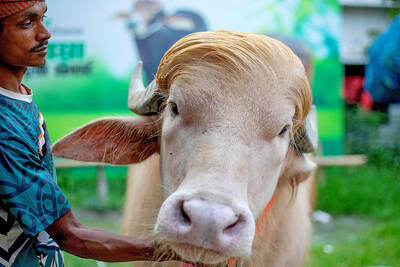
Crowds in Bangladesh are flocking to snap photographs with an unlikely social media star — an albino buffalo with flowing blond hair nicknamed “Donald Trump” that is due to be sacrificed within days. Owner Zia Uddin Mridha, 38, said his brother named the 700kg bull over its flowing helmet of hair resembling the signature look of the US president. “My younger brother picked this name because of the buffalo’s extraordinary hair,” he said at his farm in Narayanganj, just outside the capital, Dhaka. Mridha said that a constant stream of curious visitors — social media fans, onlookers and children — have come throughout

It began as a satirical online project. Now millions of young people in India are flocking to it as an outlet for their frustration. A parody political party called the Cockroach Janta Party, with the insect as its symbol, has exploded across India’s social media by turning absurdist humor into protest. Memes and short videos mocking corruption, joblessness and political dysfunction have flooded social media sites, where millions of users are embracing the cockroach — known for its ability to survive harsh conditions — as a tongue-in-cheek symbol of endurance. The online movement’s rise has been unusually rapid. The Cockroach Janta Party (CJP)

BIGGER ROLE: Beijing has said it maintains an impartial stance on the war in Ukraine, but by training Russian troops, China is far more involved than previously known China’s armed forces secretly trained about 200 Russian military personnel in China late last year, and some have since returned to fight in Ukraine, according to three European intelligence agencies and documents seen by Reuters. While China and Russia have held a number of joint military exercises since Moscow’s full-scale invasion of Ukraine in 2022, Beijing has repeatedly said that it is neutral in the conflict and presents itself as a peace mediator. The covert training sessions, which predominantly focused on the use of drones, were outlined in a dual-language Russian-Chinese agreement signed by senior Russian and Chinese officers in Beijing on
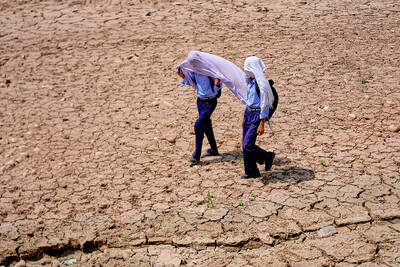
HOTTER: While Indians are accustomed to summer heat, climate change has caused northwestern India to warm faster than other parts of the country, an academic said Roads and markets have emptied during afternoons and some farmers have switched to nighttime work to avoid scorching temperatures as a heat wave grips large parts of India. The India Meteorological Department forecast maximum temperatures for yesterday of about 45°C in the capital, New Delhi, where authorities have opened temporary “cooling zones” to help people cope. The weather department warned that conditions would likely persist across several northern regions in the coming days, with temperatures staying well above seasonal averages. Authorities urged people to stay indoors during the hottest hours and take precautions against heat-related illnesses. India declares a heat wave whenever maximum temperatures


 RSS
RSS