


Shanghai yesterday reported no new cases of COVID-19 outside quarantined areas in two districts, raising hopes that the tide was turning in its battle against the epidemic, with some factories across the city making a gradual return to work.
In an event highly publicized on state media, electric vehicle company Tesla Inc resumed production at its Shanghai plant on Tuesday after a stoppage of more than three weeks.
The US automaker was on a list of 666 firms announced by the Chinese government last week that would be given priority to reopen or keep their operations running in Shanghai.
Photo: Bloomberg
Stringent lockdown measures enforced after the outbreak began early last month have left the city’s 25 million people struggling with loss of income, irregular food supplies, separation of families and poor quarantine conditions.
Shanghai health official Wu Qianyu yesterday gave them an encouraging situation report during a daily news conference.
“The city’s epidemic situation in recent days has shown a downward trend,” Wu said. “Community spread has been effectively curbed.”
While 16.3 million people are still not allowed to leave their apartments or housing compounds, 7.85 million can return to factories or walk outside — an increase of 2 million from last week, she said.
However, some people subject to looser movement restrictions say that they still need permission from neighborhood officials to go out and have been unable to obtain it.
Authorities have ramped up daily testing of residents this week, as well as transfers of positive cases and their close contacts to quarantine centers outside Shanghai.
People have shared stories on social media of busloads of residents taken from home and sent into quarantine, including babies and elderly people.
Shanghai reported 16,407 new local asymptomatic COVID-19 cases for Tuesday, down from 17,332 on Monday. Symptomatic cases fell to 2,494 from 3,084.
City authorities said that seven people infected with COVID-19 died on Tuesday.
Shanghai has reported 17 deaths since the latest outbreak began, all in the past three days.
However, several people have reported family members dying after contracting COVID-19 since early last month, but the cases had not been included in official statistics, raising doubts over their accuracy.
The Shanghai government did not immediately respond to questions regarding the death toll.
Sources told reporters that Shanghai aimed to stop the spread of COVID-19 outside quarantined areas by yesterday.
There were 390 new cases outside quarantined areas on Tuesday, down from 550 on Monday.
Two of the city’s 16 districts, Jinshan and Chongming, reported no new cases outside quarantined areas, while the case numbers reported in seven other districts were in the single digits.
Other cities that have been under lockdown began easing curbs once they halted transmission outside quarantined areas.
A key priority once life outside resumes in Shanghai is to boost lagging vaccination rates among elderly people, health officials said.
Only 62 percent of residents over the age of 60 had been fully vaccinated, with 38 percent having taken a booster.


Through the noise of rushing papers and whirring belts at a print factory in Kyoto, two creators watch their photo essay come to life in broadsheet form — part of an effort to win new audiences in the age of artificial intelligence (AI). Despite the decline of the publishing industry, self-publication and handmade “zine” magazines are growing in popularity in Japan, reflecting the nation’s enduring love of paper in the digital era. While speaking to Agence France-Presse at the plant, his hands black with ink, one of the creators, Kazuma Obara, said: “I think [paper] is a medium that engages all five
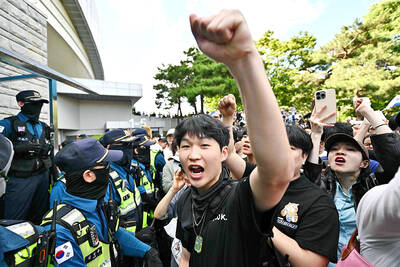
‘ABSURD MISTAKE’: The election commission said that there had been a failure to anticipate turnout after 14 polling stations ran short of ballot papers South Korean riot police yesterday cleared protesters from a Seoul polling station after a 35-hour blockade sparked by a shortage of ballot papers during local elections earlier this week. Wednesday’s election was the first nationwide vote since South Korean President Lee Jae-myung took office following the ouster of Yoon Suk-yeol over his short-lived martial law declaration. Lee’s ruling Democratic Party swept most races, but failed to flip the crucial Seoul mayoral seat. The South Korean National Election Commission apologized, blaming a failure to anticipate turnout after 14 polling stations in Seoul ran short of ballot papers. Some polling stations stayed open until 10pm to

France experienced its hottest spring on record, the French weather service said on Tuesday, after an exceptional early heat wave that also broke highs for the season in England and Wales. Meteo-France said the average nationwide temperature over March to May was 13.8°C — about 1.7°C above the norm, and surpassing records set in 2011 and 2020. “The warmest spring since records began in 1900,” it said in a bulletin. All three months were warmer than average, but the onset of an “unprecedented heatwave” late last month pushed the mercury to highs typically seen at the height of the summer. “Our country had never
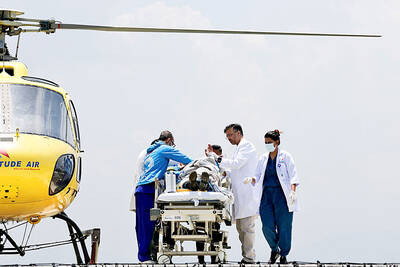
A Sherpa guide was found crawling to base camp on Mount Everest a week after he went missing and was reunited with his family, who had given up hope he would return. Dawa Sherpa was last seen on Friday last week descending the mountain, but he did not reach base camp even though his client did. The pair were among the last climbers on the mountain as the climbing season came to an end and the route was dismantled. Dawa was located by a cleaning crew on Thursday morning as he was crawling down the snowy slopes around the Khumbu Icefall, just above


 RSS
RSS