


After years spent translating Hollywood films, Russian Mila Grekova was suddenly thrown out of work after Moscow’s invasion of Ukraine.
Five Hollywood giants — Disney, Warner Bros, Universal, Sony Pictures and Paramount — have all stopped releasing new films there, leaving Russian cinemas bereft of the latest blockbusters.
However, it has not made Grekova turn against Russian President Vladimir Putin.
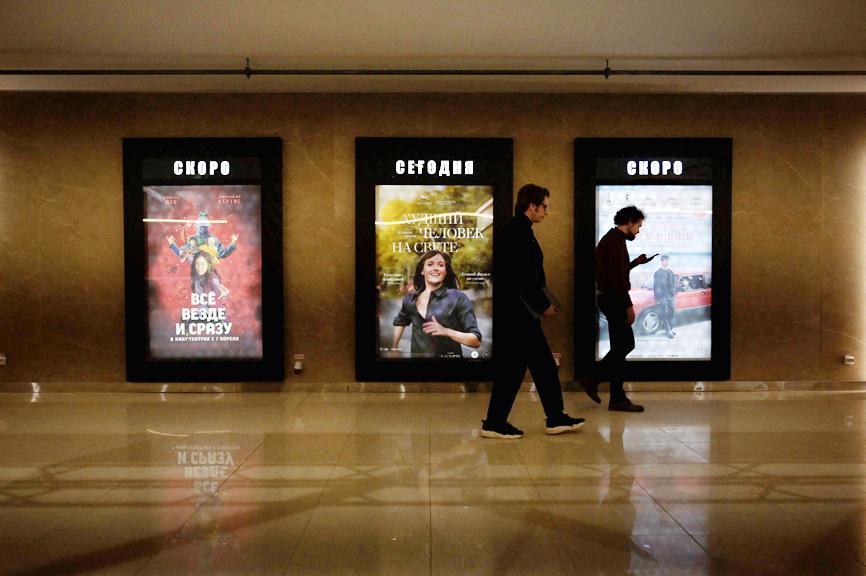
Photo: AFP
“It’s the West that I hate today and not Putin,” the 56-year-old said.
“Bollywood might replace Hollywood in Russia, but it’s too late for me to learn Hindi,” she said, referring to India’s refusal to condemn Moscow or join the West in sanctioning Russia.
Russia’s film industry has been thrown into turmoil by the fighting in Ukraine just as it was beginning to recover from the COVID-19 pandemic.
Like in many sectors hit by sanctions, the film industry is turning away from the West, looking inward to its own movies or east to Asia.
Russians are avid cinemagoers with the highest number of admission in Europe — 145.7 million cinemagoers last year, the European Audiovisual Observatory said.
Many flock to see Hollywood films, which are often dubbed instead of being shown with subtitles.
Before Hollywood’s withdrawal, Russian firm Mosfilm-Master was dubbing about 10 foreign films per month, mostly from English.
“Now we have lost two-thirds of our business,” director Yevgeny Belin said from Mosfilm-Master’s high-tech dubbing studio in Moscow.
“During the pandemic, we had films, but no cinemas open. Today, we have our cinemas, but no films,” he said.
Russia’s National Association of Cinema Owners last month said that cinemas risk losing up to 80 percent of their revenue.
Mosfilm-Master, looking to adapt, is searching for people who can translate from Korean and Mandarin, although Belin said that he “doubts that Asian films would work for Russians” because of the cultural differences.
“Westerners are closer to us,” said the 70-year-old, who has spent three decades in dubbing.
Olga Zinyakova, president of Karo, one of Russia’s leading cinema chains, said she is confident that the industry can rebuild.
“The situation is extremely difficult, but not catastrophic,” the 37-year-old said.
“Since the arrival of Hollywood in post-Soviet Russia 30 years ago, we have gone through a lot of crises: political, economic and the pandemic,” she said, surrounded by empty seats in Moscow’s Oktyabr cinema, home to Europe’s largest screening room with 1,500 seats.
Since the invasion on Feb. 24, the number of tickets sold in Karo’s 35 cinemas has fallen by 70 percent, Zinyakova said.
The Russian government has promised major financial support and tax breaks to film production and cinemas, as it looks to replace Hollywood films with more homegrown fare.
“Russians will explore themselves more deeply,” Zinyakova said, pointing to the success of Russian films from the 1990s, such as the cult movie Brat (“Brother”), which is screening again in several Moscow cinemas.
Zinyakova is also preparing to include more Asian and Latin American films among upcoming releases.
“And when Hollywood comes back, the Russian market and viewers will no longer be the same,” she said.
Pavel Doreuli, a 44-year-old sound designer who works on about 15 Russian films per year, said that it is no surprise that Hollywood has pulled out of Russia.
“World cinema has been hostage to big politics for years,” he said, adding that major film festivals such as Cannes and Berlin are no longer about art, but about promoting “certain values.”
Still, Doreuli said it would be a shame for Russia to be cut off from world cinema, citing the exclusion of official Russian delegations from this year’s Cannes Film Festival.
“If they are excluded from international festivals, Russians will give up on art house cinema that offers a different vision of the world, which is so precious today,” Doreuli added.

An American scientist convicted of lying to US authorities about payments from China while he was at Harvard University has rebuilt his research lab in Shenzhen, China, to pursue technology the Chinese government has identified as a national priority: embedding electronics into the human brain. Charles Lieber, 67, is among the world’s leading researchers in brain-computer interfaces. The technology has shown promise in treating conditions such as amyotrophic lateral sclerosis and restoring movement in paralyzed people. It also has potential military applications: Scientists at the Chinese People’s Liberation Army have investigated brain interfaces as a way to engineer super soldiers by boosting
Indonesian police have arrested 13 people after shocking images of alleged abuse against small children at a daycare center went viral, sparking outrage across the nation, officials said on Monday. Police on Friday last week raided Little Aresha, a daycare center in Yogyakarta on Java island, following a report from a former employee. CCTV footage circulating on social media showed children, most younger than two, lying on the floor wearing only diapers, their hands and feet bound with rags. The police have confirmed that the footage is authentic. Police said they also found 20 children crammed into a room just 3m by 3m. “So

Jailed media entrepreneur Jimmy Lai (黎智英) has been awarded Deutsche Welle’s (DW) freedom of speech award for his contribution to Hong Kong’s pro-democracy movement. The German public broadcaster on Thursday said Lai would be presented in absentia with the 12th iteration of the award on June 23 at the DW Global Media Forum in Bonn. Deutsche Welle director-general Barbara Massing praised the 78-year-old founder of the now-shuttered news outlet Apple Daily for standing “unwaveringly for press freedom in Hong Kong at great personal risk.” “With Apple Daily, he gave journalists a platform for free reporting and a voice to the democracy movement in

PHILIPPINE COMMITTEE: The head of the committee that made the decision said: ‘If there is nothing to hide, there is no reason to hide, there is no reason to obstruct’ A Philippine congressional committee on Wednesday ruled that there was “probable cause” to impeach Philippine Vice President Sara Duterte after hearing allegations of unexplained wealth, misuse of state funds and threats to have the president assassinated. The unanimous decision of the 53-member committee in the Philippine House of Representatives sends the two impeachment complaints to deliberations and voting by the entire lower chamber, which has more than 300 lawmakers. The complaints centered on Duterte’s alleged illegal use and mishandling of intelligence funds from the vice president’s office, and from her time as education secretary under Philippine President Ferdinand Marcos Jr. Duterte and the


 RSS
RSS