


The US, the UK and Australia on Tuesday said that they are to work together through the AUKUS security alliance to develop hypersonic missiles.
The move comes amid increasing concern among the US and its allies over China’s growing military assertiveness in the Pacific.
US President Joe Biden, British Prime Minister Boris Johnson and Australian Prime Minister Scott Morrison announced the plan after holding a check-in on the progress of AUKUS, the Indo-Pacific alliance that was launched by the three countries in September last year.
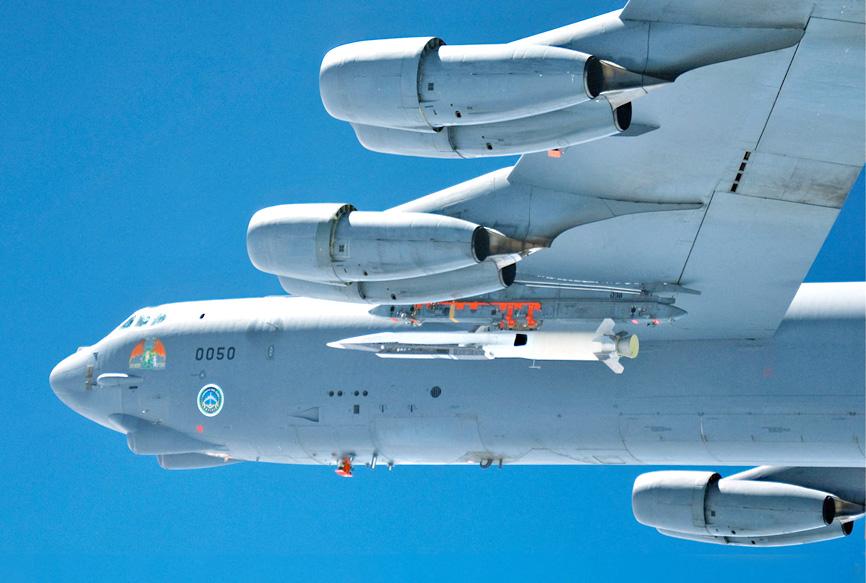
Photo: AFP / US Air Force
The leaders said in a joint statement that they are “committed today to commence new trilateral cooperation on hypersonics and counter-hypersonics and electronic warfare capabilities, as well as to expand information sharing and to deepen cooperation on defense innovation.”
The US, Russia and China have all looked to further develop hypersonic missiles — a system so fast that it cannot be intercepted by current missile defense systems.
Chairman of the US Joint Chiefs of Staff General Mark Milley in October said that China had conducted a test of a hypersonic weapon system.
Milley described the Chinese test as a “very significant event of a test of a hypersonic weapon system, and it is very concerning,” in a Bloomberg Television interview.
Russia has used hypersonic missiles “multiple” times in Ukraine, Milley said.
Last fall, as US intelligence officials became increasingly concerned about the massing of Russian forces on the Ukraine border, Russian President Vladimir Putin urged the country’s arms manufacturers to develop even more advanced hypersonic missiles to maintain the country’s edge in military technology.
The Russian military has said that its Avangard system is capable of flying 27 times faster than the speed of sound and of making sharp maneuvers on its way to a target to dodge the enemy’s missile shield.
The Avangard system has been fitted to existing Soviet-built intercontinental ballistic missiles, and the first unit armed with the system entered duty in December 2019.
The Kinzhal, carried by MiG-31 fighter jets, has a range of up to 2,000km and flies at 10 times the speed of sound, Russian officials have said.
The Pentagon’s budget request for next year includes US$4.7 billion for research and development of hypersonic weapons. It includes planning that would have a hypersonic missile battery fielded by next year, a sea-based missile by 2025 and an air-based cruise missile by 2027.
Biden, Johnson and Morrison have billed the creation of AUKUS as an opportunity to build greater sharing of defense capabilities.
As its first major action, the alliance said it would boost Australia’s defense by equipping it with nuclear-powered submarines.
Morrison said the development of hypersonic missiles fits Australia’s strategic plan released two years ago to enhance its military’s long-range strike capabilities.
“The paramount goal is to ensure we get that capability as soon as we can and it’s in the best form that can be working with our partners,” Morrison told reporters.
Australian Minister for Defence Peter Dutton earlier yesterday said that the country plans to spend US$2.6 billion to acquire long-range strike missiles for fighter jets and warships years ahead of schedule because of growing threats posed by Russia and China.
A draft security pact between the Solomon Islands and China has prompted concerns about a possible Chinese naval presence 1,930km off the northeast Australian coast.
The Solomon Islands government said that it would not allow China to build a military base there and China has denied seeking a military foothold in the islands.
LANDMARK CASE: ‘Every night we were dragged to US soldiers and sexually abused. Every week we were forced to undergo venereal disease tests,’ a victim said More than 100 South Korean women who were forced to work as prostitutes for US soldiers stationed in the country have filed a landmark lawsuit accusing Washington of abuse, their lawyers said yesterday. Historians and activists say tens of thousands of South Korean women worked for state-sanctioned brothels from the 1950s to 1980s, serving US troops stationed in country to protect the South from North Korea. In 2022, South Korea’s top court ruled that the government had illegally “established, managed and operated” such brothels for the US military, ordering it to pay about 120 plaintiffs compensation. Last week, 117 victims

China on Monday announced its first ever sanctions against an individual Japanese lawmaker, targeting China-born Hei Seki for “spreading fallacies” on issues such as Taiwan, Hong Kong and disputed islands, prompting a protest from Tokyo. Beijing has an ongoing spat with Tokyo over islands in the East China Sea claimed by both countries, and considers foreign criticism on sensitive political topics to be acts of interference. Seki, a naturalised Japanese citizen, “spread false information, colluded with Japanese anti-China forces, and wantonly attacked and smeared China”, foreign ministry spokesman Lin Jian told reporters on Monday. “For his own selfish interests, (Seki)

Argentine President Javier Milei on Sunday vowed to “accelerate” his libertarian reforms after a crushing defeat in Buenos Aires provincial elections. The 54-year-old economist has slashed public spending, dismissed tens of thousands of public employees and led a major deregulation drive since taking office in December 2023. He acknowledged his party’s “clear defeat” by the center-left Peronist movement in the elections to the legislature of Buenos Aires province, the country’s economic powerhouse. A deflated-sounding Milei admitted to unspecified “mistakes” which he vowed to “correct,” but said he would not be swayed “one millimeter” from his reform agenda. “We will deepen and accelerate it,” he

Japan yesterday heralded the coming-of-age of Japanese Prince Hisahito with an elaborate ceremony at the Imperial Palace, where a succession crisis is brewing. The nephew of Japanese Emperor Naruhito, Hisahito received a black silk-and-lacquer crown at the ceremony, which marks the beginning of his royal adult life. “Thank you very much for bestowing the crown today at the coming-of-age ceremony,” Hisahito said. “I will fulfill my duties, being aware of my responsibilities as an adult member of the imperial family.” Although the emperor has a daughter — Princess Aiko — the 23-year-old has been sidelined by the royal family’s male-only


 RSS
RSS