


Crowding, confrontations and full-on attacks. Japan’s many train fans are mostly mild-mannered enthusiasts passionate about the country’s famed railway system, but a small group is gaining surprising notoriety.
Japan’s railway system has long inspired envy around the world, with its famed punctuality, cutting-edge technology and meticulous timetables.
So it is no surprise that the country is home to a diverse landscape of train buffs, from those who enjoy poring over timetables to others who adore and even record the rumbling sound of passing trains.
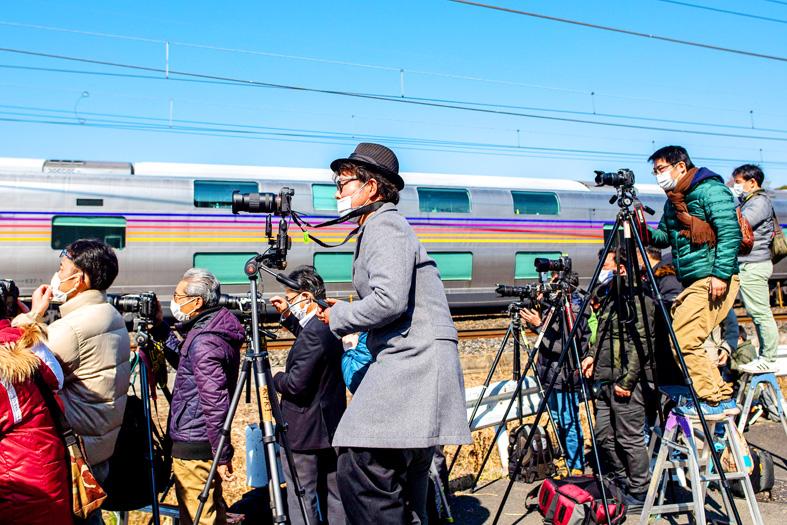
Photo: AFP
However, the perhaps best-known group is a tribe dubbed “toritetsu,” Japanese for train photographers, who strive to take perfect photographs of approaching trains.
They have been around for decades, but in the past few years, reports of shouting matches, trespassing and even violence at stations have turned toritetsu into the bad boys of Japanese trainspotting.
Some say the out-of-control behavior is not entirely new, citing frenzied farewells for retiring steam locomotives in the 1960s and 1970s, but recent incidents, including the harassment of a photobombing cyclist and an assault that left a teenager with a fractured skull last year, have some enthusiasts worried.
“The manners have gotten worse for sure,” said septuagenarian Masao Oda, who has been taking train photos for about 50 years.
It is an uncomfortable feeling for toritetsu like 27-year-old Akira Takahashi.
“People now point fingers at me,” said Takahashi, whose fondest obsession is the EF66 electric locomotive model, which he describes as his “idol.”
“The negative image of us now prevails... I don’t want to be lumped together with some of us who are causing trouble,” he said.
Most fans are more like 19-year-old Ryunosuke Takagai, a university student who has been known to get up at 5am to document his passion and sometimes takes on part-time factory work to finance his hobby.
“I love everything about trains — their sound, their atmosphere,” he said. “That moment when you succeed in capturing the train you’d spent hours waiting for is truly fulfilling.”
The increasingly raucous behavior of some toritetsu might be driven by their pursuit of the perfect photo, said Jun Umehara, a freelance railway journalist who formerly worked at one of Japan’s top train magazines.
Factors including fewer “retiring” trains and more urban development mean hobbyist photographers are squeezed into smaller spaces as they chase their dream pictures, he said.
“Every train has its last moment, which, for them, is the last missing piece of the puzzle they need to make their photo collection complete,” Umehara said. “The idea of missing that final piece is almost unbearable for them.”

When a hiker fell from a 55m waterfall in wild New Zealand bush, rescuers were forced to evacuate the badly hurt woman without her dog, which could not be found. After strangers raised thousands of dollars for a search, border collie Molly was flown to safety by a helicopter pilot who was determined to reunite the pet and the owner. A week earlier, an emergency rescue helicopter found the woman with bruises and lacerations after a fall at a rocky spot at the waterfall on the South Island’s West Coast. She was airlifted on March 24, but they were forced to

CONFIDENCE BOOSTER: ’After parkour ... you dare to do a lot of things that you think only young people can do,’ a 67-year-old parkour enthusiast said In a corner of suburban Singapore, Betty Boon vaults a guardrail, crawls underneath a slide, executes forward shoulder rolls and scales a steep slope, finishing the course to applause. “Good job,” the 69-year-old’s coach cheers. This is “geriatric parkour,” where about 20 retirees learned to tackle a series of relatively demanding exercises, building their agility and enjoying a sense of camaraderie. Boon, an upbeat grandmother, said learning parkour has aided her confidence and independence as she ages. “When you’re weak, you will be dependent on someone,” she said after sweating it out with her parkour classmates in suburban Toa Payoh,

Chinese dissident artist Gao Zhen (高兟), famous for making provocative satirical sculptures of former Chinese leader Mao Zedong (毛澤東), was tried on Monday over accusations of “defaming national heroes and martyrs,” his wife and a rights group said. Gao, 69, who was detained in 2024 during a visit from the US, faces a maximum three-year prison sentence, said his wife, Zhao Yaliang (趙雅良), and Shane Yi, a researcher at the Chinese Human Rights Defenders group which operates outside the nation. The closed-door, one-day trial took place at Sanhe City People’s Court in Hebei Province neighboring the capital, Beijing, and ended without a

‘TOXIC CLIMATE’: ‘I don’t really recognize Labour anymore... The idea that you can implement far-right ideas in order to stop the far right is nonsense,’ a protester said Tens of thousands of people on Saturday marched through central London to protest against the far right, weeks ahead of local elections and six months after Britain saw one of its largest far-right demonstrations. Organized by hundreds of civic groups, including trade unions, anti-racism campaigners and Muslim representative bodies, Saturday’s Together Alliance event was billed as the biggest in UK history to counter right-wing extremism. A separate pro-Palestinian march had also converged with the main rally. While organizers claimed 500,000 had turned out in total, the police gave a figure of about 50,000. Protesters carrying placards with slogans such as


 RSS
RSS