


Americans are paying to get a star of the psychedelic medicine movement — ketamine — shipped to them for at-home mental health treatments that are being called both a breakthrough and a gamble.
A COVID-19 pandemic-spurred easing of prescription rules helped fuel a jump in telemedicine offerings of ketamine, an anesthetic that was once a taboo party drug, but has become a buzzed-about tool against depression.
Yet long-term, large-scale studies of ketamine’s medical effects are limited, leaving some experts concerned that an unregulated online boom could result in mishaps or a regulatory crackdown.
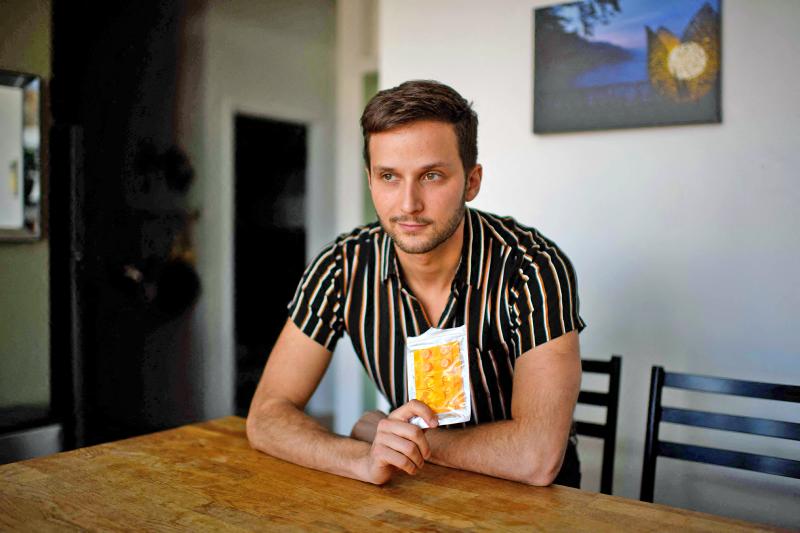
Photo: AFP
“This has to be rolled out slowly,” said Boris Heifets, a Stanford University assistant professor of anesthesiology. “The risk is that we are scaling the fix, but not the solution, which is a much more integrated approach to mental health.”
Ketamine has been available in the US since the 1970s as an anesthetic called a “dissociative” because of the hallucinogenic effects that have helped make it a rave culture drug.
It is legal for US doctors to prescribe, while some other psychedelics getting renewed attention for mental health uses like LSD or MDMA (also called ecstasy) are classified as having no medical utility and a high risk for abuse.
In this context, recent years have seen an uptick in clinics offering in-person intravenous ketamine treatments for depression, anxiety or chronic pain, although regulations and practices vary across states.
Then came the pandemic, which resulted in US authorities allowing doctors to remotely prescribe drugs like ketamine that previously required an in-person visit.
An increasing number of companies, some already doing in-clinic treatments, began offering to evaluate clients online and to send the drugs for home use to approved candidates.
Nue Life, which launched about a year ago, is one of those firms. Its CEO, Juan Pablo Cappello, estimated that it has served more than 3,000 ketamine patients so far.
“If you actually drill down on the sort of potentials for abuse here, you realize of course they exist, but we’re creating a standard of care to make that quite unlikely,” he told reporters.
For example, he said clients are instructed to have an adult “babysitter” watch over them for the roughly 90 minutes the drug experience lasts, and he reasoned that people simply looking for ketamine could get it cheaper on the street.
Clients of the service, which costs US$1,250 for a package providing six ketamine experiences, are encouraged, but not obligated to couple it with therapy, Cappello said.
“The at-home telemedicine model, I would argue, is actually safer and more effective for patients,” allowing more patients “to actually take advantage of these therapies,” he added.
Heifets said that making ketamine more available carries risks — including the chances that authorities would tighten access if an at-home treatment resulted in some sort of tragedy.
“We have very, very little evidence for our understanding of how effective ketamine is for depression at scale,” Heifets said.
Yet for people like 36-year-old New Yorker Philip Markle, who underwent an at-home treatment with a company called Mindbloom, ketamine is a profoundly useful tool.
Over his long battle with depression, the performer and comedian has tried medication, psychedelics like LSD and talk therapy since the age of 12, but found something unique in ketamine.
Rather than the short-lived sense of change other treatments provided, ketamine imparted a sense of clarity and of helpful self-acceptance — not the heavy effects he had experienced with other psychedelics.
“It felt like if any drug could be administered through the mail and you could do a psychedelic that could change your life, on your own, this would be the one,” he told reporters.

When a hiker fell from a 55m waterfall in wild New Zealand bush, rescuers were forced to evacuate the badly hurt woman without her dog, which could not be found. After strangers raised thousands of dollars for a search, border collie Molly was flown to safety by a helicopter pilot who was determined to reunite the pet and the owner. A week earlier, an emergency rescue helicopter found the woman with bruises and lacerations after a fall at a rocky spot at the waterfall on the South Island’s West Coast. She was airlifted on March 24, but they were forced to
CONFIDENCE BOOSTER: ’After parkour ... you dare to do a lot of things that you think only young people can do,’ a 67-year-old parkour enthusiast said In a corner of suburban Singapore, Betty Boon vaults a guardrail, crawls underneath a slide, executes forward shoulder rolls and scales a steep slope, finishing the course to applause. “Good job,” the 69-year-old’s coach cheers. This is “geriatric parkour,” where about 20 retirees learned to tackle a series of relatively demanding exercises, building their agility and enjoying a sense of camaraderie. Boon, an upbeat grandmother, said learning parkour has aided her confidence and independence as she ages. “When you’re weak, you will be dependent on someone,” she said after sweating it out with her parkour classmates in suburban Toa Payoh,

Chinese dissident artist Gao Zhen (高兟), famous for making provocative satirical sculptures of former Chinese leader Mao Zedong (毛澤東), was tried on Monday over accusations of “defaming national heroes and martyrs,” his wife and a rights group said. Gao, 69, who was detained in 2024 during a visit from the US, faces a maximum three-year prison sentence, said his wife, Zhao Yaliang (趙雅良), and Shane Yi, a researcher at the Chinese Human Rights Defenders group which operates outside the nation. The closed-door, one-day trial took place at Sanhe City People’s Court in Hebei Province neighboring the capital, Beijing, and ended without a

‘TOXIC CLIMATE’: ‘I don’t really recognize Labour anymore... The idea that you can implement far-right ideas in order to stop the far right is nonsense,’ a protester said Tens of thousands of people on Saturday marched through central London to protest against the far right, weeks ahead of local elections and six months after Britain saw one of its largest far-right demonstrations. Organized by hundreds of civic groups, including trade unions, anti-racism campaigners and Muslim representative bodies, Saturday’s Together Alliance event was billed as the biggest in UK history to counter right-wing extremism. A separate pro-Palestinian march had also converged with the main rally. While organizers claimed 500,000 had turned out in total, the police gave a figure of about 50,000. Protesters carrying placards with slogans such as


 RSS
RSS